From the corporate programmes I've run inside a Fortune 100 company. Client names stay private unless they tell me otherwise.

Who runs this
I'm Arvindh Sundar. Not an AI vendor. Not an engineer. I'm a facilitator who runs his own business on these tools every single day, which is a very different qualification.
Six session-days of AI enablement, delivered inside a Fortune 100 company. I design the games I run, so when a table pushes back at 2pm I can rebuild the exercise on the spot. One of those programmes came back at 8.82 out of 10 across 113 respondents.
And when somebody in your room says "yes, but that would not work for what I do" - I can usually show them, live, that it would. That is my favourite part of the day.
What an unused AI rollout actually looks like
You have probably got four of these right now. Not one of them shows up on a licence dashboard as anything except a number going sideways.
- Licences bought, a policy circulated, a launch email sent, and adoption flat after month one.
- Two or three enthusiasts using it brilliantly, and everyone else quietly not.
- People pasting things they shouldn't into tools you didn't approve, because nobody told them where the line is in a way that stuck.
- Someone sends a report AI wrote, nobody checked it, and it's wrong in a way that's now embarrassing.
- A generic vendor course was run. Everyone attended, and nobody used it on their own work afterwards.
- Your senior people won't say out loud that they don't know how to use it, so nobody fixes it for them.
Three sizes. Pick by what is actually broken.
Same spine every time. Hands on, their own real work, no code, no jargon. What changes is how far we go.
They start using it
For a team that has access and isn't using it. Short enough that you can actually release people, and it runs in batches across a large population.
- The difference between a question and a brief, practised on their own task
- A repeatable prompting method they can still remember in three weeks
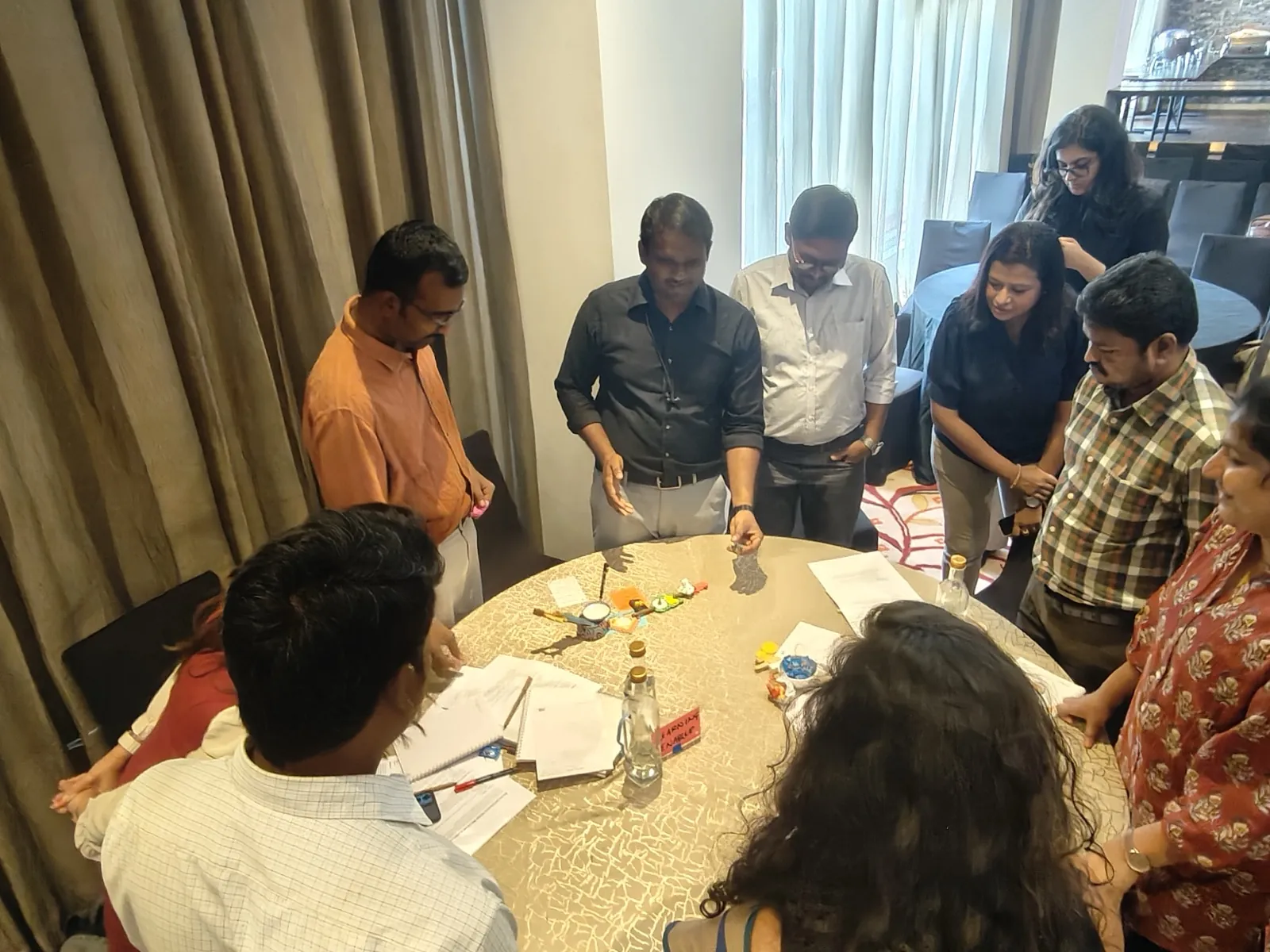
- A serious game in the middle, where the room runs a small system together and discovers what their local optimisation did to everyone else
- The tells of a confident wrong answer, and where your policy line sits in their real terms
- Each person rebuilds one repeat task before they leave
They start trusting it
For a team that uses it but can't tell good output from fluent nonsense. Everything in the half day, with room for the part three hours can't reach.
- Everything in the half day, unhurried
- Thinking in systems, not prompts - why most people's setup resets every Monday
- What these models actually are, in plain English, and why that explains the failure modes
- A second, harder task rebuilt with feedback in the room
- Where a decision must not be outsourced, worked through on their own live examples
They rebuild how they decide
For when the tool was never the real problem. Your managers can already spot what's wrong. What they can't do is get anyone to act on it. This is that, with AI doing the heavy lifting throughout.
- Separating the thing that's annoying them from the thing causing it, with AI working the evidence
- Reading a messy, multi-source pile the way the real world hands it over
- Structured divergence before convergence, so a room of eight produces eight angles
- Mapping who actually has to say yes, and building the case in their language
- The impact case in the language finance uses - the difference between "good idea" and a budget line
- 30/60/90 commitments, written and said out loud, with names against them
This one is built on Insight to Impact, my leadership decision-making programme. Its best day on record is Batch 4, Day 2, August 2026: 8.37 out of 10 across 19 respondents. I've rebuilt it so AI is the spine of both days rather than a tool that shows up occasionally. The rebuilt version is new - the 8.37 belongs to that one day of Insight to Impact, and I'd rather tell you that than let a number do work it hasn't earned.
What your people can actually do afterwards
Every one of these gets practised on their own work during the session, not demonstrated on a slide.
- Turn a vague ask into a brief that gets a usable answer - the single change that fixes most of what people complain about.
- The "make it ask you questions first" move - four words, and it quietly doubles the quality of everything that comes back.
- Hand over a two-hour reading pile and get the decision-ready version back before the coffee's cold.
- Spot a confident lie - the specific tells that show an answer is fluent and wrong, so nobody signs off on one.
- Know where the line is - what should never go into these tools, in your policy's terms, not a generic warning.
- See the whole system, not their one step - the game does this, and it's the part people quote back to me months later.
Before anyone on your team asks an AI tool anything, have them type: "Ask me 3 questions before you start." That one habit fixes most of the junk answers people complain about, because now it is working from their context instead of guessing. Send it round this afternoon and watch what happens. No charge :)
What you get as the sponsor
- Sizes that fit real calendars. Three hours is the length people actually get released for; two days is what you book when the problem is worth it.
- Batch-by-batch tuning. What batch one struggles with changes batch two. Each batch gets rebuilt on what the last one found hard - which is the argument for one person running them rather than a bench of facilitators.
- Artifacts that outlive the room - a prompt library in your own vocabulary, an agreed policy line, written commitments with names on them.
- Feedback data per batch, shared honestly, including the criticisms.
- Built around your approved tools and your real policy limits, including what's explicitly off the table.
- A debrief with me on what the room revealed - where the work is actually getting stuck.
Honestly, who this is and isn't for
This is for you if
- You've given people AI access and adoption has stalled.
- Your population is non-technical and mixed in seniority.
- You want behaviour change, not attendance numbers.
- You'll let real work into the room.
This is not for you if
- Your audience is engineers wanting technical depth.
- You want a recorded module people click through alone.
- You need certification more than you need usage.
- Nobody is allowed to bring real work in.
Tell me what is actually broken
Three things is all I need. Roughly how many people, which AI tools they are allowed to use, and what you have already tried. I will come back with the size I would recommend and a number. And if none of the three fit your problem, I will tell you that instead - it happens, and I would rather say it early.
Pricing scales with the size you pick, the number of batches and the group size, so I quote per rollout rather than publish one number. Worth telling me the full picture up front - multi-batch prices differently from a single session.
Running this for yourself rather than a team? The founder weekend is over here.
Straight answers
Which size should we pick?
Which AI tool do you teach?
Can you run this for a few hundred people?
Is three hours really enough?
In person or online?
How is this different from a vendor's AI training?
Do people need accounts before the session?
What does it cost?
With love from Bengaluru, this is Arvindh saying over and out.