
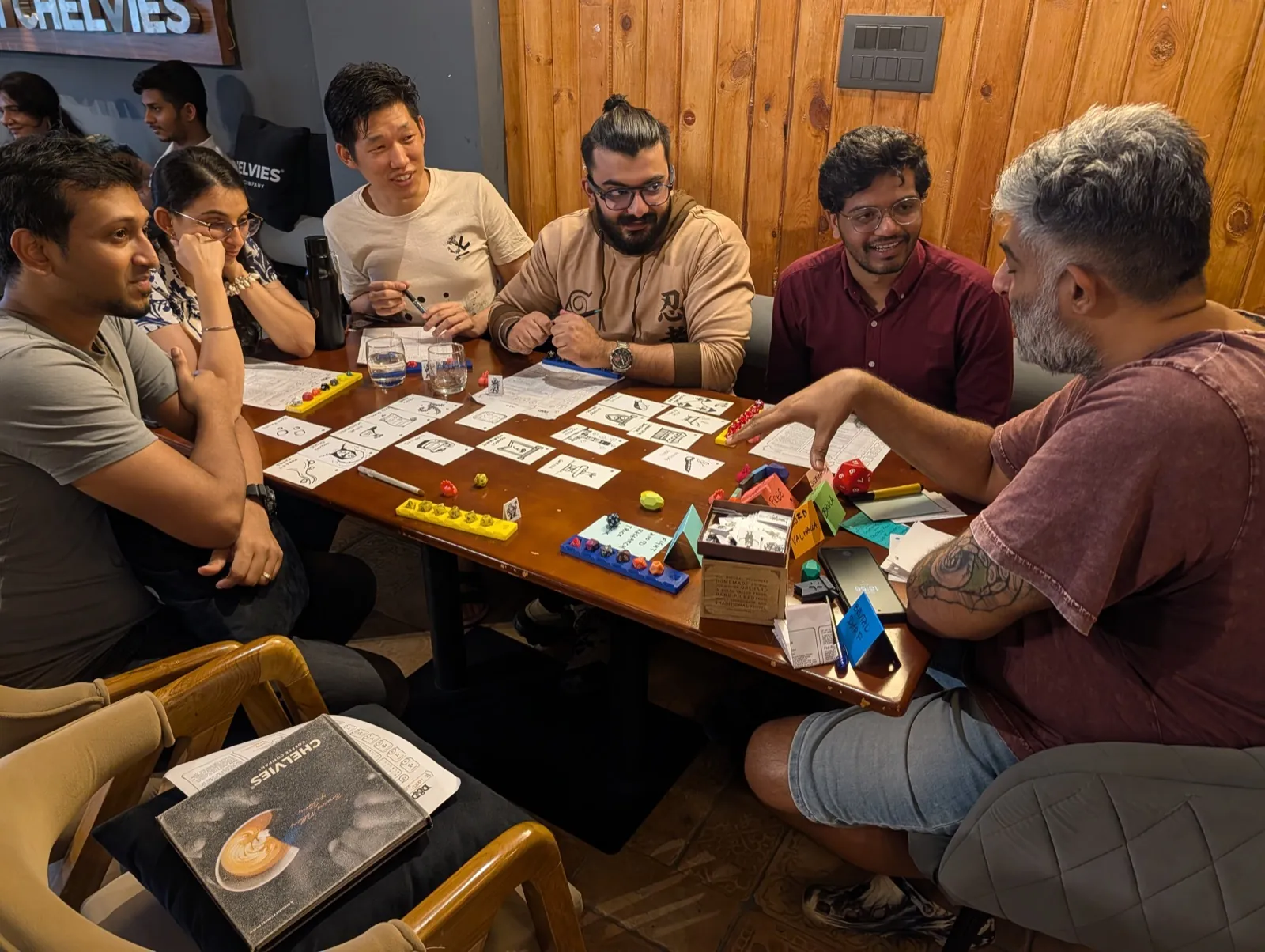
A Decision Lab is a consequence-based decision-making simulation. Your leaders practise judgment inside a live system that answers back. It is my name for what I do: serious games rebuilt as live decision environments. Nobody discusses leadership. They make real decisions under real constraint and then watch the system react, second-order effects and all - which is how the way they actually decide becomes visible, and once it is visible you can develop it. Each lab is engineered around one set of decision behaviours, from Planetfall (learning agility, acting on incomplete data) to Chaos in the Kitchen (strategy and optionality under pressure). It all sits inside the Put The Player First framework and runs the games in the serious games leadership development guide. For the thinking underneath, read decision-making under uncertainty.
What the Workshop Was Never Built to Do
"Knowledge transfers. Behaviour does not."
I say this to every client before we start.
And I watch the face change - polite interest, then something closer to recognition. Because they have seen it too.
The post-workshop glow that dies by Tuesday. The framework that looked brilliant on a slide and then met an actual bad week. All of us, myself very much included, knowing the right answer and still not doing it when it counted.
A lot of leadership development lets people try the costume on without ever stepping into the role. I've run sessions like that myself, years ago, and they went down very well.
People go home knowing more about leadership. Not much more about themselves.
Where the Format Gets in the Way
The frameworks are fine. The facilitators are fine.
We just built the whole thing around moving knowledge, and the job in front of us is to move behaviour. Which is not the same job, and I include my own early sessions in that.
Ordinary workshops are engineered for safety, clarity and comfort, and those are good things to engineer for. Discussion instead of decision. Correct answers instead of real behaviour.
What you get is a room where a leader can perform understanding and never once meet the version of themselves that shows up under constraint.
Nothing changes afterwards, and I don't think anybody should be surprised by that. The room was never asked to change anything.
What a Serious Game Actually Does
It drags leadership out of the world of ideas and into the world of action. Real decisions, real constraints, a system that keeps moving, and consequences that arrive whether you like them or not.
That is the missing bridge. Between knowing what good leadership looks like, and being able to do it when the pressure lands.
How Comfortable "Experiential" Usually Is
Walk into most experiential leadership workshops and you will find activities. Role plays. Team challenges. Puzzles that end the second somebody solves them. People engage, collaborate, even compete. Then the exercise finishes, the slate gets wiped, and everyone moves to the next thing carrying no memory and no consequence.
Nothing evolves. Nothing shifts. And so people learn how to be good at that particular activity, which tells you nothing about how they behave when conditions actually change.
That is the limit of activity-based learning. It builds closed loops. Participants work out how to win the exercise, not what kind of leader they become when the resources run out, or two priorities collide, or the strategy they committed to in round one falls apart spectacularly in round four.
Leadership shows up when decisions meet complexity. And complexity is the first thing a workshop takes out, usually for a decent reason - it is very hard to teach anything in a room that keeps moving.
So I Put the Complexity Back
A serious game does not end cleanly. It is a living environment that reacts to what people choose, shifts as patterns emerge, and surfaces the second-order effects normal training never gets near.
One person decides. Somebody else feels it. A team grabs a short-term win and quietly weakens its long-term position. A leader optimises for their own scoreboard and the system starts to crack. This isn't punishment. It is just reality, compressed small enough that you can see it and steer through it.
 The Science That Makes Behaviour Impossible to Ignore
None of this is novelty. The games are built on behavioural science and systems thinking, aimed squarely at the patterns ordinary training leaves buried.
Cognitive load theory. Leaders almost never have full clarity. They act on partial information, conflicting data and a clock. A good game recreates that on purpose - it makes people decide before they feel ready, and out come the mental shortcuts they reach for when certainty disappears.
Stress amplifies bias. Confirmation bias, overconfidence, loss aversion, in-group preference. All of them get louder when the stakes are real and the resources are thin. In a classroom a leader can cheerfully agree they have biases and never meet one. In a game the bias walks in the door and makes a choice they later cannot explain. That is not theory. That is undeniable.
Systems thinking is the backbone. Real organisations are not lists of tasks. They are webs of dependency where a decision travels across teams, departments and months. So the games carry feedback loops and delayed consequences, and small actions compound into large outcomes exactly the way they do at work.
Where Frameworks Finally Get to Do Their Job
I'm not here to trash frameworks. They are useful. Shared language, structure for messy ideas, a mental model for ambiguity. The problem isn't the framework. It's how we hand it over.
Most programmes teach a framework as if understanding it is the finish line. Understanding it is the start line. A leader can grasp influence, collaboration, prioritisation - but until those ideas get tested somewhere shifting and uncomfortable, where a real trade-off has to be made, they never become capability.
A game switches the framework on. It forces the move from knowing to choosing. Choose with too few resources. Prioritise when every option costs something. Live with consequences that outlast the moment. Negotiate with people whose incentives cut against yours. Adapt when the conditions change without warning.
That is where a framework proves itself or falls over. And where your people find out which principles they can actually use once deciding gets uncomfortable.
What It Feels Like to Walk Into One
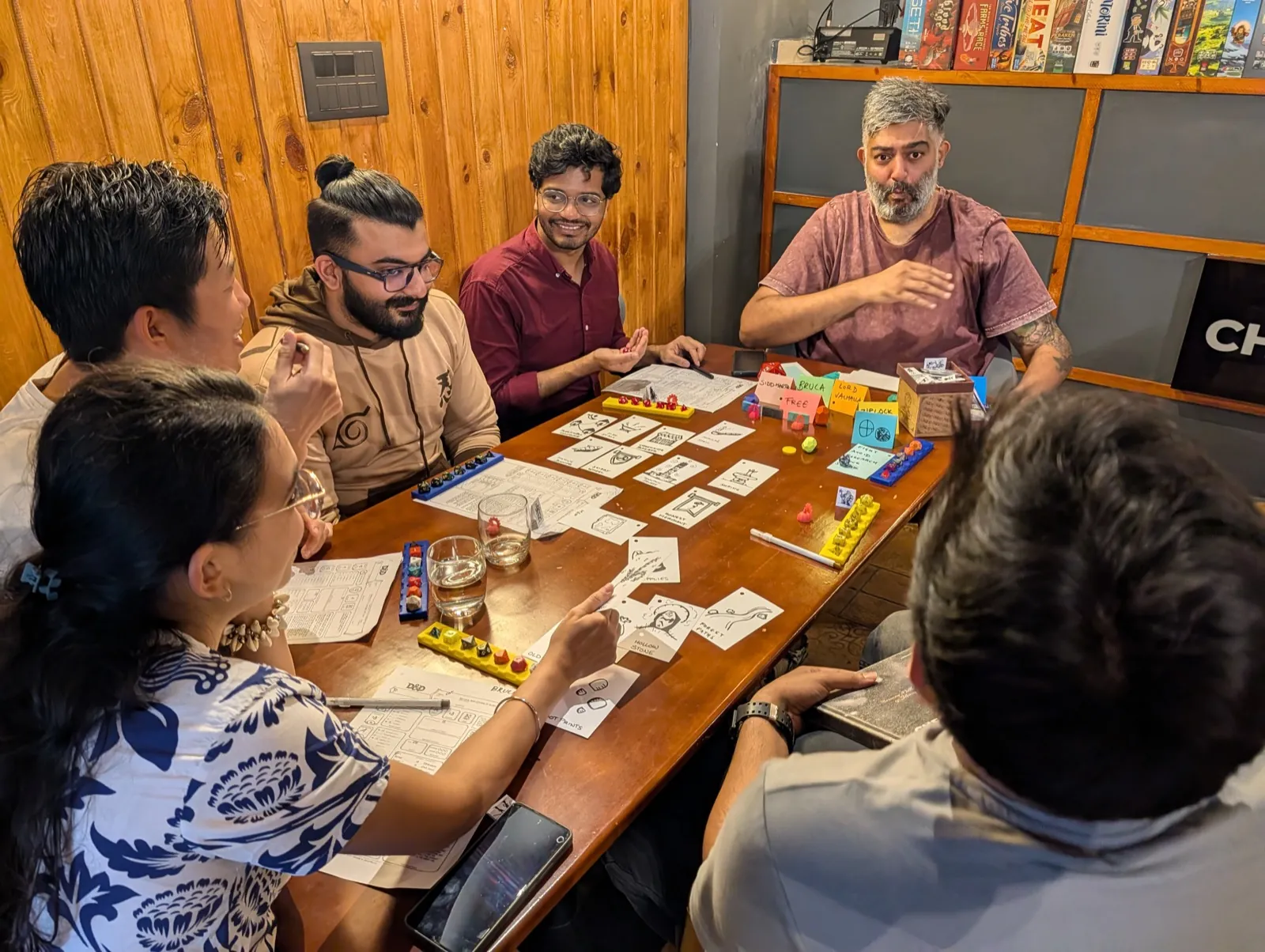
People arrive the way they arrive at any workshop. Confident, curious, a little bit sceptical. They expect another team-building thing that will end tidily with a neat lesson and a round of applause.
Then round one starts, and it lands on them fast: no move is neutral. Every choice moves the system. Every rupee they spend is a rupee denied somewhere else. Every alliance they build annoys somebody who was left out. The world inside the game is alive, and it remembers what you did.
The stakes are made up. The pressure is not, because people start to care. They want their strategy to work. They want to prove they can handle the chaos better than the chaos is currently handling them. That emotional investment isn't a distraction from the learning. It is the thing that makes learning possible.
Then negotiation takes over. Influence with no authority to lean on. Coalitions across clashing priorities. Relationships straining because there isn't enough to go round. This is not role-play. This is behaviour, live, in your room.
The arc is always the same and it is always good to watch. Confidence. Then destabilisation, as the complexity eats their opening strategy. Then, if the design is right and the facilitation holds the space, a rebuild - a new way of operating that they found themselves. Leadership is not a comfortable practice. A game compresses years of it into a few hours, and lets people fail where failure is free.
Why the Lecture Is Still the Default
Work keeps getting more complicated. Leaders have to hold uncertainty, move fast, and absorb change that arrives quicker than the planning cycle. And yet most leadership development still behaves as though the problem is a shortage of information - as if people fail because they haven't seen enough frameworks or sat through enough case studies.
The shift that is needed, and is slowly happening, is from content-driven to behaviour-driven. Leaders need lived experience. They need to watch their own decisions land, meet their blind spots under realistic pressure, and build capability by doing rather than by consuming.
Games speed that up. Consequences arrive in minutes instead of quarters. Patterns that would take years to spot on the job show up in an afternoon. And people get to try the risky approach, fail without wrecking anything, and rebuild with a much clearer idea of what actually works.
So Here's How I Build Them
Every game I design is a system. Rules, constraints and resources interacting, responding to what people choose, evolving as patterns emerge. These are not board games in a training costume. They are engineered to surface the leadership behaviour that stays politely hidden everywhere else.
Nobody gets to sit back, because the system won't let them. Resources have to be allocated. Priorities have to be set. Trade-offs have to be made. And every decision lands on somebody else who now has to respond to it. That is not facilitation through instruction. That is facilitation through design - the game does most of the teaching, by making behaviour visible and consequences undeniable.
My job is to sharpen what the game reveals. I don't lecture about leadership principles once it's over. I ask questions until people recognise the pattern they just performed. I hold the space so discomfort turns into discovery instead of defensiveness. And the mirror I hold up is made entirely of what actually happened, never of what somebody thinks should have happened.
What comes out is specific. How people influence with no authority. How they handle conflict when they can't avoid it. How they prioritise when every option costs something. How they move when the information is incomplete. And how they build or break trust through a hundred small decisions nobody was tracking.
Put The Player First. Always.
That is why the practice is called what it is called. The player is not a recipient of content. The player is inside a system that reveals them. Leadership development should not feel like school. It should feel like walking into a world that pushes back - safely, deliberately, and in a way that makes you better at the real one waiting outside.
Stop Talking About Leadership. Start Building It.
Leadership can't be taught in a classroom. It has to be seen. First by the system that answers it, then by the leader who did it. That is what these games make possible.
The gap between knowing and doing does not close with more content. It closes with more consequence, more complexity, and a lot more clarity about who you become when the decision actually costs something.
So if you're done with workshops that teach people about leadership, come and talk to me. Bring a game to your team. Stop moving knowledge around and start changing behaviour.
What Your Leaders Walk Into
Not another team-building thing that ends with a group photo. Here's what actually happens once round one starts:
- Why "no decision is neutral" hits them by round two. Every choice moves the system. Every resource they spend is one they've denied somewhere else - and they feel it before anyone explains it.
- What a strategy that looked brilliant in round one does when it collapses in round four. Because the world remembers what they did, and it doesn't reset between activities the way a normal workshop does.
- The moment influence stops being a theory. With no authority to lean on, they have to build coalitions across people whose incentives cut against theirs - and you watch who can and who can't.
- Imagine seeing a leader's real blind spot surface in an afternoon - the one that would've taken you two years and a bad quarter to spot on the job. That's the whole point of compressing the pressure into a room where failure is safe.
- Plus: a debrief they can't argue with. No "here's what you should have done." Just questions about what they actually did, until the pattern becomes impossible to unsee.
 The Games That Do This
Seven of them. Each one built to surface a particular set of leadership patterns. Pick by the behaviour you want to see, not the theme you like the sound of.
- Welcome to Zombiepuram →
Negotiation. Influence without authority. Coalitions and politics. - Planetfall →
Learning agility. Adaptability. Decisions under uncertainty. - Ripple Effect →
Cross-functional collaboration. Breaking silos. Local-versus-global. - Chaos in the Kitchen →
Strategy and optionality under pressure. Triage. - Bloom →
Stakeholder management. Relationships. Influence. - Sticky Fingers →
Collaboration. Communication. Creative problem-solving. - The Potter from Belagavi →
Working smarter, not harder. Investing in tools that compound.
Case Study
AI Bootcamp for Teams: 8.82 out of 10 across six session-days
An AI enablement programme that turned "I've heard of it" into "I used it on Monday" - and the client commissioned a second programme straight after.
Read the case studyThat programme has its own page now, in three sizes from a half day to two days: AI Bootcamp for Teams. There is also a weekend version for individual founders and leaders, if it is your own work you are trying to fix rather than a team's.
What Participants Say
"The case study way of learning was amazing."
Participant, AI Bootcamp for Teams
"Real insight into how mental models and decision-thinking patterns work, and creative problem-solving techniques I can actually apply."
Participant, AI Bootcamp for Teams
"Helped me understand the different methods for gathering insights and making decisions."
Participant, AI Bootcamp for Teams
Straight Answers
What is a Decision Lab?
A consequence-based decision-making simulation. A serious game built as a live system that answers back. Nobody discusses leadership - they make real decisions under constraint and watch the system react. Which is how behaviour under pressure becomes visible, and once it's visible you can develop it.
How is it different from a leadership workshop?
A workshop moves knowledge around through discussion and rewards the correct answer. A Decision Lab moves behaviour through consequence. The system evolves. Second-order effects surface. Then a structured debrief turns all of it into Monday-morning commitments. Knowledge transfers. Behaviour does not.
What does it actually develop?
Deciding under uncertainty. Prioritisation and trade-offs. Learning agility. Influence without authority. Cross-functional collaboration. And living with consequences over time. Each game, like Planetfall or Chaos in the Kitchen, is built for a particular set of these.
Who runs them, and where?
I do. In person. I'm Arvindh Sundar, serious-games designer and L&D facilitator, based in Bengaluru. I run every single session myself, for L&D teams, HR leaders and corporate training functions.
Want to See How Your Leaders Actually Decide?
Then let's talk. Tell me about your team and I'll point you at the right lab - or design one around the exact decision you're staring at. No obligation and no pitch deck. Just a straight conversation. And if a Decision Lab is the wrong answer for you, I will tell you so.
Message me about your team Read the philosophy first
With love from Bengaluru, this is Arvindh saying over and out.