
I've been trying to work out why "people just aren't talking" turns up in so many project post-mortems.
Because most teams I meet are perfectly nice to each other. Friendly, even. They'd share anything you asked them for.
They just never decided how they'd share it. Who tells whom, when, and where.
So they fall into a way of talking in the first week, and live with it for the rest of the project. Like a slightly rubbish flatmate.
I'm not immune, by the way. Left to myself I'll happily work heads-down for an hour and then surface to ask whether anyone has the thing I needed fifty minutes ago.
This programme lets your team find that out in a game, where it costs an hour. Then it takes one live project where people aren't talking, and helps the manager draft how the team will talk from now on.
Sticky Fingers is the game at the heart of AI-augmented Creative Problem Solving, my creative problem solving training. It's one of the 7 games.
How the change actually happens: play, then EPPA
Every session runs on the same loop. I call it EPPA.
- Experience. The heist itself. One hour of cards, pressure and a fair bit of shouting across tables.
- Patterns. The room names what kept repeating. Who announced, who hoarded, who walked laps looking for the one picture they needed.
- Principles. The room connects those patterns to how teams solve problems together. In their own words, which is why it sticks.
- Application. A named behaviour, a real situation and a date. People tend to stall here, so it's the step I've built the most around.
Application is also the only place AI comes in.
 The game at the heart of it: Sticky Fingers
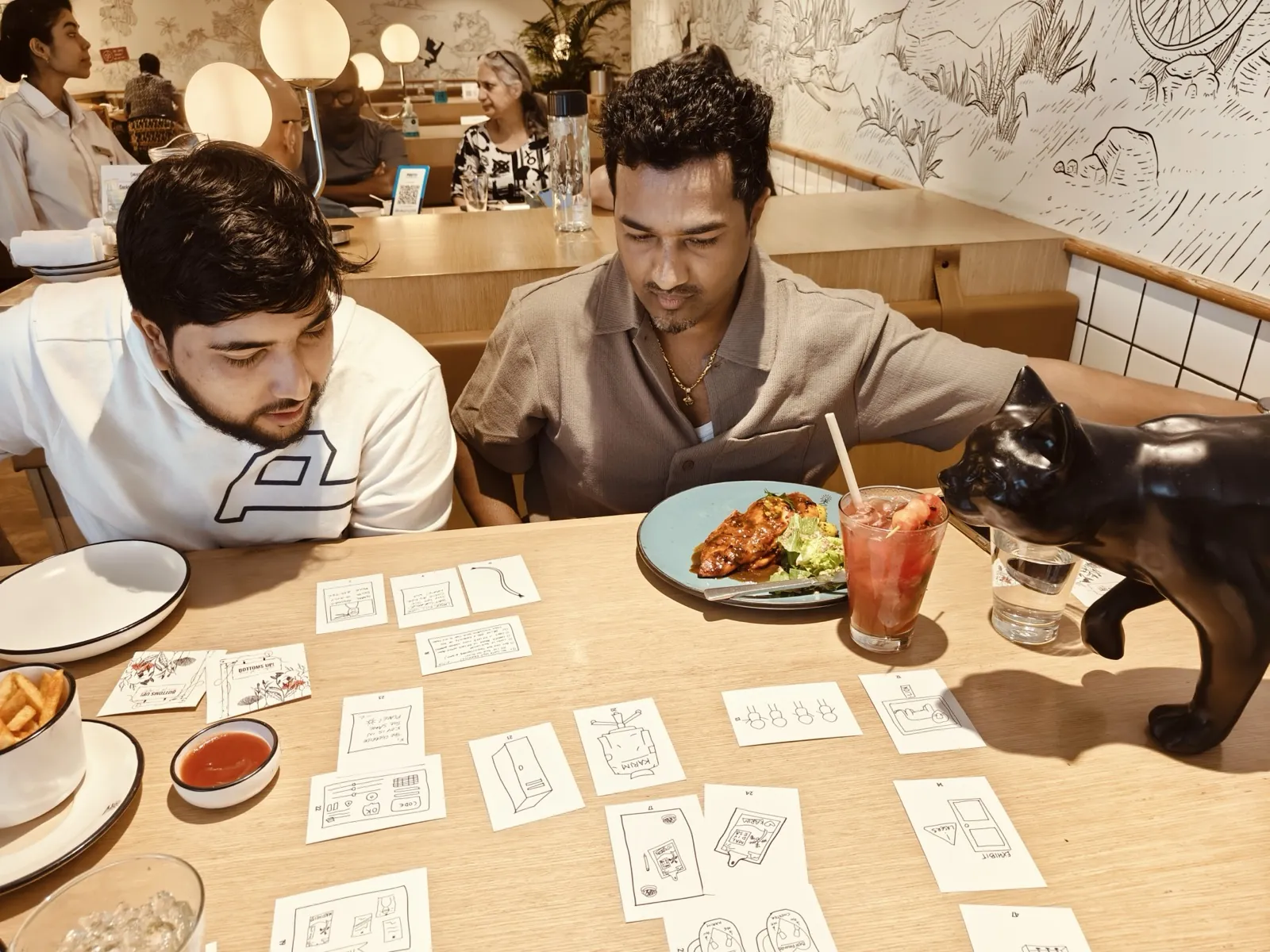
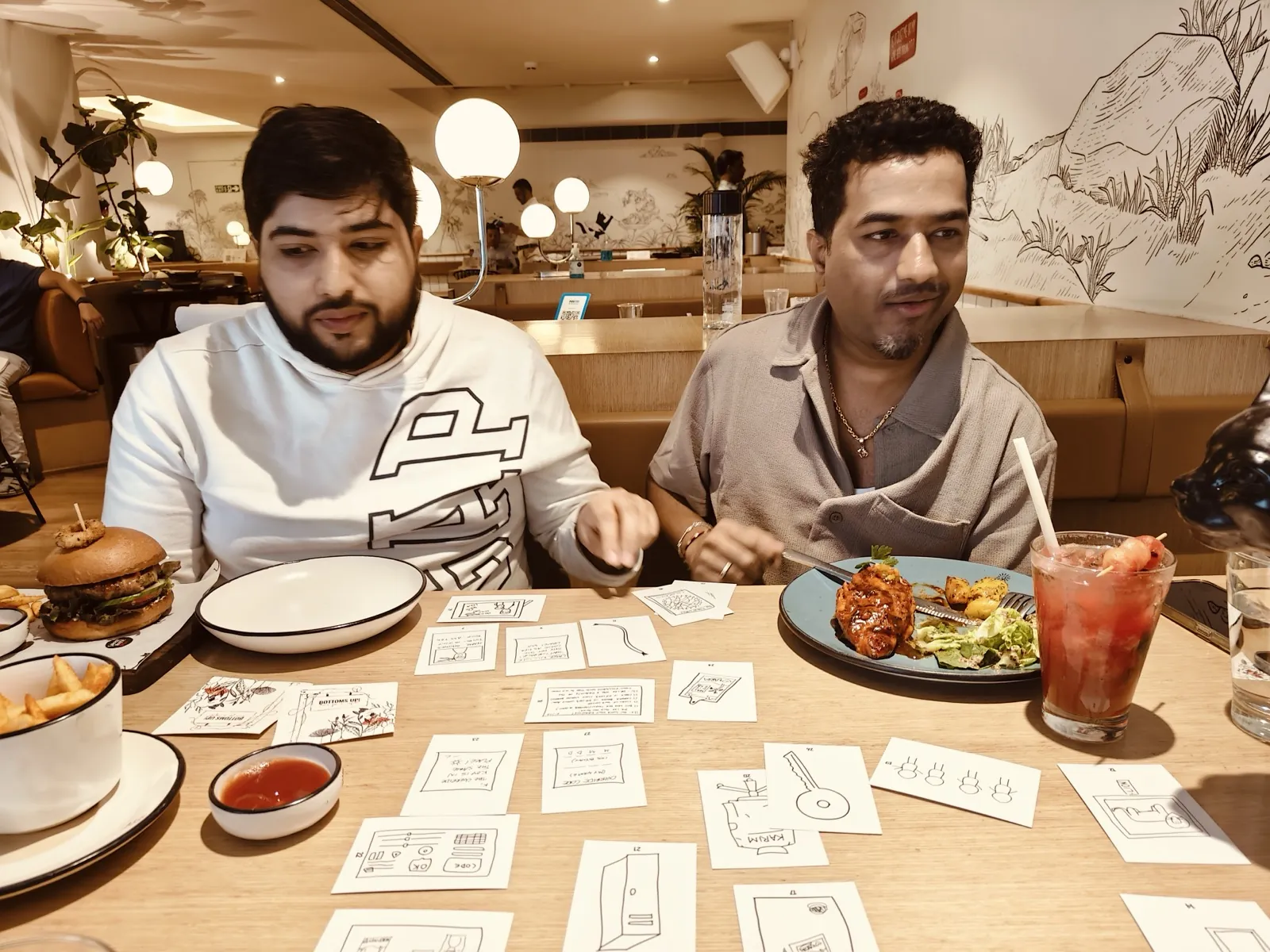
Sticky Fingers drops your team into a heist. They're a crew lifting a diamond out of a museum, and the only way out is to pool what each of them sees in the cards on the table. Simple enough. Nobody manages it in the first ten minutes.
I built it so that no single card solves anything. All the cards sit in one shared pool on the table, so nobody can solve it alone. It simply can't be done.
The cards push the room into the one thing teams quietly avoid under pressure... talking to each other. Then I stand back and watch how they choose to.
The first ten minutes tell you a lot
Cards go out and the room becomes lovely chaos. Some people go quiet and process. Some broadcast every card they're holding within four seconds. And at least one person stands up and starts walking laps of the room looking for whoever has the thing they need.
Then a leader turns up. Nobody appointed them. They just said "right, everyone tell me what you've got." Whether the room follows that person or talks straight over them is worth watching closely.
And I see this nearly every time. The teams that finish fast agree on how they'll talk inside the first ten minutes. The teams that stall spend 45 minutes heads-down on their own little corner, surfacing occasionally to ask "wait, what's on your card?" before diving back under.
"Everyone describe what is on your card, out loud, one at a time" takes about 90 seconds. Do it early and you finish with time to spare. Skip it, and 50 minutes later every picture the team needed has been in the room the whole time, and nothing at all is on the table.
Every card they needed was there from minute one. Nobody built a way to move it around. Barely a game at all, on paper. It's what people do next that makes it one.
 What you'll see before the debrief even starts
- The announcer and the hoarder. One person spills everything the second the cards land. Another sits back to see what the rest do first. Both show up inside two minutes, and both cost the team, in completely different ways.
- Who the room actually listens to. Someone always steps up with "tell me what you've all got". Volunteering isn't the signal. Whether anybody does what they said is.
- Why the person who's sure they can crack their bit alone ends up slowing everyone down, and how quickly they notice.
- Decision by drift. Most teams never actually decide how they'll communicate. They fall into a method in minute three and stick with it for the next 45.
- Who checks out when it gets hard, and quietly waits for a hero to turn up.
- The reframer. Every so often, one person notices the whole approach is rubbish and proposes a different one. Easy to miss in the moment. One of the most valuable people in your building to name out loud.
Where AI comes in, and where it doesn't
There's no AI in the heist. It's cards, a clock and a room full of people trying to find one another.
AI only arrives at Application, once the room has named its own patterns. And it works on the team's real project, not on the game.
- Each manager brings one live project where people aren't talking the way they need to.
- AI reads the project's real messages and mails, whatever they're allowed to bring, and drafts the team's talking rules. Who shares what, when, and where.
- The manager edits that draft at the table and sets the date they'll take it to the team.
What stays human: deciding how the team talks.
AI is quite good at spotting where the messages go missing. The rules your team actually agrees to live with are a conversation, and that conversation is still theirs.
What your managers walk out with
- A first draft of the team's talking rules for one real project. Edited by them, at the table, with a date to take it back.
- The 90-second habit that separates fast teams from stuck ones, in their own words, because the room worked it out.
- Imagine the next project kick-off where somebody says "before we start, how are we going to talk?" and nobody rolls their eyes.
- A clearer read on who in their team is the announcer, the hoarder and the reframer. Useful on Monday. Even more useful in a crisis.
- Shared language from one hour of play. "What's on your card?" turns out to be a very handy thing to say in a meeting.
What changes when the room hits 150
Same chaos, much bigger canvas. And the thing that separates the teams who crack it from the ones who don't is still exactly one thing. Does somebody set a way to talk, early?
At 150 something else happens. Little sub-leaders pop up all over the floor, each running their own cluster, none of them talking to the others. Who steps into that, and whether they ever look up, is some of the richest behaviour I get to watch all day. I track it live and enjoy myself far too much.
What I can show you
I'll be straight about this. I don't have a separate score for Sticky Fingers on its own, so I won't pretend to.
What I can tell you is how the rest of my work has landed.
- I've been training founders and leaders since 2019, with founders in the US, Canada, Australia, Singapore and India.
- The game library Sticky Fingers belongs to has been used with a Fortune 100 company, a leading HR-tech platform, a Fortune 500 technology company, a global retail corporation and a global engineering and technology firm.
- Across every session-day I've had scored, the satisfaction score is 8.40/10 from 244 respondents.
- On a separate programme for a leading HR-tech platform, all 13 participants agreed they understood the learning objectives, and 12 of 13 (92.3%) said they would apply what they learned.
Who this is for
- Cross-functional and project teams, especially the ones quietly living in silos and calling it focus
- New teams still finding their rhythm. Far better to find the patterns in a game than in a live project with real money on it
- Teams where "people just aren't talking" keeps turning up in post-mortems
- Big rooms. Offsites, town halls, all-hands. It holds energy at 150, which very little does
- Functions meeting for the first time. Different teams, different floors, different habits
Who would probably get more from something else
- Teams where the real problem is trust, not talking. Sticky Fingers will show you people aren't sharing. It won't tell you why. If the root is psychological safety, you'd get the symptom and not the cause, and I'd rather say that now. Ripple Effect gets closer to trust between teams.
- Very senior teams who want depth. They do enjoy it, but an hour is an hour. It works best beside a longer game, or as the opener to a longer day.
- Anyone who needs individual assessment data. This shows team-level patterns. If you're assessing individual leaders, something else will serve you better.
A few fair worries
"An hour-long card game feels a bit light for a serious problem."
It is light, and I think that's partly why it works. People drop their guard for a heist in a way they don't for a communication model. The game is only the start, though. The real work happens afterwards, in the debrief and on their own project.
"We've done communication training before."
That's fair, and most of it was probably sound. What I've found is that teams usually know they should talk more. What they rarely do is sit down and decide how. That one decision is what the game makes visible, and what the Application step makes them actually write down.
"Are we comfortable putting our team's messages into AI?"
Honestly, that depends on your company's rules more than mine. Bring only what you're allowed to share. We'll work with what you bring.
"Can AI really help a team talk better?"
Not on its own, no. What it can do is read a pile of messages much faster than any of us and point at where things go missing. The team still has to agree on the rules, and that part is very much a human conversation.
Come and see
Tell me a little about your team and the project where people aren't talking, and I'll tell you straight whether this is the right programme. If it isn't, I'll say so and point you at the one that is.
Worst case, we have a conversation and you come out of it with a clearer brief.
Let's find out if it fits your team
Your team, the project that's stuck, and a straight answer on whether this is the right programme. And if your team already talks brilliantly... well, I'd quite like to know how.
Come and have a look at the calendar
With love from Bengaluru, this is Arvindh saying over and out.