I've been trying to work out for a while why stakeholder management is so hard to teach.
Not hard to explain, exactly. Hard to make stick.
Because the training on it is usually fine. The maps are sound, the influence models are sound, and most managers can draw a power-interest grid before lunch.
And then they go back to their desks and spend the next quarter waiting to be asked.
Which isn't their fault, really. Nobody ever made them feel what the waiting costs.
That is the job I built this programme for.
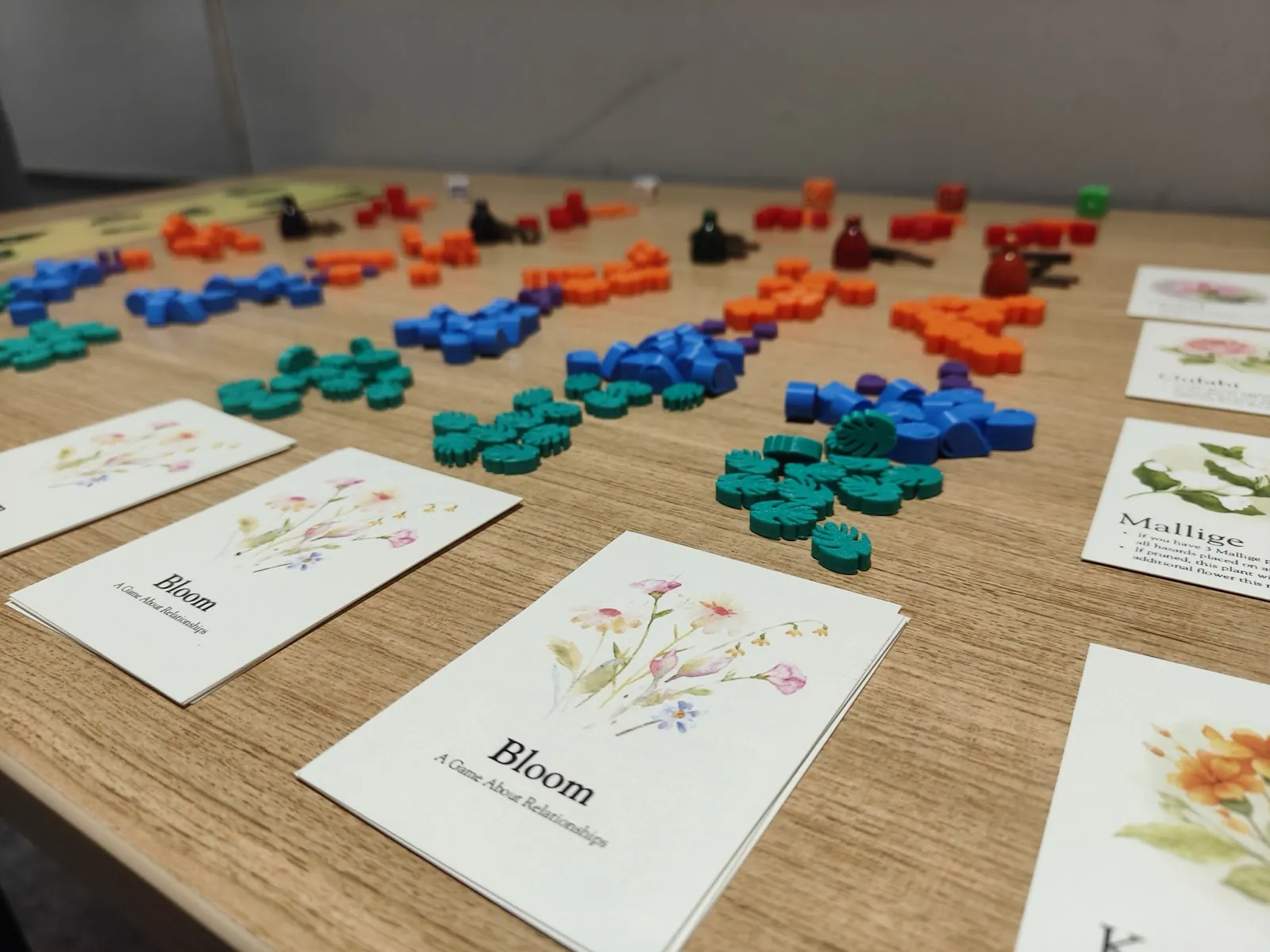
Bloom is the game at the heart of AI-augmented Stakeholder Management, my stakeholder management training. It's one of the 7 games.
 How it works: play, then the EPPA loop
The programme runs on one loop, and I call it EPPA. Experience, Patterns, Principles, Application.
The Experience is the game. Six rounds of Bloom, played properly, with something on the line.
Then we unpack it. Patterns first - what kept repeating at the table. Then Principles, which come out of the room's own mouth. I don't lecture them in. The idea is that it lands because they got there themselves.
And then Application, which is the bit that usually gets cut when the clock runs out. It is also the only bit that changes anything on Monday.
So that is where the AI goes. Only there.
Never inside the game. Bloom is cards, flowers and people across a table, and it stays that way.
The game at the heart of it: Bloom
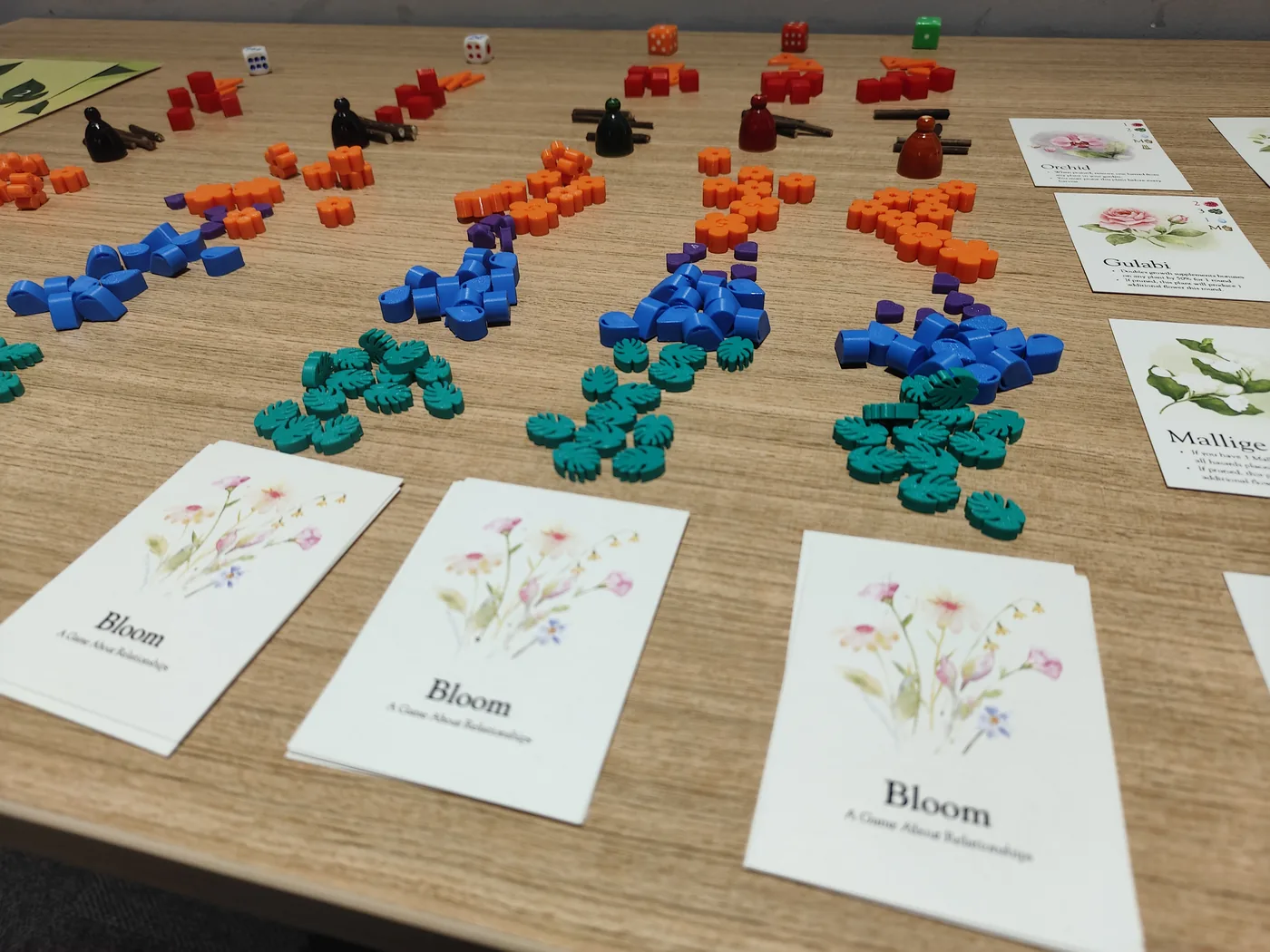
I hand each team a garden of three plants (Mallige, Gulabi and Bougainvillea), five flowers, five actions a round and one instruction. Grow the most flowers. The team with the most flowers wins.
The whole team shares that garden and those five actions, so every move has to be agreed out loud. Which is where it gets interesting, honestly.
Underneath, every plant is a person, and across the six kinds no two want the same thing. One is cheap, steady and easy to forget. One pays the most flowers in the game and needs pruning before every single bloom. One hands you an extra action on the rounds you leave its water alone.
And flowers are money and points at the same time, so every plant you buy from the market is flowers you didn't keep.
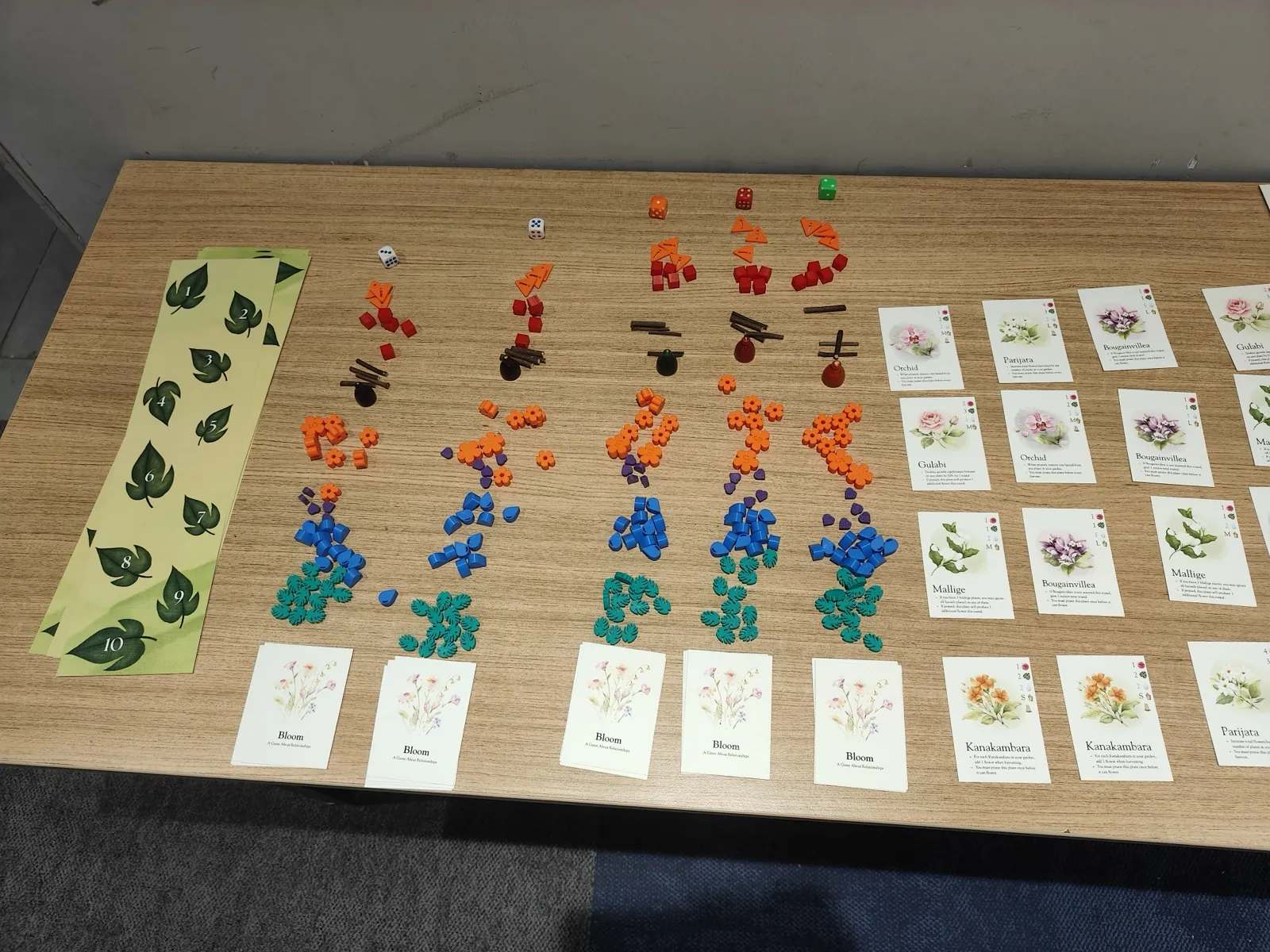
Here is the catch. The garden grows every time you buy a plant. The five actions don't, unless you spend flowers on help.
So sooner or later the team has to decide which plant it is going to stop looking after. And at the start of every round, each plant the team didn't touch last round takes a hazard. A plant with a hazard can't bloom until somebody spends an action clearing it.
Six rounds, and nobody packs up at the end. The plant cards stay face up with the hazards still sitting on them, and that table is what we read in the debrief. I suspect it will be a bit more honest than anybody on the team expects.
There are several ways to win, I think. Tending everything isn't one of them.
 What six rounds of Bloom is built to tell you
The bet behind it: put something valuable on the table and people stop performing their values. Here is what the game is built to bring out into the open:
- Who the team drops first, when it can't tend everything. And whether it is the same plant the second time a hazard lands.
- Who gets parked because they'll deliver anyway. Mallige is the cheapest, most forgiving plant on the table, so it is the easiest one to forget. And a plant nobody touched last round is exactly where the next hazard lands.
- Who argues for the plant the team drops, and who wins that argument. Five actions shared by a whole team means every choice gets said out loud.
- When the team buys help. The upgrades in the market are the upskilling in this garden. The Watering Can earns its keep early and does very little late, and the cheap copy of anything goes to whichever team reaches the market first. A bit like training, really.
- Which plants the team never takes on. All six kinds sit in the market in the middle of the room, in front of everybody. One of them is a bad buy, and I made it that way on purpose. Not owning one is a choice made in the open.
And the table keeps quiet score of all of it. Every hazard nobody cleared is still sitting on its plant at the end, and every one of them landed on a plant the team chose not to touch. So by the end the evidence is laid out by their own hands.
I'd honestly rather they read it out than hear it from me.
Where AI comes in: the Application step
By the time we reach Application, the room has already named its own patterns and its own principles. Nobody needed a machine for that, and I'd honestly rather they didn't have one.
Then each manager turns to their real work. Here is what that looks like:
- They list their real stakeholders. The actual people, from their actual quarter. Not a case study about somebody else's company.
- AI turns their own notes into a one-line read per person. Does this person need water, a bigger pot, or space? The same three needs they just spent six rounds learning to tell apart.
- They pick one person who cannot pay them back yet. The plant nobody bought, in real life.
- They plan the first give, and put a date on it. A named behaviour, a real situation, a date. All three, or it did not happen.
What stays human is the choice in that third line.
AI can sort the notes quickly. It can't decide to back somebody before there is anything in it for you. That one is theirs, and I think it should be.
What your managers walk out with
- A read on every stakeholder that matters this quarter, in one line each, built from their own notes.
- One person they have chosen to back, before that person can do anything for them.
- One first give, with a date, so Application is a diary entry and not a good intention.
- A shared language for the team - water, bigger pot, space - that is easy to remember, mostly because it is a bit silly.
- Their own data on their own patterns, which is harder to argue with than feedback from somebody else.
Case Study
A leading HR-tech platform: all 13 agreed they understood the learning objectives
One day, a frontline manager programme, Bloom on the table. All 13 participants agreed they understood the learning objectives, and 12 of the 13 said they would apply the learning. That was an earlier edition of Bloom. The team version on this page has no survey score of its own yet.
Which is probably the more useful number of the two.
The rest of the receipts
I've been training founders and leaders since 2019, with founders in the US, Canada, Australia, Singapore and India.
One programme at a Fortune 100 company scored 8.82/10 as a satisfaction score, across 113 respondents and six session-days. That is one programme, so I won't pretend it is all of them.
Across every scored session-day I have, it is 8.40/10 across 244 respondents. A bit lower, and a lot more honest.
Who it fits
- Someone capable who just got promoted into a role with no authority in it. They are finding out that "because I said so" does not cross a function boundary.
- Technical teams who are superb in their lane and know nobody outside it. Bloom is built to price the isolation for them. Out loud. On a scoreboard.
- Teams who agree relationships matter and haven't quite got round to acting on it. Everyone agrees with the slide, and then the week gets busy, which is fair enough.
- The session right before a 360. The idea is that people arrive at the colleague feedback already knowing their own patterns, so it can read as confirmation instead of an ambush.
New managers, project leads, business partners. Anyone whose results depend on people they cannot instruct.
Who would get more from something else
- When the problem is the org chart, not the people. No cross-functional meetings, nowhere to actually connect. Bloom changes behaviour. It can't rebuild your structure, and I'd rather say so than take the booking.
- Groups too small to make proper teams. Bloom is played by 2 to 4 teams, and every team has to agree out loud before it moves. Without a few people on each team there is nothing to argue about, and the debrief has nothing sharp to compare.
- When the real question is authority and decisions rather than influence. Ripple Effect or Planetfall probably fits better, and I'll point you there.
- Teams who are genuinely already good at this. Bloom is a diagnosis. If there is nothing to find, you'd be paying me to confirm a thing you knew.
Fair questions
"A garden game, for managers?"
That's a fair worry, and it is usually the first one I hear. It does look harmless. What I'm counting on is that the petals stop mattering fairly quickly, and what is left is a table deciding, out loud, who it is going to stop looking after.
"We don't have much time."
Honestly, this needs more than a quick slot. The game is six rounds, and the debrief and the AI-augmented Application step need their own time after it. We size the session around your group, and I'll tell you on the call what I think it needs rather than squeeze it.
"We've done stakeholder training before."
Most teams have, and it was probably fine. The difference here is that your managers act it out with witnesses first, and then plan one real move on one real person before they leave.
"Can AI really help with something this human?"
With part of it, I think. It is quick at turning messy notes into a clear read. It doesn't choose who to back, and it isn't asked to. Where your managers' notes go, and which tools your company allows, is a fair question too - one I'd rather answer properly for your setup on a call than guess at here.
Worst case? We have a conversation and you come out of it with a clearer brief, whether or not it is Bloom.
Come and see if it fits
Twenty minutes on a call. Your managers, where the relationships are thin, and my honest answer on whether Bloom is the right heart for it.
Come and have a look at the calendar
It won't turn anybody into a natural networker overnight. It just makes the first give a lot more likely to happen, which, for most people, is the hard part anyway.
With love from Bengaluru, this is Arvindh saying over and out.