
I've been trying to work out for a while why good leaders, in perfectly good companies, still end up pulling in different directions.
Not fighting, exactly. Just quietly optimising their own patch.
Because the people doing it are usually sensible and well meaning. The finance head guards the budget, because that's the job. The tech head pushes the tech roadmap, because that's the job too.
And each of those calls makes complete sense on its own.
It's only when you add them all up that the company comes out worse than any of them meant it to.
I've done my own version of it, more than once. Usually while feeling rather pleased with how well my bit was going.
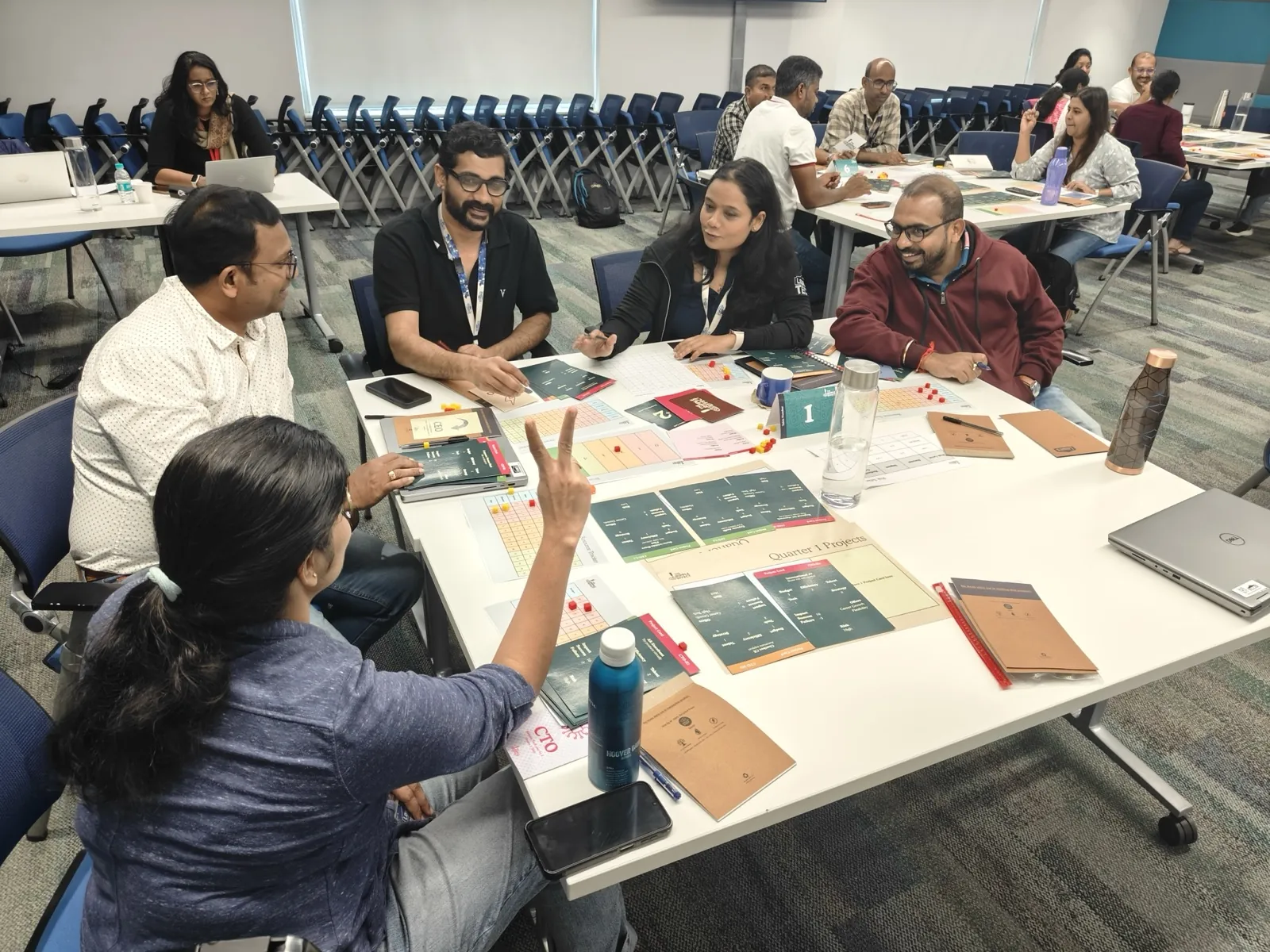
So this programme lets your managers do it in a room first, where it costs nothing real. Then it takes one real piece of cross-team work and makes them decide what to do about it, with a date on it.
Ripple Effect is the game at the heart of my leadership simulation programme, AI-augmented Trust and Collaboration. It's one of the 7 games.


How the change actually happens: play, then EPPA
The programme runs on one loop, and it's the same loop every time. I call it EPPA.
- Experience. The game itself. Somewhere between 90 and 120 minutes of choosing, funding, rolling dice and occasionally arguing about whose project matters more.
- Patterns. The room names what kept repeating. Who guarded their own resources, who chipped in on someone else's project, who kept fighting for the same slot.
- Principles. The room connects those patterns to how trust and collaboration work across functions. In their own words, because it sticks better when they get there themselves.
- Application. A named behaviour, a real situation and a date. In most training this is the step that stalls, so it's the one I've built the most around.
It's also the only place AI turns up. More on that in a moment.
 The game at the heart of it: Ripple Effect
Each table becomes the leadership team of Ripplewater Retail, a fictional company. Five people, five roles: CEO, CFO, COO, CTO and CHRO.
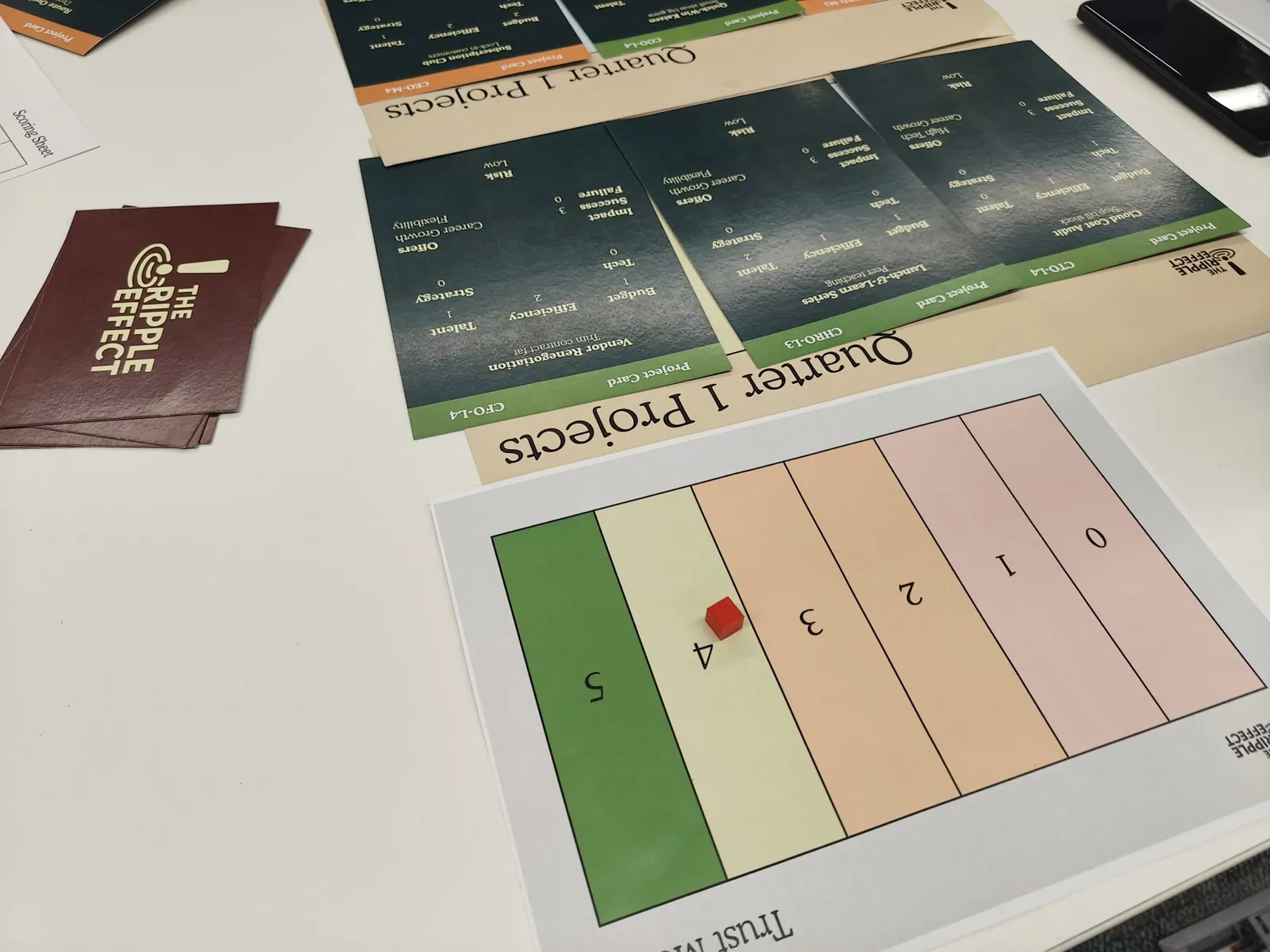
Every leader holds their own function's resources. Budget for the CFO, Talent for the CHRO, Tech for the CTO, Efficiency for the COO and Strategy for the CEO.
And here's the bit that does the work. Each quarter, the company can only run three projects.
Five leaders. Three slots.
Most projects also cost more than one kind of resource, so nobody can fund the bigger ones on their own. A project gets done when two or three functions decide to back it together.
Nobody at the table has to behave badly for the company to struggle. Everybody just has to be a little bit sensible on behalf of their own function. Which is, honestly, most of us, most of the time.
For a bigger group, several tables play side by side, each one its own leadership team of the same company. Somewhere between 16 and 60 people in all.
How it works
The game runs over four quarters. Every quarter follows the same loop, and I run the clock and call each step.
- Kickoff. Each leader turns over a mood card for the quarter. A good week helps your dice, a rough one counts against you.
- Planning. Every leader walks over to their own role table, so all the CFOs in the room are standing together, all the CTOs and so on. Each one picks three projects from their function's deck and brings them back.
- Negotiation. Now the team has a pile of good ideas and room for three. They decide which three the company runs, and who puts what into each one.
- Execution. The team can spend extra resources to make a risky project safer. Then they roll a die to see if it lands. Bigger projects pay more and fail harder.
- Resolution. The company scores what its projects delivered. Projects backed by more than one function earn a bonus. Resources left sitting unused count as waste and cost the company. And the team's trust goes up or down with how its shared projects did.
- Mini-debrief. A few minutes as a table on one question, before a short break and the next quarter.
Each quarter, I'll also turn over an event card. Something happens to the company, and the team has to deal with it this quarter whether it suits their plan or not.
At the end of the four quarters, the whole room comes together for a grand debrief and a gallery walk round every table's results.
What the game is built to bring out
The first quarter is mostly about learning the loop. People find their role table, pick some projects and work out what the dice mean.
Then it starts to matter which three projects run, and whose.
The design rewards a leader who puts their resources into somebody else's project when that's the one the company needs. And it quietly costs a leader who sits on their resources waiting for the perfect project of their own.
By the middle of the game, each table tends to have a clear read on itself. Who always chips in. Who always needs to be asked. Who keeps bringing back the same project from their role table and pitching it again.
That's the moment I'll be watching for: who gives something up for the company, and whether the rest of the table notices in time to do anything with it.
 What it's designed to show you about your managers
A game of this is built to put one thing out in the open: how each person weighs their own function's win against the whole company's.
- Who funds a project that isn't theirs, when funding it costs them something. Easy to be a team player when it's free. Much more interesting when it isn't.
- Whether the leader with the scarcest resource uses it as leverage or as help. Same tokens on the table. Very different quarter.
- Who arrives back from their role table with an offer, and who arrives with a request.
- Who treats trust as a transaction and who treats it as an investment. The trust track on the table is there to make that visible.
- Who holds on to resources just in case, while the company is short of exactly those resources.
- Who keeps one eye on the company's score, and who is so busy getting their own project through that they miss the company slipping.
Where AI comes in, and where it doesn't
There's no AI at the table. The game is cards, resource cubes, a die, a trust meter and a lot of people walking between tables.
AI only shows up at Application, after the room has already named its own patterns and principles. And it works on their real work, not on the game.
- Each manager brings one real promise they've made to another team. A handover date, a shared target, a "leave it with me".
- AI maps who depends on it. Every team and person downstream, and what breaks for each of them if it slips.
- The manager writes the note. Keep it, or go back and change the deal honestly. And they set the date it gets sent.
What stays human: whether to keep the promise when keeping it costs you.
AI is genuinely good at drawing the map of who leans on what. The call itself is still yours, and I think it should stay that way.
What your managers walk out with
- One real cross-team promise, already dealt with. Mapped, decided, and with a send-by date on it.
- A short list of everyone who was quietly depending on that promise. Written down, possibly for the first time.
- The difference between winning for your function and winning for the company, put in their own words, because the room got there itself.
- A way of saying it out loud. Imagine the Monday meeting where somebody says "that's a three-slot quarter" and the whole room knows exactly what they mean.
- A read on themselves they didn't have this morning. Guardian of the budget, the one who always chips in, or the one who keeps pitching the same project.
Patterns the game is built to surface
- The leader who builds the perfect plan for their own function while the rest of the table has already agreed on the three projects
- The negotiator whose words say "let's do what's best for the company" and whose terms say "starting with mine". Only visible in hindsight, which is the whole point of seeing it here first
- The table where every leader has a good quarter on their own board, and the company still comes out behind
- The resources that sit unused at one end of the table while a project at the other end fails for want of them
- The one person who backs somebody else's project first and changes how the whole table plays the next quarter
What I can show you, and what I can't
The version of Ripple Effect on this page is the one I actually run, and I've run it with leaders at a Fortune 100 company.
One person in that room said it was a bit hard to follow at first. Fair enough, honestly. It settled once they'd played a quarter.
I won't quote you a score for this game on its own. It ran inside a longer programme, and I'd rather not borrow that programme's numbers for one part of it.
What I can tell you is how the rest of my work has landed, so you know who you'd be talking to.
- I've been training founders and leaders since 2019, with founders in the US, Canada, Australia, Singapore and India.
- On one programme at a Fortune 100 company, across six session-days, the satisfaction score came to 8.82/10 from 113 respondents.
- Across every session-day I've had scored, it's 8.40/10 from 244 respondents. Which is probably the more useful number of the two, because it includes the days that went less well.
- On a separate programme for a leading HR-tech platform, 12 of 13 participants (92.3%) said they would apply what they learned.
Who this is for
- Managers from different functions who have to deliver for each other, and who each get measured on their own numbers
- Leadership teams that sit round one table on paper and still run as five separate departments in practice
- Pairs of functions that are supposed to depend on each other and behave like separate companies. Sales and delivery. Product and engineering. Operations and commercial
- Enterprise leadership programmes with bigger groups, anywhere from 16 to 60
- Organisations where collaboration is the stated value and the incentives pay for individual numbers. The game is built to make that tension visible, and nobody has to be the one who said it
Who would probably get more from something else
- Groups under 16. The game needs a few tables running side by side, so the debrief has more than one table's story to compare. Sticky Fingers will probably suit a smaller room better.
- One difficult relationship between two people. A good coach will get further with that than a room of forty people funding projects.
- Leadership teams that already back each other's work well. Honestly, you may not need this. I'd love to hear how you did it, though.
A few fair worries
"We've done collaboration training before."
That's a fair worry, and honestly, most of what you did was probably fine. The models usually are. What I've found is that people already know collaboration matters. The hard part is the moment backing someone else's project means your own one waits, and that's the exact moment the game recreates, quarter after quarter.
"Can AI really help with something as human as trust?"
With the trust bit itself, probably not, and I wouldn't ask it to. Where it helps is the dull part most of us skip: listing everyone who depends on a promise and what happens to them if it slips. AI does that quickly. Most of us, left alone, never get round to it at all.
"Our managers don't have time for this."
That's true, and I won't pretend it isn't time away from the desk. What I'd say is that every manager walks out with one real promise already sorted, which is work they would have had to do anyway. Just later, and probably in a hurry.
"Our people aren't CXOs. Will it still work?"
I think so, yes. Nobody needs to know how a real CFO spends their day. They just need to hold one function's resources and feel the pull to look after them, which most managers already know rather well. Tell me who's coming and I'll tell you straight if I think it fits.
Come and see
Tell me where collaboration keeps breaking down between your teams, and I'll tell you straight whether this is the right programme. If it isn't, I'll say so and point you at the one that is.
Worst case, we have a conversation and you come out of it with a clearer brief.
Let's see if it fits your managers
We'll talk about your teams, the places their priorities keep pulling apart, and whether this is the right programme. No pitch deck. And if it isn't the right fit, that's a perfectly good outcome too.
Come and have a look at the calendar
With love from Bengaluru, this is Arvindh saying over and out.