
Serious Games for Leadership Development: A Field Guide (2026)
"Leaders don't fail because they lack knowledge. They fail because no one ever tested their behaviour in a system that fights back."
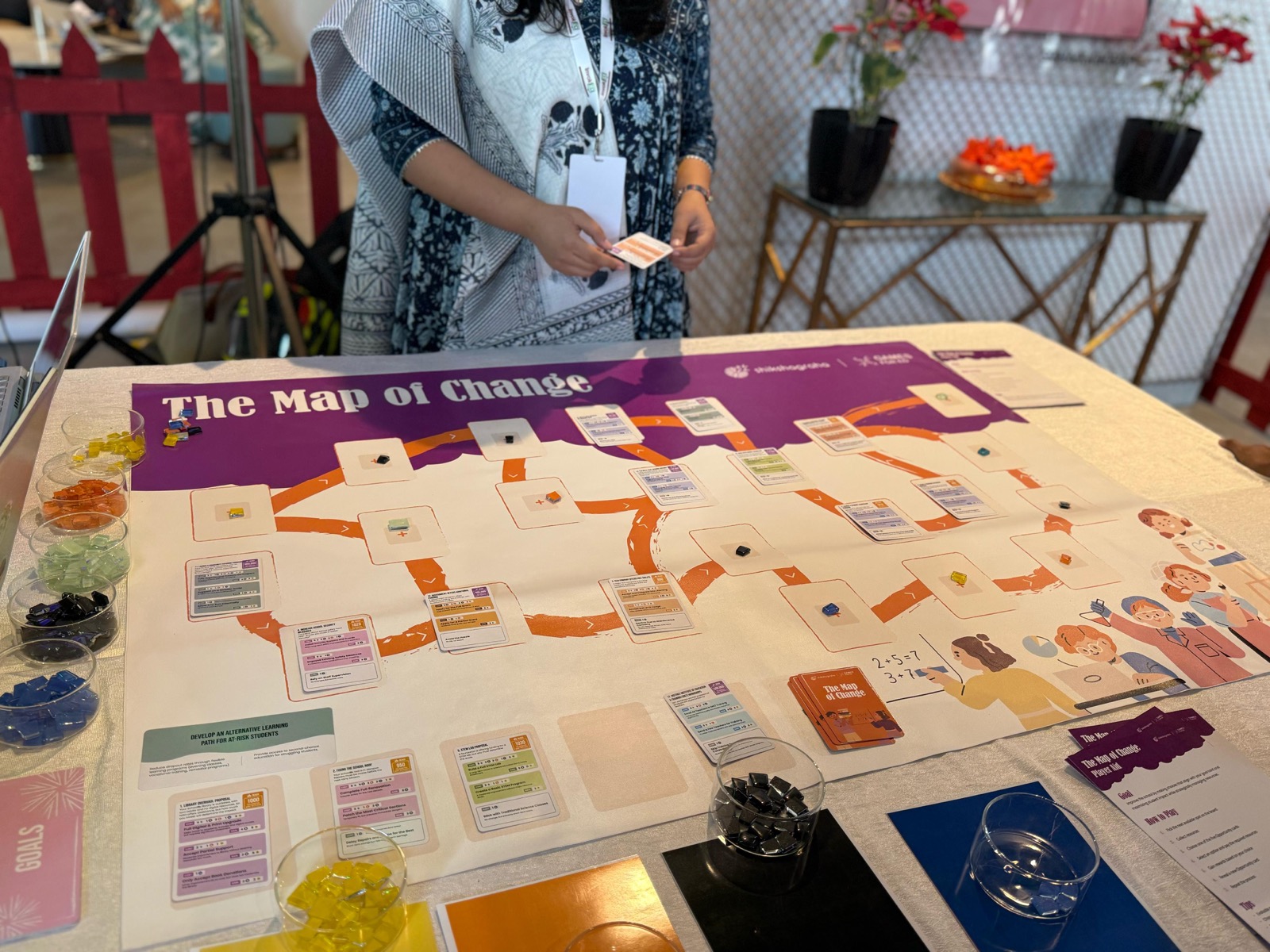
If you got here searching for a simulation, the page you probably want is the other one.
A fair number of people land on this guide having typed something like leadership simulation game, or leadership development simulation, or games for leadership training. Different words, near enough the same thing, and I have no argument with any of them.
This page is the long version of why the method works. The reasoning underneath it, the behavioural science, the misconceptions worth clearing up first.
It is not the menu.
The menu is over on leadership simulation games, where the seven I have designed and run are laid out one at a time, with who each one is for, how many people it takes and how long it runs.
Start there if you are choosing one. Come back here if you want the reasoning underneath.
Or skip this page entirely, honestly - the other one stands up on its own.
 When Leadership Training Removes Everything That Makes Leadership Real
The knowing-doing gap shows up like this. The manager who aces every workshop, quotes Drucker in meetings and can draw servant leadership on a whiteboard from memory... is very often the first person to sit on information the moment budgets get tight.
I've watched it happen dozens of times. The executive who talks collaboration in every town hall and builds a quiet little empire the second somebody else's team needs something from him. The high-potential who tests brilliantly on every assessment and then goes completely still when the handrails come off.
They all knew what to do. Nobody had ever seen what they do. Those are two different things, and only one of them turns up on Monday.
Leadership Development often leads to structural failure
This is a structural failure at the heart of leadership development, and it isn't a facilitation problem or a curriculum problem. It's an environment problem. We build training rooms that carefully remove consequences, scarcity, politics, ambiguity and pressure - the exact five things that show you how a person leads - and then we act surprised when leaders wobble the first time they meet any of them for real. Traditional workshops are brilliant at teaching frameworks. They fail, comprehensively, at showing you how somebody operates. The gap between those two is where most leadership careers quietly stall.
Serious Games fix leadership development by testing differently
Serious games don't fix this by teaching better. They fix it by testing differently. They are decision labs. You build a small world where behaviour becomes visible before it becomes expensive. Patterns show up that no self-report tool and no 360 will ever catch. The collision between what somebody intends and what somebody does happens in front of everyone, on purpose, in a room built to make it discussable. This isn't clever for the sake of clever. It's the only method I've found that shows you how a person leads instead of how they think they lead.
The Thing Everyone Calls a Game That Isn't Actually a Game
Let me clear the ground first, because the words have gone sloppy. Serious games are not gamification. Gamification is points and badges bolted onto a process you already had. It gets things finished. It changes nothing about how anybody thinks.
They're not icebreakers either. Icebreakers make energy and warmth, which is lovely, and no decisions. They're not team-building activities, which build rapport and produce no behavioural data. And they aren't simulations in the old sense, where the whole job is copying reality faithfully enough that the transfer is obvious. A simulation copies the world. A serious game squeezes it.
In that old technical sense, anyway. Because "simulation" is also just the word most people reach for, and I have no quarrel with it at all - if that is the one you use, the same seven games are laid out under that name over on leadership simulation games.
What are Serious Games?
Serious games are behaviour-driven, consequence-based decision environments.
Full stop.
The theme is set dressing. The mechanics are set dressing. What matters is the decision architecture - the invisible scaffolding of constraints, incentives, dependencies and trade-offs that decides which choices exist and what each one gives away about you. I have run a simulation about gardening that exposed office politics more sharply than any crisis scenario I've ever built, because the soil ran out and nobody could see everybody else's hand. The tomatoes were decoration. The real game was who guarded their patch, who shared what they knew, who built alliances in the first ten minutes, and who insisted on doing it alone until the maths made that impossible.
Serious Games are the next evolution of experiential learning
This is where experiential learning goes next, and it asks you to swallow something uncomfortable: consequences and ambiguity are not problems to design out of a learning room. They are the point. Take them away in the name of safety and clarity and you don't get better learning. You get professional theatre. People perform the version of themselves that training rooms reward, which is almost never the version that turns up when the budget is short, three stakeholders want three different things, and the timeline has just collapsed.
Why Training Rooms Are Structurally Incapable of Revealing Real Leadership
Real leadership runs on incomplete information, competing priorities, politics, thin resources and constraints that move while you're looking at them. That's not a bug in organisational life. That's the operating system. Clarity is always provisional. The right answer depends on whose problem you decided to solve. There is never quite enough of anything. And every decision rearranges the ground for the next one. This is the water leadership swims in.
Traditional training is sterile
Training rooms drain the water out, then teach people to swim. We hand over complete information. We take out the politics, or call them dysfunction. We give abundant time and abundant budget. We set crisp objectives so nobody has to wonder what good looks like. There is always a facilitator on hand to smooth it over the moment things get uncomfortable, and the worst thing that can happen to you all day is mild embarrassment. Then we wonder why leaders freeze when it turns volatile. Why they duck the hard trade-off. Why they go straight back to command-and-control the second things get murky.
Traditional Training environments are a test of compliance, not leadership
It isn't that facilitators are weak or the content is thin. I've watched world-class facilitators run genuinely thoughtful workshops that revealed nothing at all, because the room itself was built to prevent it. If the environment is safe, predictable and guided, it is not a test of leadership. It is a test of compliance. It measures how well somebody absorbs and recites frameworks - not what they do when two frameworks contradict each other and both of them are inadequate.
Leadership frameworks aren't broken. The rooms we teach them in are. This isn't blame, it's physics. You cannot measure a thing after removing the conditions that make it measurable.
How Decision Environments Create Behavioural Visibility
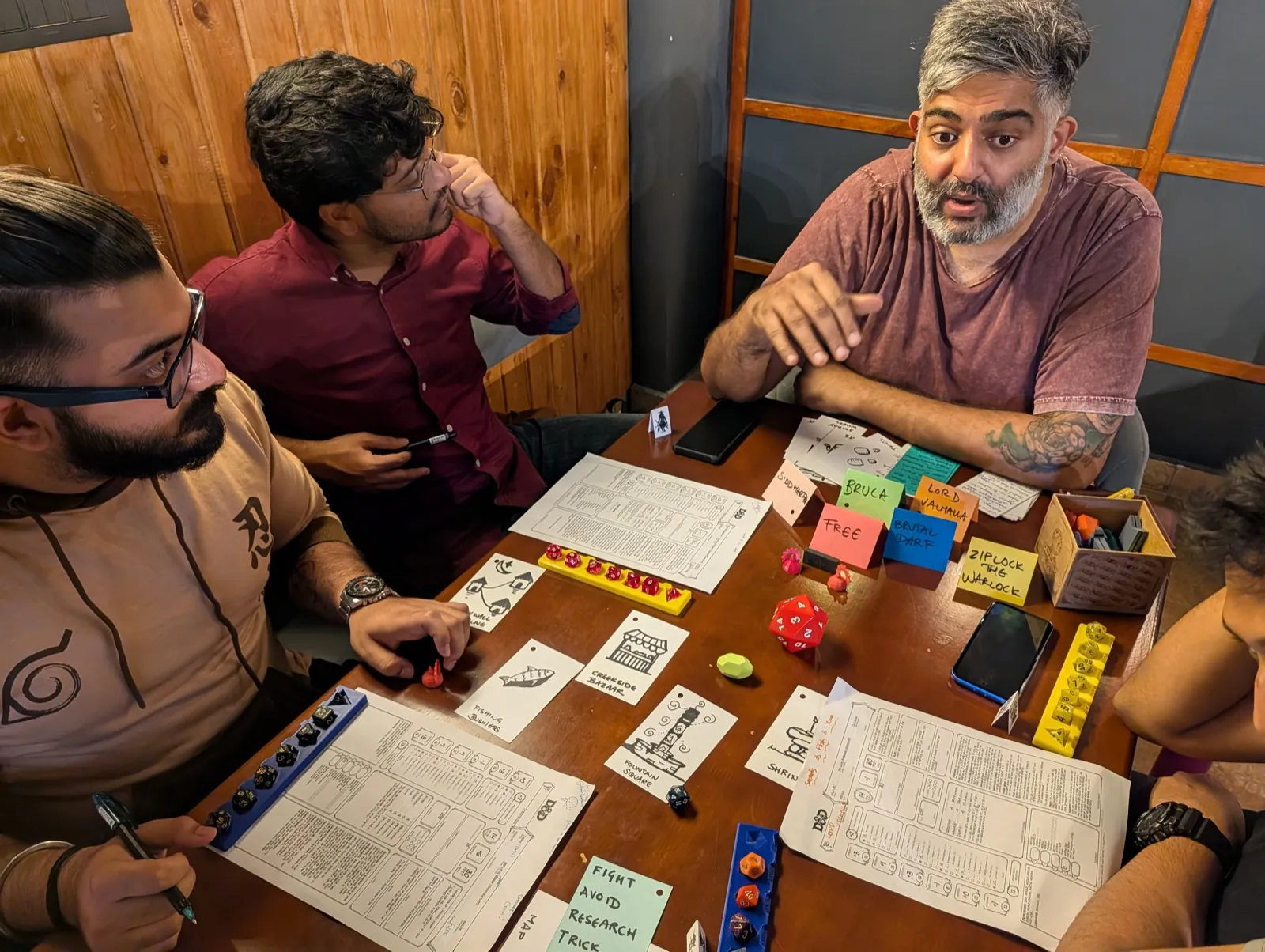
Serious games work by putting the conditions back. Consequences real enough to sting inside the game's own logic. Scarcity that forces somebody to choose. Interdependence that makes collaboration a strategy rather than a slogan on a wall. Information split unevenly, so influence has to be earned. Volatility. And moral tension, so ethics stop being a poster and start being a decision. None of that is decoration. That is the machine.
Serious Games are great for observing behaviour
Behaviour only becomes visible when a decision hits a constraint. Give somebody unlimited time and money and you learn nothing about how they prioritise. Make it scarce and you see it in minutes: who guards their patch, who negotiates, who shares, who builds a coalition, and who insists on doing everything alone right up until the arithmetic beats them. Give everybody the same information and you learn nothing about trust. Split it, so different people know different things, and you see exactly how somebody builds credibility while admitting they don't have the full picture - and how they behave the moment they realise the person next to them knows something they don't.
Leaders are more honest in serious games
This is why people are more truthful inside a well-built system than in any reflection exercise. In a reflection, I can tell you I value collaboration. In a role-play, I can perform collaboration for you beautifully. In a game with real scarcity, you get to watch whether I collaborate when it costs me something I could have kept... which is a different question entirely. The gap between what somebody says, what somebody can demonstrate, and what somebody does when it costs them - that gap is the whole development conversation.
 Four Decision Architectures That Make Leadership Visible
Here's the mechanical part, because this is exactly where gamified workshops fall over. Four architectures, used again and again, each one built to bring out a different piece of how a person leads.
Serious games present hard leadership choices
Scarcity architecture makes the resources - time, budget, information, backing - deliberately not enough for everybody to get what they want. Somebody has to choose. And the choosing tells you who protects themselves first, who negotiates from strength and who negotiates from panic, who pools resources early, and who ends up isolated wondering why nobody returns their calls. A garden teaches this as well as a boardroom crisis does, provided the soil and the water genuinely run out and everybody can see whose plot went bare.
Serious games present strategic leadership opportunities
Asymmetric information architecture hands different players different pieces. One knows the market. One knows the politics. One knows what the technology can actually do. Nobody can win holding only their own piece. So you get to watch how somebody builds credibility while admitting they don't know something, whether they trade information or sit on it for leverage, and what they do in the moment they work out that the person opposite knows more than they do.
Serious games present collaboration and influence opportunities
Alliance and interdependence architecture makes going it alone mathematically impossible. Your goal is reachable through other people or not at all. That drags the informal power map into daylight - who builds bridges, who builds walls, who trades win-win, who trades zero-sum, and who mistakes independence for strength until the system teaches them otherwise.
Serious games present choices and consequences
Cascading consequences architecture means every decision reshapes the board for the next one. A rubbish call in round one wrecks round four. An alliance made early becomes an obligation later. Information withheld in the first hour comes looking for you in the third. You see very quickly who thinks in systems and who thinks in silos - who is playing five moves out, and who is permanently astonished by second-order effects.
Serious games create conditions to make leadership behaviour visible
Why the architecture beats the theme should be clear by now. The story can be gardens or spaceships or a corporate crisis. What matters is whether the scarcity is real, whether the information is genuinely uneven, whether you truly cannot win alone, and whether consequences carry forward. Get that right and behaviour arrives on its own. Get it wrong and you have built an expensive icebreaker.
The Behavioural Science That Makes This Work
There is real science under this, not just taste. Cognitive load research says decision quality changes under pressure - not because people get less clever, but because working memory narrows and habit steps in where thinking used to be. Stress response research says honest behaviour surfaces whenever the stakes feel real in the moment, even when everybody in the room knows full well it's a game. Your nervous system doesn't check whether the consequence is real. It checks whether it is immediate, and whether people are watching.
Serious games test ambiguity tolerance
Ambiguity tolerance turns out to be one of the most reliable things separating leaders who do well from leaders who don't, and a simulation measures it directly by taking away the clarity a classroom hands out for free. Some people widen their options when things get uncertain. Others shut them down and grab for control. You cannot spot the difference in a discussion about managing ambiguity. You can only make actual ambiguity and watch.
Serious Games present raw, unfiltered data
And here's the part that separates this from any self-report tool or 360 review. What somebody does beats what somebody remembers about themselves, and it beats what their colleagues remember too. Both of those arrive filtered through wanting to look good, through whatever happened last week, and through the honest gap between intending and doing. I don't need to ask whether you collaborate when resources are tight. I can put you in a room where resources are tight, and watch. The data is behavioural, not perceptual. That is the whole difference.
 What Gets Revealed When Frameworks Collide With Reality
People don't reveal themselves in discussion. They reveal themselves in collision - framework against constraint, stated value against scarcity, long-term thinking against a deadline this afternoon, my success against ours. Serious games arrange those collisions on purpose and let the whole room watch what falls out.
Serious games show how people really behave
You see the real decision pattern instead of the tidy one. How fast somebody moves when nothing is clear, against how long they wait for a clarity that is never coming. Whether they ask around or just decide. How they weigh a win this quarter against a position next year. And you see influence with the job titles stripped off - who earns it through expertise, who through relationships, who through track record, and who changes tack when the first attempt bounces.
Serious games show how people really interact with each other
You see conflict styles turn up on their own, because the interests genuinely diverge - not because a facilitator handed out a conflict scenario at 2pm. What somebody does when another player's win costs them theirs. Whether they compete, collaborate, dodge or fold. And whether that shifts with the situation, or is simply who they are in every room they walk into.
Serious games present uncomfortable truths
And this is the part some organisations find genuinely uncomfortable. The ethical decision points arrive without anybody scripting them. Personal win against the collective one. Money now against trust later. Being straight with someone against being strategically vague. Those choices happen live, driven by real incentives, in front of colleagues. The game doesn't judge any of it. It just makes it visible, and therefore discussable, which is the bit that was always missing.
Serious games show how well leaders can think in systems
You see how far ahead somebody can actually see. Whether they optimise their own corner or the whole board. Whether the game feels to them like a string of separate decisions or one connected thing where every move sends ripples. Some leaders see three moves out. Others are surprised every single time. That gap is measurable, and it predicts real-world effectiveness better than almost anything else you can put on a spreadsheet.
The Misconceptions That Need Correcting Before We Go Further
Let me take the objections head on, because they're predictable and they're mostly a category error.
Serious games are not childish
"Serious games are childish." They're diagnostic instruments with consequences attached. Calling them childish is like calling an MRI childish because the patient has to lie down in a tube. The format doesn't set the rigour. The design does. I've watched a room of C-suite executives go completely quiet over a game about spaceships and breathable air, because the strategic tension was real. The spaceship was irrelevant. The scarcity was everything.
Serious games abstract complexity. They don't remove it.
"Games simplify reality." They show you what reality keeps hidden. Real organisations are so thick with noise that isolating a single behavioural pattern is nearly impossible. A serious game strips out just enough noise for the pattern to appear, while keeping the dynamics that produce it. That isn't simplification. That's signal extraction.
Serious games help leaders learn from ambiguity
"Learning must be clear and clean." Ambiguity is where leadership growth comes from, not an obstacle sitting in front of it. Remove it from the learning room and you produce people who panic the first time reality puts it back. The discomfort of not knowing the right answer isn't a design flaw. It's a rehearsal for every ordinary Tuesday.
Serious games are fun, not frivolous
"Serious games are entertainment." They're behaviour laboratories. High engagement doesn't make them frivolous any more than a stressful surgery makes it unnecessary. I design for engagement because engagement is the price of admission for honest behaviour, not because I want learning to be fun. The fun is a means. It was never the point.
Facilitators are limited by their environments
"Workshops fail because facilitators are weak." Workshops fail because the room limits honesty no matter who is standing at the front of it. I've seen superb facilitators run sessions that produced nothing usable, because the structure was quietly preventing it. That isn't weak delivery. That's a building with no windows.
How This Scales Without Breaking
These games run for 4 people and they run for 100-plus, without losing the diagnostic value - but the scaling logic is not the workshop one. Modularity does the work. The same decision architecture flexes by adding factions, adding resource complexity, or widening the information gap. A negotiation and alliance engine built for 15 works for 60 once you multiply the stakeholder groups and let coalitions nest inside coalitions.
Serious games can be customized for organizational context
Reusable architecture also means the theme can move. The same scarcity-and-consequences engine becomes a garden, a market entry simulation, or a colony on a dead planet. The story adapts to your audience and your context. The mechanics don't, because the mechanics are the part making the data.
Facilitation is important for serious games
Where quality control actually lives is the debrief. Running the game produces the patterns. The debrief puts them on the table and connects them to Monday morning. The work afterwards turns them into development plans and coaching conversations. That's the genuinely hard part to scale - not the game, the follow-through. A small game run three times with a ruthless debrief will beat a big production run once with a shrug at the end.
Serious games deliver great results with depth
Depth beats breadth, and not by a little. Organisations that run the same game three times with the same cohort - changing one variable each time and debriefing the difference - get more behaviour change than the ones who run three different games once each. Repetition with variation shows you the pattern. A single exposure just shows you a nice day out.
The Future Is Environments, Not Content
The future of leadership development isn't more frameworks, more content, more assessments or more workshops. It's better rooms. Consequence-based decision environments that make behaviour visible while it is still cheap. That isn't optional innovation. That's infrastructure.
It's the only method I've found that closes the distance between leadership theory and a Tuesday afternoon.
Serious games help you shift from perception to performance
The shift is already underway in organisations that have worked out something awkward: assessments and 360 reviews measure perception, and workshops teach frameworks without ever testing whether the framework survives contact with a real decision. Once you accept that behavioural data beats perceptual data, the uses are obvious - talent identification, supporting a manager into a bigger role, stress-testing a leadership team before the market does it for you, cultural diagnostics, a baseline for decision-making maturity.
Serious games are consequence-based learning systems
The end of that road is learning that isn't separated from performance at all. Development happens through progressively harder decisions instead of through content consumption, and what people actually did feeds coaching, succession and team design. Serious games aren't the whole ecosystem. They're the diagnostic engine that makes the rest of it precise.
You will either love serious games - or hate them
When the environment changes, behaviour changes with it. Serious games change the environment. That is the entire pitch, and it either lands with you or it doesn't, depending on whether you believe behaviour matters more than knowledge. I've built a career on believing it does, and the rooms keep proving me right.
Where This Shows Up in My Work
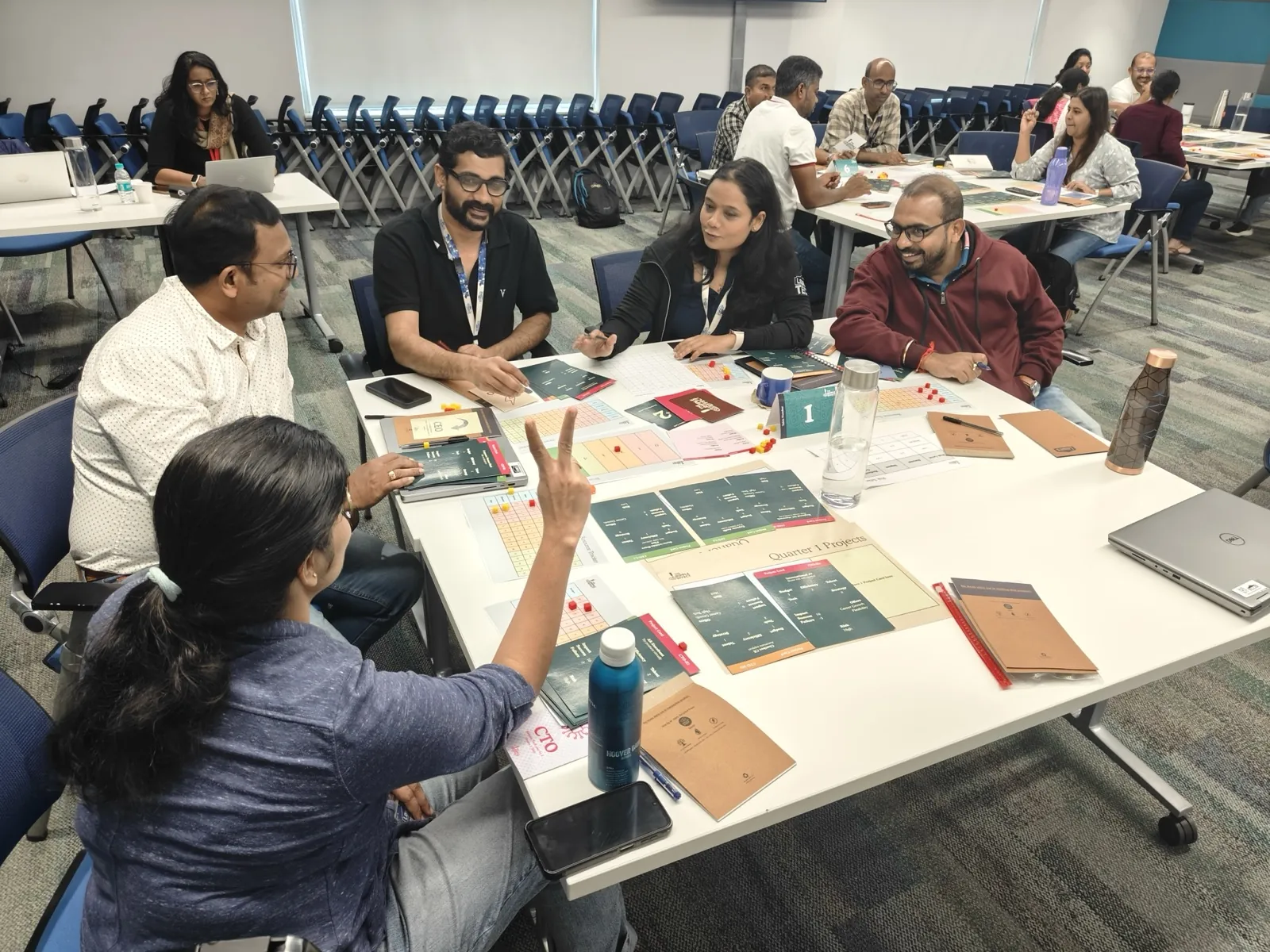
At Put The Player First I design and run these games for leadership development and team diagnostics, and none of the above is theory. It's what the work taught me, session by session. A badminton academy simulation that exposes prioritisation and systems thinking. A village festival game full of negotiation and ethical trade-offs. A TTRPG-shaped scenario where the complexity comes from the players rather than from me. Different clothes. Same skeleton.
It's all about context - just like the real world
I've watched leaders who interview brilliantly turn command-and-control the moment sharing started to cost them something. I've watched high-potentials who look flawless on paper come apart when the right answer turned out to depend on who you asked. I've run sessions where the political dynamic everybody knew about but nobody would name finally became discussable... because a game about gardening made the alliances impossible to deny. These aren't edge cases. This is simply what happens when you build a room where behaviour has nowhere to hide.
Serious games help leaders become better
The reason I keep building these is simple. Organisations keep telling me they need better leaders, and then keep training those leaders in rooms designed to stop leadership from showing up. That gap is fixable. Not perfectly and not universally, but repeatedly. Every rule I write is a guess about behaviour. Every session tests the guess. Every debrief turns what happened into something a person can use on Monday. It isn't entertainment and it isn't innovation theatre. It's diagnostic work that happens to be gripping, because gripping is the only state in which people forget to perform.
TLDR - Because Frameworks Don't Change Behaviour, Environments Do
- Stop teaching leadership in rooms that remove everything leadership actually needs
- Knowledge with no behavioural test is professional theatre, not development
- Decision architecture beats theme every time. A garden can expose politics
- Scarcity, ambiguity, interdependence and consequences aren't problems to fix. They're the features that make behaviour visible
- Leaders reveal themselves in collision, not in discussion or self-report
- What somebody does under constraint predicts performance better than what they say they value, or what a 360 says about them
- Small games repeated thoughtfully beat big productions run once
- The future of leadership development is better environments, not more content
- Make behaviour visible. Make consequences immediate. Make reflection unavoidable. That is the entire design philosophy, more or less
Here's how you can get started with serious games for leadership development
If you're tired of watching capable people come unstuck for reasons no workshop predicted, if you doubt that another 360 or another offsite will tell you anything you don't already know, if you've worked out that transferring knowledge and changing behaviour are two different jobs - this is the missing piece. It won't fix everything. It won't replace coaching or feedback or the hard-won experience of doing the job. But it will show you how your people lead when the consequences are real and the answer isn't obvious. And that, more than any single intervention I know of, is what makes development possible.
Tell me the challenge, the group size and the seniority. I'll tell you which game fits. And if none of them do, I'll tell you that too.
Book a discovery call WhatsApp me
Or the form below, if that is easier. It all lands with me either way.
Or just tell me what you are trying to fix
I went back and forth on whether to put a form at the end of this page.
Because a form asks you to be tidy about something you are probably still working out. And the enquiries I enjoy most tend to arrive as three messy lines, written by someone who has not finished deciding what they want yet.
So there are two ways in, and I genuinely do not mind which one you use.
Write to me directly at arvindh@puttheplayerfirst.com and say roughly what you want to change. Three lines is plenty. I read my own email.
Or fill this in, if that is easier. It lands in the same inbox.
I answer these myself, usually within a day. Two if I am in a room somewhere with my phone in a bag.
And you are not committing to anything by writing in. Worst case we have a conversation, and you come out of it with a clearer brief than you had this morning.
With love from Bengaluru, this is Arvindh saying over and out.

See Also
Explore the serious games referenced throughout this guide, and the case studies that show them at work:
The games
- Bloom, stakeholder management, relationships, and influence
- Chaos in the Kitchen, strategic thinking, optionality, and prioritisation under pressure
- Decision Labs, decision-making, ambiguity, and problem-solving
- Planetfall, learning agility, adaptability, and decisions under uncertainty
- Ripple Effect, cross-functional collaboration, breaking silos, and local-versus-global trade-offs
- Sticky Fingers, collaboration, communication, and creative problem-solving
- The Potter from Belagavi, working smarter instead of harder, and investing in tools that compound
- Welcome to Zombiepuram, negotiation, influence, and coalition-building
Case studies
If you want to build one yourself
Some people get to the end of this guide and want to design their own game rather than book one of mine. That is a completely fair place to land.
- Build Your Own Serious Game, a five-session mentorship where you do the designing, playtest between sessions, and own the finished game
- Custom game design, for when you want the game but not the job of building it
- Every programme in one place, including the AI ones
Related reading
- What is a serious game? A plain definition
- Leadership simulation games: what they are and how one runs
- Facilitation philosophy: why I run it this way
- Serious games for corporate training: what they are and why they work
- Change management training for leaders: why simulations beat seminars
- Decision Labs: how we turn decisions into behavioural data