Change Management Training for Leaders: Why Simulations Beat Seminars
"Change fails at the human layer. Always. And we keep training for it at the conceptual layer."
The research is not subtle about this. Somewhere between 60 and 70 percent of change initiatives never land what they set out to land.
And usually the strategy was fine. The systems got updated. The comms went out. What didn't happen is that people carried on working, talking, and deciding exactly as they had the month before. Change happened on paper. Humans did not participate.
That's the problem change management training is meant to solve. Most of it doesn't. Here's why, and what does.
The Gap in Change Management Training for Leaders: Model vs. Reality
Every change practitioner has a favourite framework. Kotter's eight steps. ADKAR. Lewin's unfreeze-change-refreeze. Bridges. All of them genuinely useful, all built from real observation, all giving people a shared language for what's going wrong.
The frameworks aren't the problem. The problem is what happens when you teach them.
Teach a change framework to a room of leaders and you get leaders who understand change frameworks. That is not the same as leaders who are better at leading change, and the distance between those two things is enormous.
Leading change means reading resistance accurately without dismissing it. Holding your nerve on direction while genuinely changing your mind about implementation. Managing your own anxiety well enough that you don't leak it all over the people you're meant to be steadying.
None of that is knowledge. All of it is a skill, and skills need reps.
What most organisations commission provides understanding instead. And understanding change management is about as useful as understanding tennis. Intellectually satisfying. Absolutely no help on the court. Leadership and management training that actually changes behaviour works differently to the seminar everyone defaults to.
Resistance Is Information, Not Obstacle
Resistance almost never comes from nowhere. When people push back on a change, they're usually responding to something real - an operational problem nobody upstairs has thought about, an implementation gap, or a very reasonable fear about what this does to their role and their standing.
There's nearly always something underneath. And nearly every leader knows this.
They know it right up until the moment they're under pressure, at which point the instinct is to push, and they push.
You don't fix that with a slide explaining that resistance is information. You fix it by putting a leader somewhere they feel their own instinct to push, watch what it costs them within about four minutes, and get a felt sense of why the other approach works. Felt, not understood. That's the whole difference.
The Three Ways Change Actually Fails
Before you pick a format, name what actually goes wrong. It's almost always one of three things.
Misread resistance. The change is sound. Leaders read opposition as obstruction rather than information, so they push harder, and the resistance sets like concrete. What started as a solvable concern becomes a position somebody now has to defend publicly. The gap isn't knowledge of models. It's staying curious when you're being challenged, which is much harder than it sounds.
Coalition collapse. Early support looks stronger than it is. Key people nod warmly in one-to-ones and go quiet in the room. Then the first real obstacle arrives, everyone looks around, and the coalition turns out to have been three people and a lot of politeness. The gap is telling stated support apart from actual commitment - a distinction that only becomes visible under pressure, which is exactly when it's too late.
Pace mismatch. The leader's timeline and the organisation's capacity to absorb don't match. Too fast and the anxiety makes resistance explosive. Too slow and it loses legitimacy and quietly dies. The gap is calibrating in real time - knowing when to push and when to let the thing breathe.
Standard training covers all three beautifully. At the conceptual level. Where nothing lives.
Why Simulations Produce What Seminars Can't
A simulation puts people inside the change instead of outside it.
They're not analysing a case study of someone else's initiative. They're running one, live, alongside other people who have their own agendas, blind spots and reactions to pressure. Decisions have weight inside the system. Consequences turn up in ways nobody predicted. And the emotional part of leading change - the resistance, the coalition-building, the moment your own conviction wobbles - becomes something you can actually put on the table and look at.
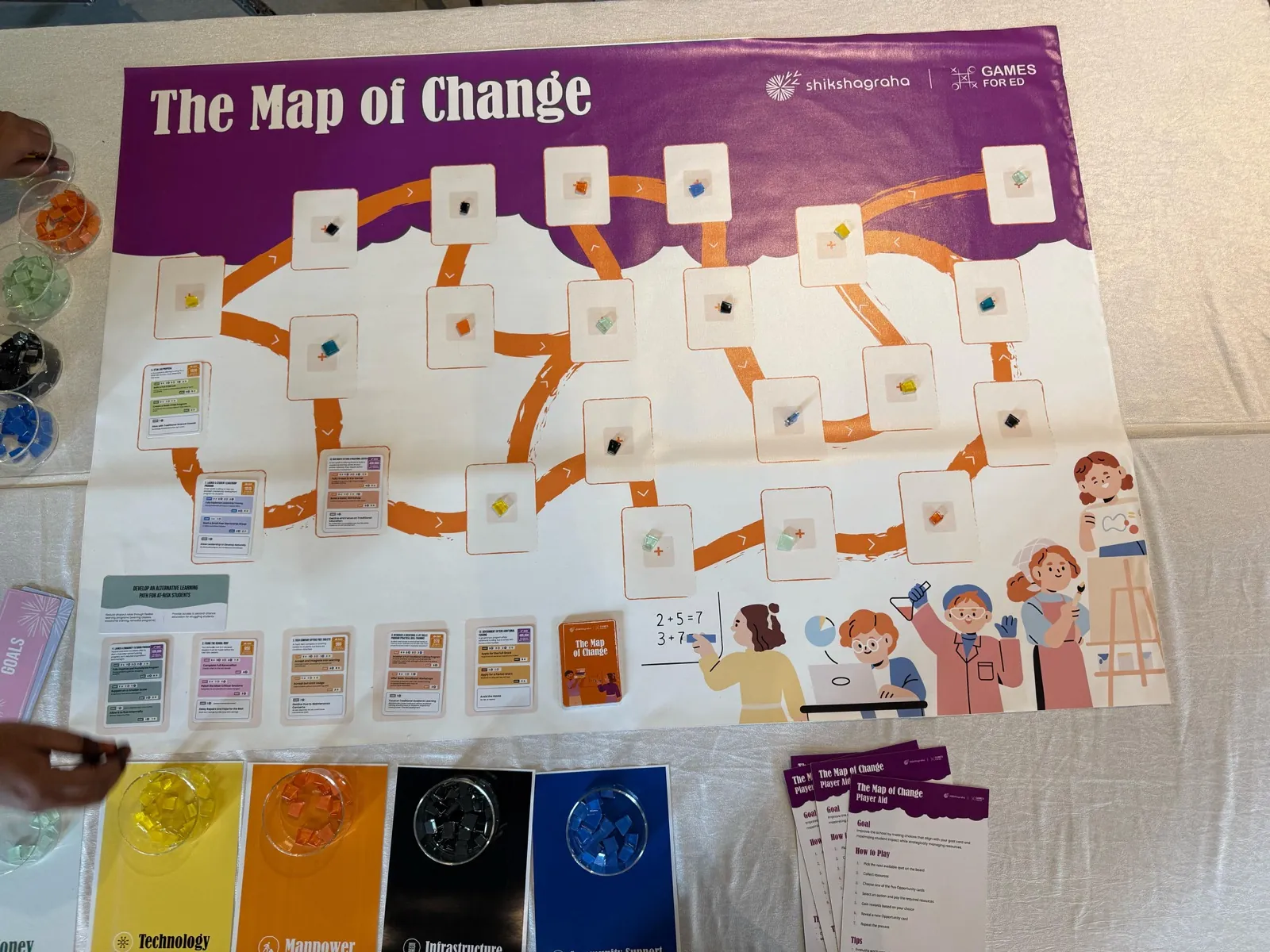
That's why serious games for corporate training have picked up ground in this space.
Because "what did you do in round two, when the coalition started coming apart?" maps almost exactly onto "what are you going to do next month, when your implementation team hits the first real wall?" Same question. One of them people can actually answer honestly, because it already happened.
What Good Change Management Training for Leaders Actually Develops
The capabilities worth building are specific, and they're learnable. Reading a room properly rather than assuming you already know how it feels. Telling apart a concern that's about the operation and a concern that's about losing status. Knowing when to hold the direction and when to change the plan. Building your coalition before you need it, rather than scrambling for support the week resistance crystallises.
None of that develops in a lecture. It develops through repeated practice in conditions close enough to the real thing, followed by somebody making you look at what you just did. Experience, observation, reflection, application - that's the loop adults actually learn complex skills through.
The seminar format jumps straight to reflection and skips the experience that would have made reflecting worth anything.
There's one more thing, and it's the hardest to train. Equanimity. Staying steady while the environment is uncertain and everybody near you is anxious. It's partly temperament, yes. But it's also just having been through enough difficult things to trust that you'll get through this one. A simulation can't fully replicate the stakes of a real restructure. It can absolutely build the reps. Worth noting alongside this: Prosci's research on change management ROI finds organisations applying structured change management are six times more likely to hit their objectives.
Who the Programme Is For
Two groups, mainly.
Mid-level leaders implementing a change they didn't design. The squeezed ones. A directive from above they may privately have doubts about, and a team below with concerns they're expected to absorb. These are also the people most likely to perform change management - hold the town hall, forward the deck, follow the playbook - without ever working through any of it. Put them inside that squeeze in a game and ask them to get out, and you get insight no amount of theory will produce.
Senior leaders sponsoring a change they aren't personally running. Sponsors consistently underestimate how loudly their own behaviour speaks. Where they turn up, what they ask about, what they let slide - the organisation reads all of it as the real answer on whether this change is happening. A simulation that shows them their own pattern, including where they delegated too early and where they sent two different signals in the same week, is a mirror that survey data never manages to be.
Where it's a poor fit: an organisation in the middle of a crisis change. The urgency is too high for a reflective half-day and I'd be taking your money. It works best before an initiative starts, as preparation, or after phase one, as a diagnostic of what's actually happening versus what leadership believes is happening. Those two are rarely the same document.
What This Looks Like in Practice
At PutThePlayerFirst.com, this work starts with a diagnosis, not a game.
What's the change really? Where is the resistance sitting, and what is it telling us? Who has the most to lose and the most influence over how this goes? And the awkward one: what is the leader's own relationship to this change - are they genuinely bought in, or are they also quietly ambivalent and hoping nobody notices?
Then the design question. What do these people need to experience to build the capability this particular situation demands? Sometimes that's a high-stakes stakeholder conversation. Sometimes a multi-faction negotiation that mirrors the real coalition mess. Sometimes a game about information asymmetry and trust, because that turns out to be what's actually making this hard.
The debrief gets designed before the game is finalised. Always. If I can't connect what happens on the table to what's happening in your building, the game isn't right yet and I go back and change it. Thematically adjacent isn't good enough - it has to be structurally joined. There's also the guide to leadership workshops if you want the wider picture.
What Happens After the Session
Two things come out that you can actually use.
A written behaviour summary. Not individual scorecards - a picture of how this cohort handles uncertainty, meets resistance, and holds or loses a coalition. Built to be handed to the CHRO or the change sponsor, so they're working from observed patterns rather than impressions.
Committed action plans. Everyone leaves with one named behaviour and one specific situation in the next four weeks where they'll use it. Written before the session ends, while it's still live, and said out loud to the group, because saying it out loud is what makes it real. A follow-up at thirty days finds out whether the intention survived contact with the calendar.
Together those give you a concrete next step that exists outside the training room. The session is the start of something, not the thing itself.
Change fails at the human layer. So the training has to work there too - not with better explanations of why change is hard, but with the experience of doing it, being bad at part of it, and building the judgement to be less bad next time.
That's what a well-built simulation does. And it's why organisations that use this format tend to notice, a few months later, that their change initiatives are landing differently.
With love from Bengaluru, this is Arvindh saying over and out.
See these ideas in action
Put The Player First runs serious game sessions for leadership teams across India. The designer is in the room for every session.
See the games Get in touch