Leadership Workshops: The Complete Guide (and Why Most Fail)
"The entire success of a workshop can often be traced back to how well the structure was planned. Not the content. The structure."
I've been running leadership sessions since 2019, and that's the conclusion I keep landing back on.
Organisations agonise for weeks over which frameworks to include, which speaker to book, which activity will land. Then they schedule it all back-to-back with no break after lunch, pack five objectives into a half day, and wonder why nothing survived the week.
The content was fine. The container was broken.
So here's the whole thing - what makes a leadership workshop work, and what quietly kills most of them.
The Signs a Workshop Was Actually Well Designed
First sign: focus. One or two objectives, not twelve.
I understand the pressure completely. Getting senior people in one room is expensive and logistically horrible, so of course you want to cram it full while you have them.
But cramming is the enemy of retention. A workshop that covers stakeholder management, communication styles, change leadership and feedback culture in three hours has covered none of them. People leave with a vague sense of having been informed and nothing they can do on Monday.
Second sign: energy management. Breaks aren't admin. They're design.
People manage about 90 minutes of engaged work and then need air. And the first hour of any workshop is mostly decompression anyway - people arriving out of back-to-back meetings, still carrying whatever happened at 10am, physically present and mentally somewhere else entirely. The last stretch needs room to land, close and connect.
A day that runs content wall to wall isn't efficient. It's just less effective, faster.
Third sign: variety in delivery. Not variety for its own sake. Variety because people take things in differently. Some need to hear it. Some need to see it drawn. Some need to move it around with their hands before they can think about it. Run the whole day on discussion and reflection and you'll lose that third group entirely. That isn't a character flaw on their part. It's just how learning works.
Fourth sign: success was defined before the design began. And not "participants will understand the framework" - that's an output, not an outcome. What behaviour should be different afterwards? What should somebody be able to do in their job that they couldn't do as well before?
A workshop with a clear success definition has something to design towards. A workshop without one is content delivery with a good catering order.
The Mistakes Organisations Make When Commissioning Workshops
The commonest mistake is solving the presenting problem instead of the real one.
Management spots a symptom - poor collaboration, low engagement, missed deadlines - and commissions a workshop on that word. But the root cause is usually sitting next door. Unclear decision rights. A culture where challenging someone isn't safe. A gap between what gets rewarded and what gets said in the town hall.
A workshop on collaboration does not fix a broken incentive structure. Get the diagnosis wrong and the intervention is irrelevant, however well it's run.
Second mistake: treating attendance as sufficient. Who is in the room matters enormously. If the genuinely influential people aren't there, the people who are won't implement any of it, because the environment they walk back into hasn't moved an inch.
Worse is a senior leader who is present and visibly disengaged. Phone out, leaves early, clearly attending because somebody made them. That does more damage than not coming at all. Participant investment tracks leadership investment with almost embarrassing precision.
Third mistake: using credentials as a proxy for quality. I'm not dismissing them - they say something real about training and body of knowledge. They say nothing about whether this format will change behaviour with your people around your problem.
The question isn't "what are your qualifications". It's "how will the behaviour change happen, and how will we know whether it did".
What Participants Should Actually Walk Away With
The most valuable thing out of a leadership workshop isn't knowledge. It's a new lens.
Hacks are useful, genuinely. Quick techniques, a reframe, a tool somebody can use tomorrow without fully understanding why it works. Take the hacks.
But the return arrives when someone leaves seeing a situation they face every single day differently.
The difference between a hack and a lens is durability. A hack works until the situation changes. A lens works across situations, because it's changed how the person reads what's in front of them.
A workshop on feedback that teaches a framework gives you a hack. A workshop that makes you give real feedback to a peer, live, with mild social discomfort in the room, and then takes apart what actually happened - that has a chance of giving you a lens.
Which is why the workshop format beats the course format for leadership specifically. A course delivers content over time, systematically, with assessment. Perfect container for knowledge. A workshop creates one concentrated shared experience that can be debriefed and attached to real work immediately.
Different tools. Using a course where you needed a workshop is like learning to ride a bike from a manual.
Designing for Transfer: How Learning Survives Monday Morning
The hard part of workshop design isn't the room. It's the fortnight after it.
Most workshops end with good intentions and a list of actions that die quietly within two weeks. That isn't laziness. It's that nothing was built to hold the new behaviour up. People go back to environments designed without any knowledge of the workshop, and the old pattern wins because the old pattern is frictionless.
So transfer has to be designed for, deliberately.
That means building the check-in structure inside the session rather than handing out a template and hoping. It means co-designing what accountability actually looks like for these people in their real context. It means naming a small number of concrete behaviours for week one, not a broad aspiration to "be more collaborative". And it means leaving them shared reference points - a game they played, a moment in the debrief, a principle they named themselves.
The instinct to close with "here's my email, reach out any time" is well-meant and almost completely useless. It puts the work on the participant, and nobody ever does it.
The better question, asked while everyone is still in the room: what can we build right now that will still be running in six weeks without me in it? Whatever answers that is the real deliverable.
What All of This Looks Like in Practice
My process starts with a conversation about the root problem - not the brief, but what's actually costing you money and people.
Then I work backwards. What do these participants need to experience to shift? And what would make that experience real enough to produce genuine insight rather than the performed kind?
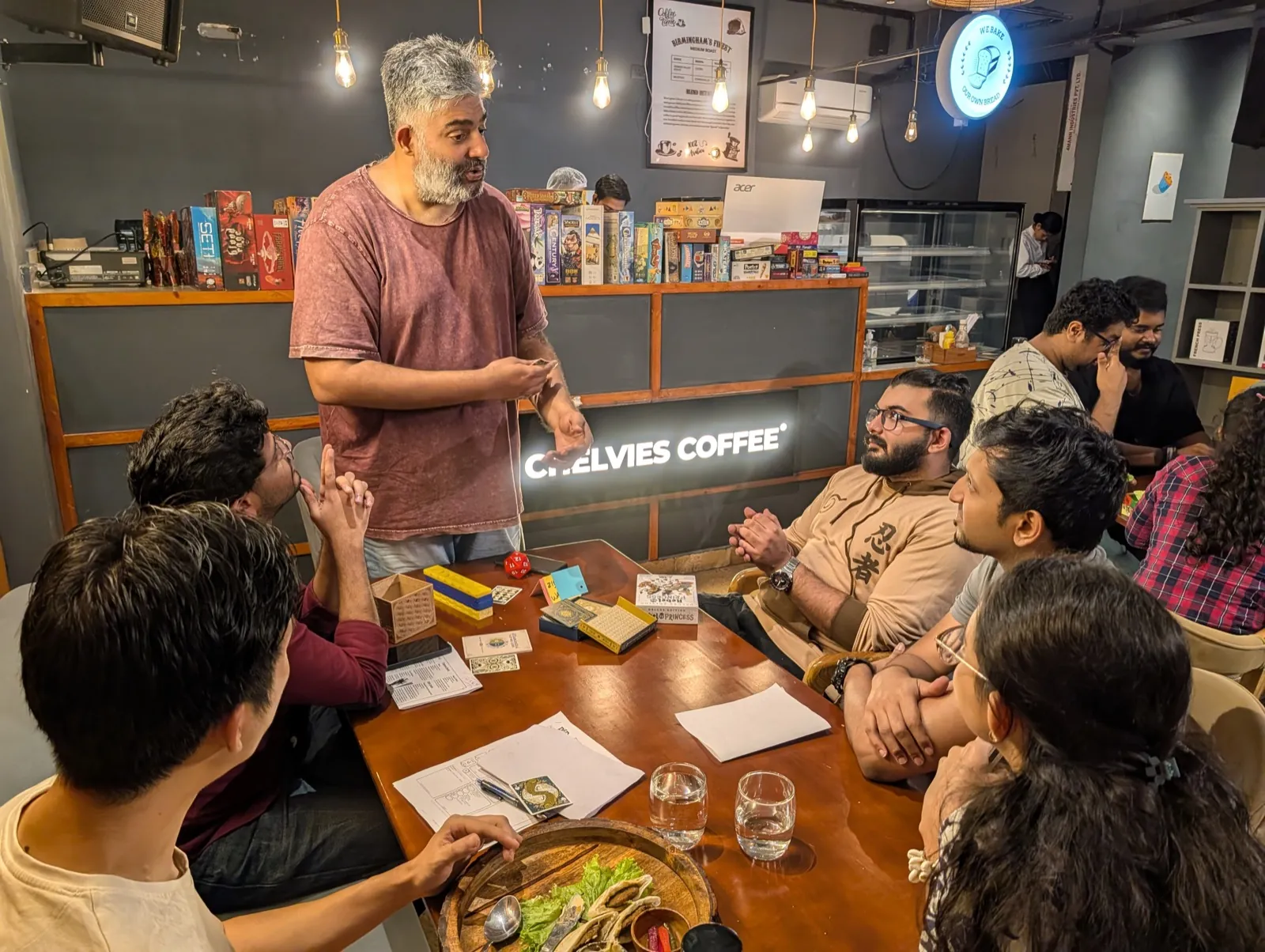
The serious games I design are built around exactly that question. They create conditions where honest behaviour surfaces, so the debrief has something real to work with and the principles belong to the group rather than to my slide.
And the structure gets the same attention as the mechanics. The pacing, the breaks, the social contract at the start, the ritual at the end. Because a brilliant game inside a badly built day still fails, and I've watched that happen.
Most leadership workshops fail quietly. Everybody leaves feeling like something happened. Three weeks later, nothing has.
The difference between that and one that moves something isn't the quality of the content. It's whether the design treated behaviour change as the deliverable or as a pleasant side effect.
It's always one or the other. And you can usually tell which one you're sitting in by the end of the first hour.
With love from Bengaluru, this is Arvindh saying over and out.
See these ideas in action
Put The Player First runs serious game sessions for leadership teams across India. The designer is in the room for every session.
See the games Get in touch