
 Why a classroom tells you nothing about a BFSI team
Banking, financial services and insurance run on control, and that is exactly what makes your leaders impossible to read. The culture rewards caution, deference to whoever is most senior in the room, and covering the downside before anybody asks. Those are the right instincts for the business. They are terrible conditions for a training room.
Put a BFSI team in a classroom and here is what comes back. The textbook answer. Three nods towards the head of the table. A very polite "we should take that offline". And nothing whatsoever about how these people behave when a real decision carries real risk and somebody has to own it.
Meanwhile the leadership problems that actually cost you money are structural. Retail, operations, risk, compliance and treasury each guarding their own numbers, each entirely correct on their own terms, and the customer paying for every seam between them. Your mid-level managers can feel the friction. They can describe it precisely, over coffee, to one trusted colleague. They will not say a word about it in a room stacked three levels deep. That is not a courage problem. That is arithmetic.
What a serious game surfaces in BFSI
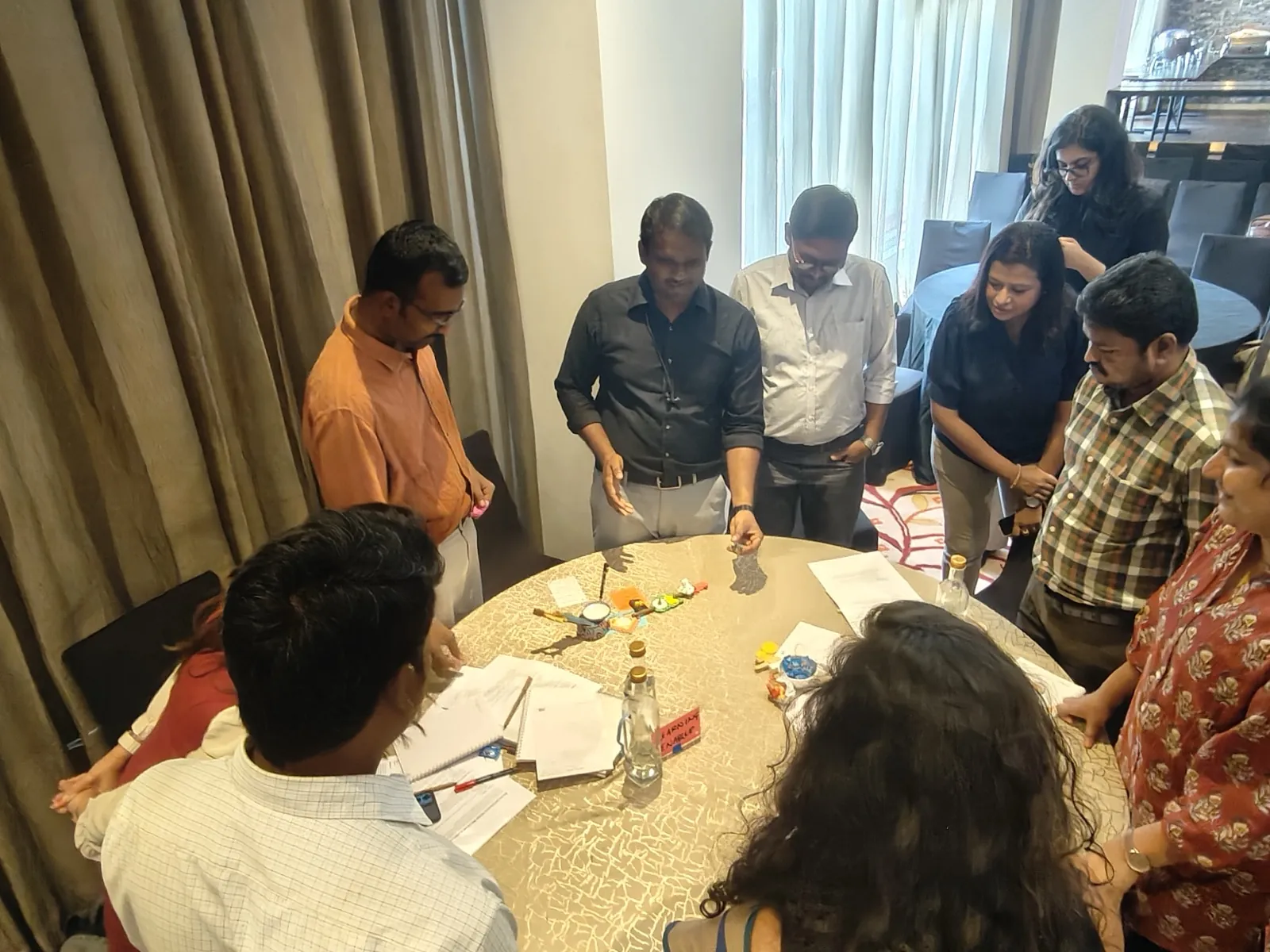
A serious game is a designed scenario that puts real pressure on real people, followed by a debrief that names what came out. The reason it works in a risk-averse culture is almost boringly simple: the simulation gives everybody cover. Nobody has to volunteer a criticism of a colleague or a function. They just play. The pattern turns up on its own, in front of everyone, and then there is nothing to deny. In one afternoon you see:
- Who quietly optimises their own silo even when it damages the whole - the trade-off nobody has ever once admitted to in a status meeting.
- Who goes silent the second a senior voice speaks - and roughly how much good thinking you have been losing to that one reflex, every week, for years.
- Who keeps deciding cleanly when the information is incomplete and the clock will not wait, and who locks up and calls it due diligence.
- Who builds the coalition - and who finds out about the decision afterwards, from an email, with everyone else copied.
The debrief names those patterns as behaviour, never as an accusation. In a hierarchical culture, that is the only form of honest feedback that survives past four o'clock.
 Which games fit a BFSI programme
I match the game to the behaviour you want to examine, not to a theme. For BFSI, these are the sharpest fits:
- Ripple Effect - cross-functional trust, and the silo-versus-collective trade-off. Built for the classic BFSI trap where every single function wins and the bank loses. 16-60 people, 75-90 minutes of play.
- Planetfall - deciding under uncertainty, and learning agility. For teams who have to act on partial information without freezing or ordering one more analysis. 8-20 people, ~2 hours.
- Chaos in the Kitchen - senior decision-making when conditions keep shifting. Built for business-head and function-head cohorts. 15-50 people.
- Welcome to Zombiepuram - influence and coalition-building, for leaders who have to move a decision through functions they do not control and cannot instruct. 15-80 people, ~6 hours.
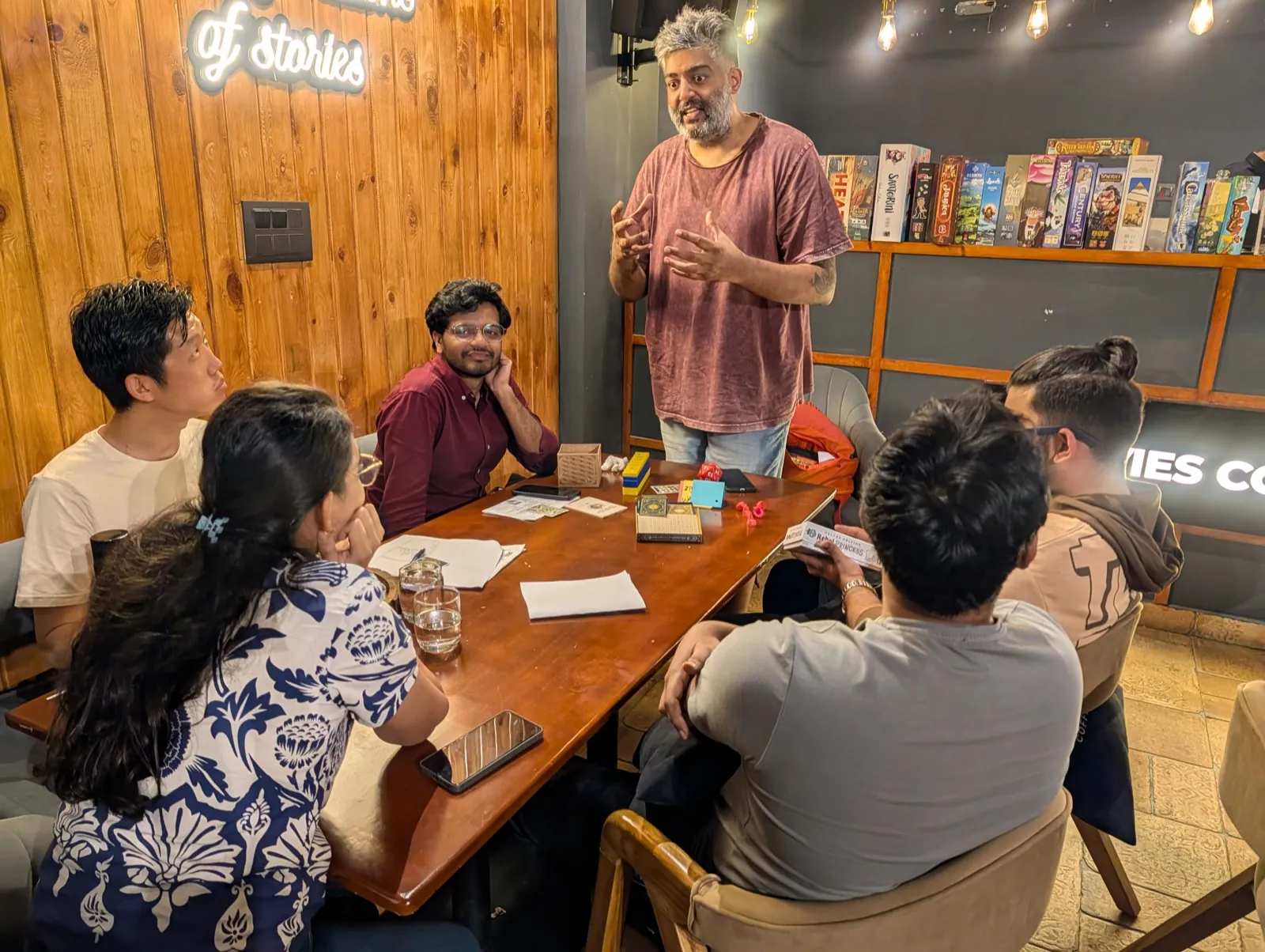
Why I run every session myself
In a hierarchical room, the debrief is the whole product. And a debrief only works if the person running it watched the room with their own eyes. So I don't hand these off. No associate delivery, no licensed facilitator working off my slides. The person who designed the simulation is the person who runs it, watches how your teams behave inside it, and gives it back to them straight. A stranger reading a deck simply cannot do that - they have nothing specific to say, so they say something general, and general feedback bounces off a BFSI audience like rain off a windscreen. That is the difference between a pleasant offsite and risk finally telling operations the truth on Monday.
 Proof
Proof
I have run these programmes out of Bengaluru for technology and services organisations carrying the same risk-aware, hierarchical dynamics your teams live inside. A leading HR-tech platform's frontline manager cohort: all 13 participants agreed they understood the learning objectives, with not one negative response across any of the four measures. And a Fortune 100 company came back and commissioned a second, different programme, which, honestly, is the fact I trust most.
What you get
- A discovery call and a written brief, calibrated to your functions and the seniority mix in the room
- The game itself, half-day or full-day, run by me - the person who built it
- An EPPA debrief, designed to make behaviour visible and then name it clearly
- A written behaviour summary afterwards, ready to put straight in front of a CHRO or a leadership committee
- A committed action plan from every single person in the room
And here is my promise: if the session doesn't surface at least three named leadership behaviour patterns worth changing, I redesign the next one at no cost. Nobody should pay for a session that showed them nothing.
What it costs
A day in the room runs between ₹60,000 and ₹1,00,000, plus taxes as applicable.
Half a day is half of that. So ₹30,000 to ₹50,000, plus taxes as applicable, on the same terms.
Both of those are ranges rather than a price list, and I do mean that. A short session with a lot built into it can land above a longer one with very little, so the clock is only part of it.
I put the range here because you should not have to sit through a call just to find out whether we are in the same ballpark. If that number is nowhere near your budget, you have saved yourself a fortnight and I would still rather you wrote to me and said so.
Where you land inside either of them comes down to five things, and none of them are a mystery:
- How long we are in the room. Half a day with one game and its debrief is one thing. A two-day programme is another.
- How many people are in the room, and how senior they are. Fifteen managers and sixty leaders are not the same day's work.
- How much I build from scratch. Running a game I already own costs less than designing your world, your constraints and your data into a new one.
- Whether I am leaving Bengaluru. Travel and stay are quoted separately, up front, so nothing appears on the invoice we did not talk about first.
- Whether it is one session or a series. Four batches of the same programme do not cost four times a single batch, because the design is built once.
A bespoke senior day, built from nothing, in another city, sits at the top of the band. A game I already run, one batch, here in Bengaluru, sits at the bottom. Most work lands somewhere in the middle, and I will tell you which end you are at in the first conversation rather than the third.
One honest thing about the calendar while we are being straight with each other. I take two or three engagements a month, mostly because I run every one of them myself, so dates go three or four weeks out. I would rather say that now than when you already have a date in mind.
Tell me roughly what you are trying to fix and you will have a real number, not a range, within a day of us speaking.

Frequently asked questions
Do serious games work in a hierarchical, compliance-heavy BFSI culture?
They work best there. The whole problem in a bank or an insurer is that hierarchy and risk-aversion switch off honest behaviour the moment a training room opens. A simulation gives everyone cover. People act, decide and disagree inside a scenario, and afterwards the debrief can name what happened without anybody having to stick their neck out first. The game surfaces the pattern, not a colleague. That distinction is the entire trick.
Which serious game fits a BFSI team?
Ripple Effect for silos and cross-functional trust. Planetfall for deciding when the information is incomplete and the clock will not wait. Chaos in the Kitchen for senior decision-making when conditions keep shifting. In the pre-session brief I match the game to the behaviour you actually want to look at, which is usually not the one written on the training request.
Can this address silos between functions like risk, ops, and sales?
Yes, and that is precisely what Ripple Effect was built to expose. It creates a situation where doing right by your own function quietly damages the whole, and then makes that trade-off impossible to look away from in the debrief. Teams leave able to point at where their real silos sit, instead of nodding along that silos are bad in the abstract for the fourth year running.
Related
- Serious games for leadership development in India
- How to break down silos between teams
- Decision-making under uncertainty
With love from Bengaluru, this is Arvindh saying over and out.