
What a serious game really is (and isn't)
Not a team-building exercise. Not gamification. No points, no leaderboard, no wristbands. A serious game is a designed simulation where real leadership behaviour comes out under pressure, followed by a debrief that makes that behaviour visible, names it plainly, and ties it to what has to be different on Monday.
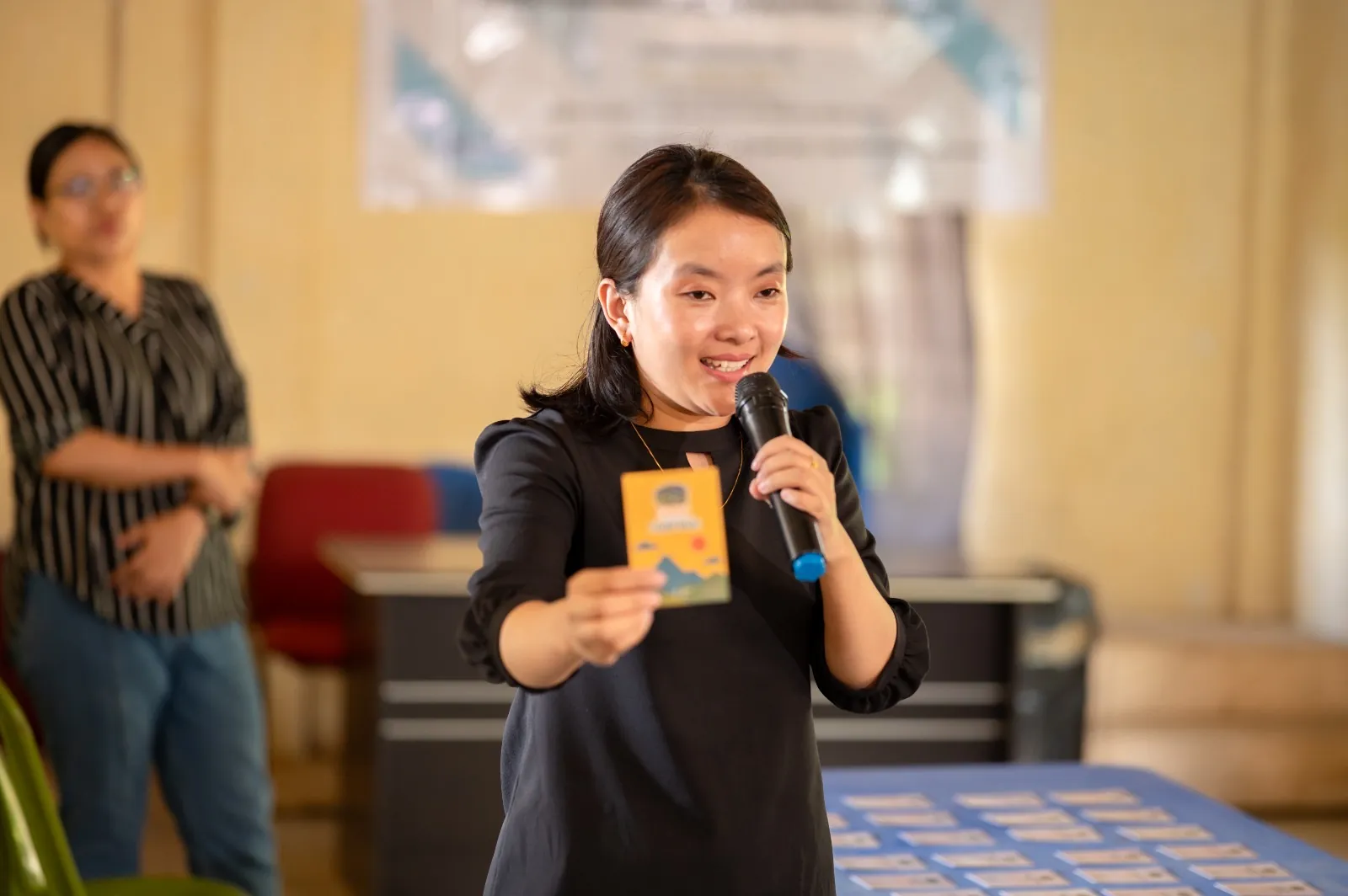
Something I cannot argue my way around, and I have tried. Everyone in your leadership cohort already knows how to perform in a workshop. They have had practice. They nod at the right slide, they say the sensible thing in the breakout, they fill the feedback form kindly. Put the same people inside a simulation with a clock running and it all falls away in about eleven minutes. The real decision-maker appears. So does the real collaborator. So does the one who goes very quiet the moment things get complicated.
Which is why the debrief is a different animal. I am not reading from a deck. I watched it happen, and I say it back to the room - specifically, and without spin.
 Why imported games fall flat in Indian rooms
Most of the serious games and simulations sold in India were built somewhere else. They quietly assume the participants will challenge their boss, speak freely, and own a mistake in front of twenty colleagues. Lovely assumptions. Now run that in a GCC, a family-run conglomerate, or a properly hierarchical pharma or BFSI floor... and what you get is polite silence and a very good tea break.
Mine are designed here and run here, calibrated for what Indian rooms actually do - the coalition that forms in the corridor, the deference that swallows honest feedback, the nod that everybody reads as agreement and nobody means. The trick is that the simulation surfaces it, not me. Nobody is put on the spot by a facilitator with a theory. The game just happened, and everybody saw it.
Programmes have run out of Bengaluru, plus IIM Bangalore and IIM Indore. In person, half-day and full-day, 15 to 150 people depending on the game.
Who brings me in
Usually an L&D head or an HR director somewhere between 200 and 2,000 people. The situations that keep landing on my desk:
- A new CHRO who would like to see actual behaviour before signing away the development budget on faith.
- A GCC that has done the 360s and the workshops - all of them, twice - and the behaviour is exactly where it was.
- A team with a dynamics problem everyone can feel - silos, crossed wires, influence going nowhere - and nobody can say out loud what it actually is.
- A company scaling fast that needs its mid-level managers deciding better this quarter, not after a two-year framework rollout.
- An L&D consultancy that needs a serious games and simulation partner for a client programme.
Clients have included a Fortune 100 company, a leading HR-tech platform, a Fortune 500 technology company, a global retail corporation, a global engineering and technology firm, a global pharmaceutical company, an enterprise software company, a large agri-inputs company, IIM Bangalore and IIM Indore. One of them came back and commissioned a second, different programme.
 The seven games
Each one surfaces a different behaviour. Pick the game for the behaviour you need to look at, not the theme you fancy talking about. This is the single most common mistake I see, and it is an expensive one.
- Welcome to Zombiepuram - influence, coalition-building, political intelligence. 15-80 people, ~6 hours.
- Bloom - stakeholder management, networking behaviour, relationship investment. 12-40 people, ~2 hours.
- Sticky Fingers - emergent leadership, collaboration under pressure, information sharing. 12-150 people.
- Planetfall - learning agility, ambiguity tolerance, adaptive decision-making. Up to 20 people, ~2 hours.
- Ripple Effect - cross-functional trust, systems thinking, silo vs. collective optimisation. 16-60 people, ~3 hours.
- Chaos in the Kitchen - senior leader decision-making under shifting conditions, strategic thinking. 15-50 people.
- The Potter from Belagavi - working smarter instead of harder, investing in skills and tools that compound. 12-40 people, ~45 minutes.
Why this works, in one sentence of research
This argument was settled a long time ago and we all keep pretending it is open. Kolb's cycle, the 70:20:10 model, decades of training-transfer research: knowledge moves in a classroom, behaviour moves through experience, reflection and application. That is the whole finding.
A simulation just compresses that cycle into one session. The experience is the game. The reflection is the debrief. And the application - actual named commitments, from actual named people - happens before anyone gets up for their bag.
The numbers, since you will want them: one programme at a Fortune 100 company scored 8.82/10 average satisfaction across 113 respondents over six session-days. A leading HR-tech platform recorded 100% comprehension across 13 participants, with not one negative response on any of the four measures. Not vanity numbers. They measure whether the thing landed.
 What every programme includes
- A pre-session discovery call and brief
- The facilitated game session (half-day or full-day), run by me, Arvindh Sundar, the person who designed the game
- An EPPA debrief, built to make behaviour visible and name it clearly
- A written behaviour summary afterwards, ready to share with a CHRO or the board
- A committed action plan from every person in the room
No associates. No licensed delivery with me somewhere else that day. And a promise: if the session doesn't surface at least three named leadership behaviour patterns worth changing, I redesign the next one at no cost. You should never pay for a session that showed you nothing.
Pricing
Programmes start at ₹50,000 for a group of 15-25. Your number depends on group size, seniority, location, and whether it is one batch or six. Send me a note and you will have a quote within 24 hours of the discovery call.
One honest constraint, because I would rather say it here than after you have fallen in love with a date: I take two or three programmes a month, mostly because I run all of them myself, and slots go 3-4 weeks out. If you have a date in mind, come and talk early.
Frequently Asked Questions
Are serious games suitable for all seniority levels?
Different games for different levels. Bloom and Sticky Fingers land beautifully with mid-level managers - team leads, senior ICs. Welcome to Zombiepuram and Chaos in the Kitchen are built for senior and C-suite rooms. Ripple Effect and Planetfall travel across levels. The Potter from Belagavi is the one for individual contributors and team leads. Tell me who is in the room and I will tell you which one fits, in the pre-session brief.
Can serious games be run remotely?
These seven are in-person only, and that is a design decision, not a limitation I am hiding. The whole value sits in the social data - who talks to whom, who leads when nobody appointed them, who goes silent at exactly the wrong moment. That does not survive a grid of rectangles. Digital platforms run perfectly good simulations, they just produce different data. If your group is spread out, let's talk about it before you book.
How do serious games fit alongside other L&D interventions?
As a diagnostic or an anchor. Rarely as the whole thing. A simulation hands you behavioural data - named patterns, specific people, specific teams. Useful before a coaching programme, because it tells you what to actually coach. Useful after a framework rollout, because it answers the question nobody enjoys asking: did any of that change anything? And useful as a reset when the last three interventions produced enthusiasm and nothing else.
What industries do you work with?
GCCs, tech, BFSI, pharma, FMCG, manufacturing. The games surface how people behave, not what your industry knows, which is precisely why they travel. I calibrate the scenario framing to your context in the pre-session brief so nobody spends the first twenty minutes arguing that it wouldn't happen like that in their business.
With love from Bengaluru, this is Arvindh saying over and out.