
Experiential Leadership Development Programs
Leadership is a set of behaviours. Behaviours are built by practice, not by slides.
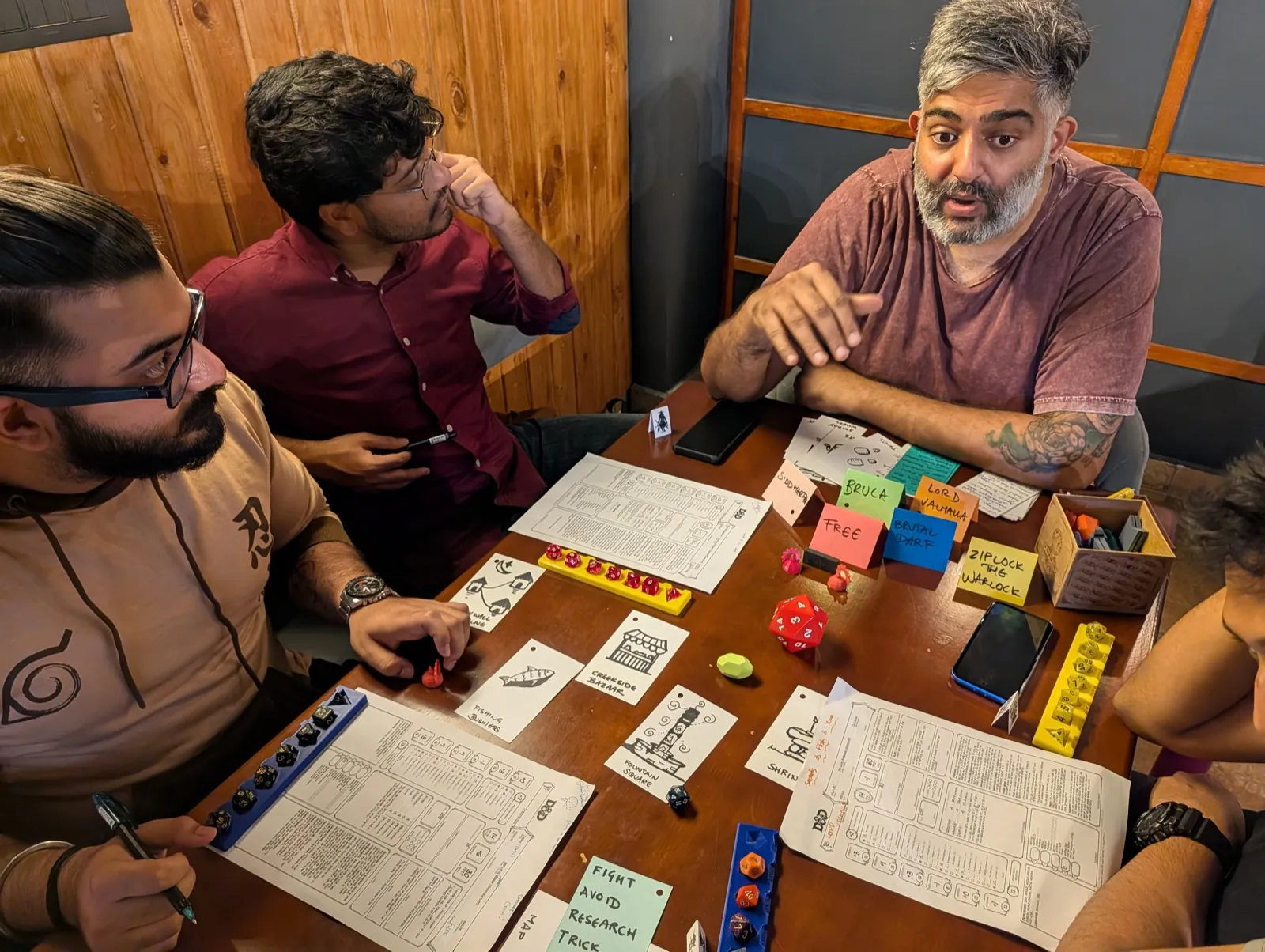
The short version: I put your managers somewhere they have to lead for real, under pressure, tangled up with each other. Then I show them what they actually did, which is usually not what they think they did. Then we turn that gap into commitments they carry back to the job.
It works because behaviour only shifts by doing, being told the truth about it, and doing it again.
This page is the hub for the whole thing. Six competencies, the game behind each one, what a programme costs, and how I run and measure it.
Key takeaways
| Idea | What it means | Why it matters |
|---|---|---|
| Leadership is behaviour | It is what you do under pressure, not what you know | You cannot lecture a behaviour into someone |
| Practice beats content | People change by doing, then being shown what they did | Learning survives past the workshop |
| The debrief is the product | The game surfaces behaviour, the debrief converts it | No debrief, no change |
| Start from the behaviour | Pick the game after you name the target behaviour | Design serves the outcome, not the reverse |
| Measure what changes | Track observable commitments, not smile sheets | Behaviour change is the only real result |
 Why most leadership training slides straight off
Here's the uncomfortable thing about my own industry. Most leadership training transfers knowledge to people who already have it.
A room of managers hears a genuinely good explanation of delegation. They nod. They ask decent questions. Then they go back and delegate exactly the way they always did. The content was fine. The format was the problem.
You cannot lecture a behaviour into existence. Same as you cannot teach anyone to swim with a slideshow.
Nobody has ever frozen on a decision because they hadn't heard of reversible versus irreversible calls. They froze because in the moment, with something real on the table, the old habit fired faster than the new idea.
So you have to reach the person where the habit actually lives. Under stakes, with feedback arriving fast enough to matter. That is the whole job.
And your best operators are not automatically your best leaders
There is a second version of the same problem, and it is the one most of my clients actually have. The manager carrying your team was brilliant at the job one rung below. That is precisely why they got promoted. Then you asked them to lead other people doing the same, and no course closed the gap.
Every jump rewards a different skill than the one it demands next, and the training most companies buy quietly pretends all three jobs are the same. It hands managers a stack of models about feedback and delegation, everyone rates it 4.6, and then the room is surprised that nothing about the team changed.
Management is a set of tasks you can be taught. Leading is not. Reading a team as a system. Building trust you cannot mandate into existence. Delegating instead of doing it yourself at 11pm. Deciding on partial information while everybody watches your face for the tone.
How I actually build the behaviour
It is a loop, and I keep it deliberately simple.
Put people into a designed experience that forces the target behaviour to show up. Let them lead it for real, with pressure and consequences, so they act on instinct instead of performing the answer they think the facilitator wants. Then debrief hard. Mirror up. What you did, versus what you believe you did. Turn that gap into something specific they carry out of the room.
The game is never the point. It exists to make behaviour visible in front of peers, which a normal workday will never do for you.
The debrief is where development actually happens. Which is exactly why a weak experiential programme runs a fun activity and quietly skips the hard conversation afterwards. Everyone leaves happy, and not much of it survives contact with the week.
This is the core of the Put The Player First framework. Your people's real behaviour is the curriculum. Everything else is scaffolding for getting at it. It is also why this is a different thing from classroom training rather than a livelier version of it.
What actually becomes visible in the room
A serious game is a simulation with teeth. A designed situation, a running clock, other people with their own agendas, and consequences that turn up whether or not anyone was ready.
The reason I like it for a leadership cohort is that nobody has to report on themselves. You just see it, and everyone in the room sees it at the same time.
- Who decides cleanly and keeps the team moving - and who holds every decision until it feels safe, which usually means until it's late.
- Who delegates and trusts the team - and who grabs the work back and does it themselves.
- Who reads the team as a system - and who plays their own scorecard brilliantly while the group loses the round.
- Who leads through a change they didn't choose - and who goes quiet in a way that's easy to miss until much later.
- Who sets a steady tone under chaos - and who transmits the panic straight down the line.
- Who hears the quiet person with the answer - and who talks straight over the one piece of information that would have saved them.
None of which is a character flaw, by the way. Most of it is a habit that worked somewhere else, in a job where it was genuinely the right call. The game just puts it somewhere it doesn't work.
The debrief names those behaviours specifically, in the language of your leaders' actual week. That recognition is the transfer, not the game. The game is only the most honest way I know to get to it.
 The six competencies I build - start with the one that names your real problem
Almost every challenge a client brings me boils down to one or two behaviours under pressure. Here are the six I train most, each with a page of its own and a game built to stress it. Start with whichever one names the problem you actually have, not the one that sounds best in a board update.
Decision making under uncertainty
How your managers learn to decide well on incomplete information - process over outcome, reversible versus irreversible calls, and when to stop analysing and just move. Built with Chaos in the Kitchen.
Cross-functional collaboration
Getting teams that do not report to each other to move as one - and killing the silos that quietly wreck delivery while every dashboard still shows green. Built with Ripple Effect.
Influence and stakeholder management
How to lead without authority - reading stakeholders, building coalitions, and getting to yes when you cannot simply give the order. Built with Bloom.
Team communication
Making sure the right thing gets said, heard and acted on - and pulling disagreement into the room instead of leaving it to fester in the corridor. Built with Sticky Fingers.
Leading change
How a leader carries a team through uncertainty and resistance when the ground is moving and nobody has the full map. Built with Planetfall.
Negotiation and workplace politics
Navigating competing interests, trading well, and handling the politics of getting things done - without turning either naive or cynical. Built across the game portfolio.
A related competency, structured problem solving for teams, sits alongside these when the issue is how a group thinks together rather than how one leader behaves. For newly promoted managers, pair any of it with the first-time manager guide.
 The games behind the programs, and how many people each takes
Each competency gets the game that forces exactly that behaviour into the open. I match the game to the behaviour you are trying to build, never to a theme. The games are the how, never the headline. Nobody buys a game. They buy managers who decide faster, or influence better, or hold a team together through a mess.
- Sticky Fingers - emergent leadership, collaboration and information-sharing under pressure. Scales to a full cohort. 12-150 people.
- Ripple Effect - reading a team as a system, cross-functional trust, and the cost of everyone optimising their own patch. 16-60 people.
- Planetfall - learning agility, leading change, and adapting when the evidence contradicts the plan. 8-20 people.
- Bloom - influence without authority, and stakeholder relationships.
- Chaos in the Kitchen - senior decision-making when the conditions keep shifting.
If none of them fits your problem cleanly, I build one - see custom serious game design. The full landscape is laid out in the serious games for leadership development guide.
How I design and run a program - backwards from the behaviour
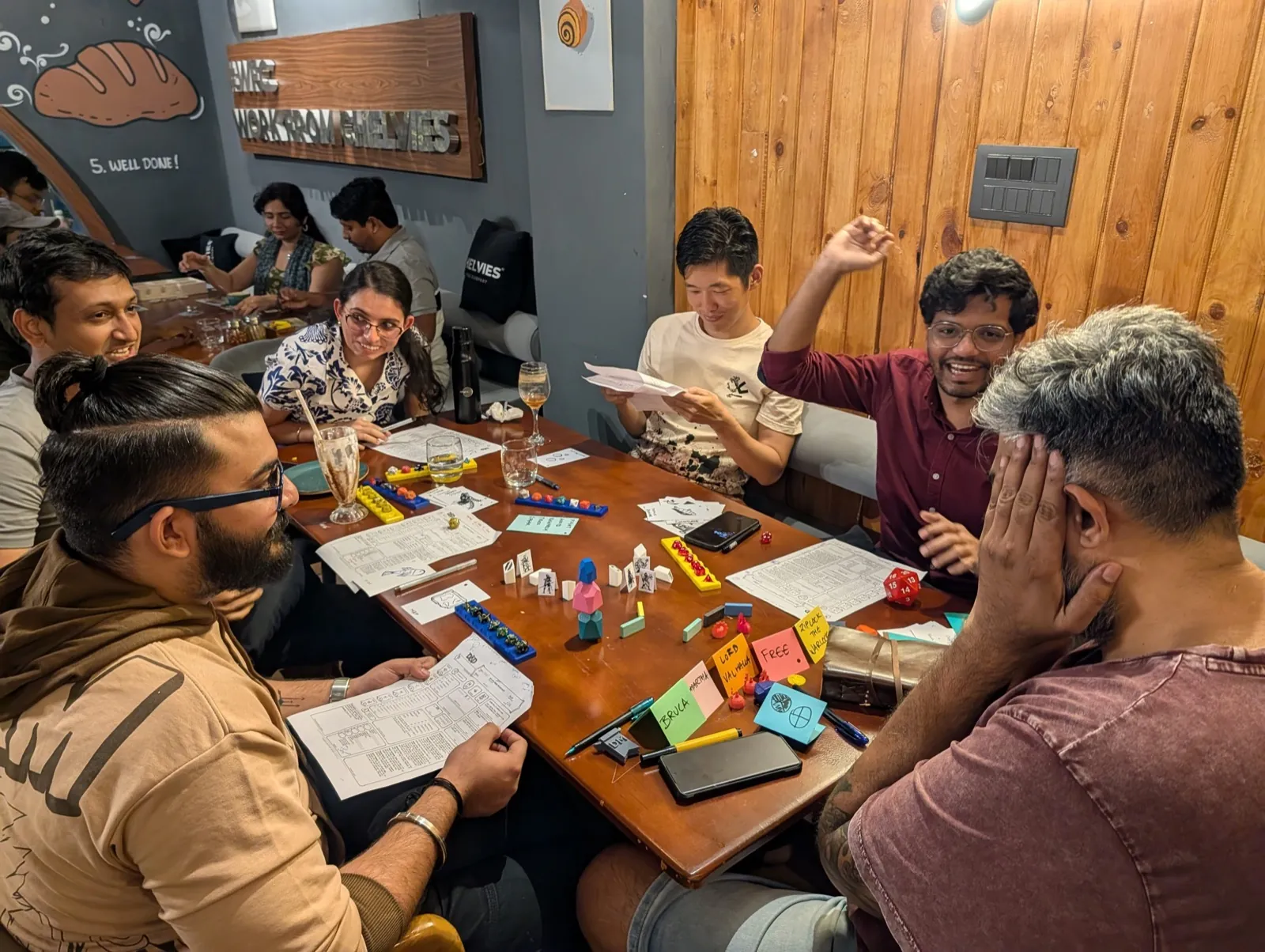
Every programme gets built backwards from the behaviour you want changed. Never forwards from a game I happen to enjoy running. Same five steps, every time:
- Name the behaviour. If I can't name it, I can't build for it. Not "improve leadership". Something you could stand in a corridor and watch happen. Managers who close out reversible decisions inside a day. Managers who say the disagreement in the meeting instead of in the car park afterwards.
- Pick the instrument that drags it into the open. From the games above, or a custom build if nothing fits properly.
- Run it for real, so nobody can perform the right answer. With genuine pressure on, people act on instinct instead of giving me the textbook response they think I'm fishing for.
- Debrief hard. This is where the money is. What happened, versus what everyone believes happened, versus what they are going to do differently. Named, out loud, in front of each other.
- Build the cadence around your reality. One competency can be a single intensive day. Several can be spaced out so people go and try the behaviour at work in between, which is where it actually sets. Bigger populations run as multiple batches.
I run these for first-time managers learning the fundamentals, for experienced managers unlearning habits that stopped serving them years ago, and for executive teams who already know all the theory and just need somebody to hold up the mirror.
And here's the counter-intuitive bit. The more senior the room, the better this works. Content has almost nothing to offer people who have heard it all. The mirror has everything.
Why I run every session myself
The person who designed the game runs it. That's the part I'm not willing to change.
Watching your leaders act under the game's pressure, and then debriefing the specific behaviour I saw, is not something I can hand to somebody with a script. No associate delivery, no licensed hand-off.
It also keeps the debrief fast, concrete and named, which is the only register I've found that holds a room full of senior people with targets waiting for them outside. Managers will not sit through training theatre. They tune out the moment it feels generic.
What you get
- A pre-session discovery call and brief, calibrated to your leaders' level and your real situation
- The facilitated game session (half-day or full-day), run by me, the designer
- An EPPA debrief, built to make behaviour visible and name it clearly
- A written behaviour summary afterwards, ready to hand to a CHRO or leadership team
- A committed action plan from every person in the room
And a promise, which I mean literally. If the session doesn't surface at least three named leadership behaviour patterns worth changing, I'll redesign the next one at no cost. You shouldn't pay for a session that showed you nothing.
 Proof
Proof
I've been designing and running these since 2019, for a Fortune-100 organisation and for fast-growing companies, with founders in the US, Canada, Australia, Singapore and India.
One of those Fortune-100 programmes ran six session-days and scored 8.82/10 average satisfaction across 113 respondents, with the game-based learning the most-cited takeaway in every batch.
Then they came back for a second, different programme, which is probably the more useful number of the two.
How I measure whether anything actually changed
The honest measure is not how the room felt at 5pm. Satisfaction scores tell you the day went well. They tell you nothing about whether one single person leads differently on Monday.
Because every programme starts from a named behaviour, it can end with named, observable commitments. Then those get checked over the following weeks, with the manager and with their team.
Did the reversible decisions actually get faster? Did the disagreement move into the room? Simple questions. Slightly terrifying ones. And the only results worth paying for.
Which is why this holds up on exactly the terms classroom training struggles with. What people do, not what they scored.
What it costs
A day in the room runs between ₹60,000 and ₹1,00,000, plus taxes as applicable.
Half a day is half of that. So ₹30,000 to ₹50,000, plus taxes as applicable, on the same terms.
Both of those are ranges rather than a price list, and I do mean that. A short session with a lot built into it can land above a longer one with very little, so the clock is only part of it.
I put the range here because you should not have to sit through a call just to find out whether we are in the same ballpark. If that number is nowhere near your budget, you have saved yourself a fortnight and I would still rather you wrote to me and said so.
Where you land inside either of them comes down to five things, and none of them are a mystery:
- How long we are in the room. Half a day with one game and its debrief is one thing. A two-day programme is another.
- How many people are in the room, and how senior they are. Fifteen managers and sixty leaders are not the same day's work.
- How much I build from scratch. Running a game I already own costs less than designing your world, your constraints and your data into a new one.
- Whether I am leaving Bengaluru. Travel and stay are quoted separately, up front, so nothing appears on the invoice we did not talk about first.
- Whether it is one session or a series. Four batches of the same programme do not cost four times a single batch, because the design is built once.
A bespoke senior day, built from nothing, in another city, sits at the top of the band. A game I already run, one batch, here in Bengaluru, sits at the bottom. Most work lands somewhere in the middle, and I will tell you which end you are at in the first conversation rather than the third.
One honest thing about the calendar while we are being straight with each other. I take two or three engagements a month, mostly because I run every one of them myself, so dates go three or four weeks out. I would rather say that now than when you already have a date in mind.
Tell me roughly what you are trying to fix and you will have a real number, not a range, within a day of us speaking.
If it sounds like it might fit, there are three ways to reach me, and I genuinely do not mind which one you use.
Book a discovery call WhatsApp me Send me a note
Three lines is plenty. Whichever one you pick lands with me and not with a queue.

Straight answers
Basics
What is experiential leadership development?
Building leadership by doing it rather than hearing about it. Your managers go into a designed situation where they have to lead under pressure, and then we look honestly at what they did. Leadership is behaviour, and behaviour is learned by doing, getting told the truth, and doing it again.
What makes a leadership development programme actually work?
Practice, rather than lecture. Leadership is a behaviour, and you cannot really develop a behaviour nobody can see. It works when it puts leaders in a situation that surfaces how they actually decide under pressure, and then debriefs that specifically. Another framework deck does not do it - not because the frameworks are wrong, but because knowing them was never the missing piece.
How is it different from a classroom workshop?
A classroom transfers knowledge. This changes behaviour. The models still turn up, but in the debrief, attached to something the person in front of you actually did forty minutes ago. Which is why it survives past lunch and travels back to the job.
What is the difference between management training and leadership training?
Management is running tasks, processes and resources well. Leadership is reading a team as a system, deciding under uncertainty, and taking a group somewhere it would not go on its own. Most people are promoted for the first and then measured on the second. This builds the second, because that is the one training usually skips.
Scope
What can it build?
Deciding under uncertainty. Cross-functional collaboration. Influence and stakeholder management. Team communication. Leading change. Negotiation. All six are behaviours that only surface under pressure, which is exactly what a game creates and a debrief makes coachable.
Does it work for executives?
Yes, and better than it works anywhere else. Senior leaders already know the theory, so lecture bores them. An experience shows them their own habits in front of their peers, which is feedback almost nobody at that level gets any more.
Is it for new managers or experienced ones?
Both. New managers use it to build the leadership behaviours nobody taught them. Experienced managers use it to see habits they have never had held up to a mirror. The brief calibrates the game and the debrief to the group's level.
Delivery
How is a programme structured?
Start from the behaviour you want changed. Pick the game that stresses it. Run it for real. Debrief hard into commitments. That can be one intensive day or a sequence across several competencies, spaced so people go and try it at work in between.
How long is it, and can you run it for a large group?
Half-day or full-day sessions, and multi-batch programmes when the population is bigger. Sticky Fingers has run for as many as 150 people with additional facilitators; a team simulation like Ripple Effect works best at 16 to 60. I match the format to your numbers and seniority in the brief, and I would rather run one session that lands than four that get diarised and quietly forgotten.
Who designs and runs the sessions?
I do, both. The value is in reading the room live and running the debrief that ties the game to your leaders' real work, and that is not something I can write down and hand over.
Can behaviour change actually be measured?
Yes, by tracking observable commitments rather than satisfaction scores. The debrief produces specific ones - deciding reversible calls inside a day, for instance - and those get checked with the manager and the team over the following weeks.
Related reading
- Serious games for leadership development: the complete guide
- The Put The Player First framework
- Serious games vs classroom training
- First-time manager guide
- Emotional intelligence leadership training
- How to delegate as a manager
- Custom serious game design
- Every programme I run, in one place
Tell me what you're trying to fix
I went back and forth on whether to put a form at the end of this page.
Because a form asks you to be tidy about something you are probably still working out. And the enquiries I enjoy most tend to arrive as three messy lines, written by someone who has not finished deciding what they want yet.
So there are two ways in, and I genuinely do not mind which one you use.
Write to me directly at arvindh@puttheplayerfirst.com and say roughly what you want to change. Three lines is plenty. I read my own email.
Or fill this in, if that is easier. It lands in the same inbox.
I answer these myself, usually within a day. Two if I am in a room somewhere with my phone in a bag.
And you are not committing to anything by writing in. Worst case we have a conversation, and you come out of it with a clearer brief than you had this morning.
With love from Bengaluru, this is Arvindh saying over and out.