
 Why your best individual contributors stall as leaders
Global Capability Centres in India grew up in a hurry. A centre that started life as an offshore delivery arm now owns products, runs global processes and carries real weight on the P&L. The people leading it were promoted for being outstanding at the work - strong engineers, sharp analysts, delivery leads who never dropped anything - and then handed a job that has almost nothing in common with the one they were good at.
Here's the part most development programmes miss entirely. The gap is not knowledge. Your managers have sat through the frameworks, twice, and can quote them. The gap is behaviour under one very specific kind of pressure: leading people whose work you no longer do yourself. Influencing a counterpart in another country who outranks you on nothing and still treats your priorities as a suggestion. Making the call at 9pm when headquarters is asleep, the local team is waiting, and the safe move is to wait until morning and let somebody else own it.
Classroom training talks about that moment beautifully. It never keeps a manager inside it long enough to find out what they default to when it is real.
What a serious game surfaces in a GCC context
A serious game is a designed scenario where real behaviour comes out under pressure, followed by a structured debrief that names it. For a GCC audience, it means finally getting to watch what your managers do when:
- Authority is unclear and they have to build influence instead of issuing instructions - the single skill that separates a leader from a very reliable delivery manager.
- A global stakeholder's agenda cuts straight across theirs and they have to negotiate with no mandate, no leverage, and a call that ends in twenty minutes.
- The information is incomplete, the clock is against them, and somebody in the room has to decide anyway.
- The person who should lead has no title - and the whole table waits, politely, to see who actually steps in.
These are the exact moments that decide whether a manager grows into someone the global org trusts with more scope, or stays a capable delivery lead who keeps getting bypassed on the decisions that matter. The simulation makes those moments happen in one room, on purpose, in a single afternoon. Then the debrief names what each person did, so it can change.
 Which games fit a GCC programme
I match the game to the behaviour your managers are struggling with, not to a theme.
- Bloom - stakeholder management and relationship investment. The closest fit for managers working global counterparts and internal partners they don't control. 12-40 people, ~2 hours.
- Welcome to Zombiepuram - influence, coalition-building and political intelligence with no formal authority anywhere in sight. Built for senior audiences. 15-80 people, ~6 hours.
- Sticky Fingers - emergent leadership and collaboration under pressure. Shows you who actually leads when no title says they should. 12-150 people.
- Chaos in the Kitchen - senior decision-making when conditions refuse to hold still. For centre-head and function-head cohorts. 15-50 people.
Why I run every session myself
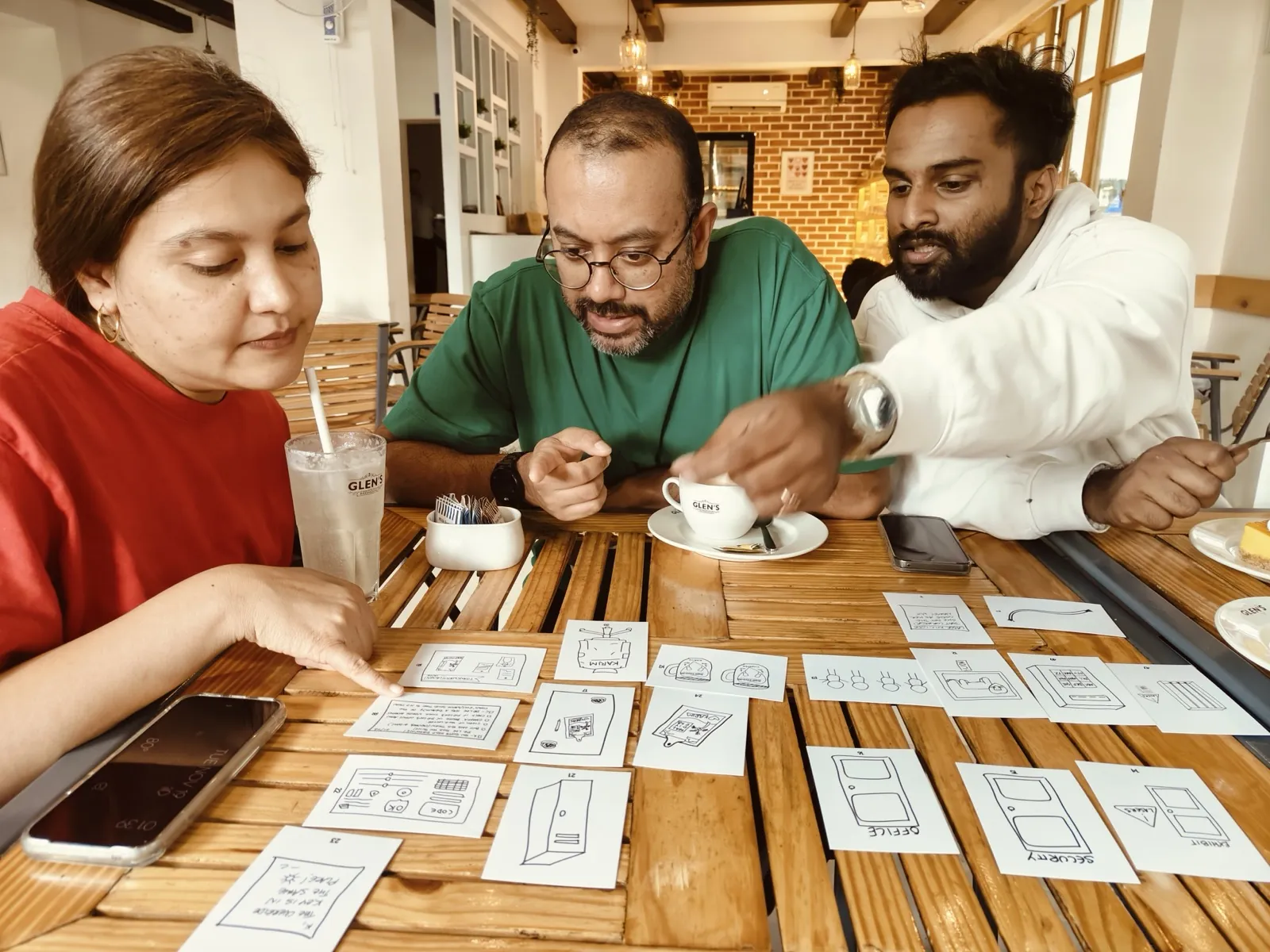
Most leadership vendors license an exercise and send an associate to deliver it. The debrief then runs off a script instead of off what happened in the room, and everybody has a nice time. I work the other way round. The person who designed the simulation runs every session, watches your managers play, and debriefs the behaviour they personally saw. That is the entire point, because the value was never the game. It is the moment a manager hears, accurately and with no spin, what they just did under pressure, in front of the people they lead. You cannot outsource that. I have tried thinking of a way, and there isn't one.
 Proof
Proof
I have run these programmes for the centre of a Fortune 500 technology company, and for other captive centres in Bengaluru. One programme at a Fortune 100 company ran across six session-days and scored 8.82 out of 10 average satisfaction, from the 113 people who filled in the form. Then they came back and commissioned a second, different programme, which is the fact I trust most.
What you get
- A discovery call and a written brief, calibrated to your centre's scope and the manager level in the room
- The game itself, half-day or full-day, run by me - the person who built it
- An EPPA debrief, designed to make behaviour visible and then name it clearly
- A written behaviour summary afterwards, ready to send straight to a global HR or leadership team
- A committed action plan from every single person in the room
And my promise: if the session doesn't surface at least three named leadership behaviour patterns worth changing, I redesign the next one at no cost. Nobody should pay for a session that showed them nothing.
What it costs
A day in the room runs between ₹60,000 and ₹1,00,000, plus taxes as applicable.
Half a day is half of that. So ₹30,000 to ₹50,000, plus taxes as applicable, on the same terms.
Both of those are ranges rather than a price list, and I do mean that. A short session with a lot built into it can land above a longer one with very little, so the clock is only part of it.
I put the range here because you should not have to sit through a call just to find out whether we are in the same ballpark. If that number is nowhere near your budget, you have saved yourself a fortnight and I would still rather you wrote to me and said so.
Where you land inside either of them comes down to five things, and none of them are a mystery:
- How long we are in the room. Half a day with one game and its debrief is one thing. A two-day programme is another.
- How many people are in the room, and how senior they are. Fifteen managers and sixty leaders are not the same day's work.
- How much I build from scratch. Running a game I already own costs less than designing your world, your constraints and your data into a new one.
- Whether I am leaving Bengaluru. Travel and stay are quoted separately, up front, so nothing appears on the invoice we did not talk about first.
- Whether it is one session or a series. Four batches of the same programme do not cost four times a single batch, because the design is built once.
A bespoke senior day, built from nothing, in another city, sits at the top of the band. A game I already run, one batch, here in Bengaluru, sits at the bottom. Most work lands somewhere in the middle, and I will tell you which end you are at in the first conversation rather than the third.
One honest thing about the calendar while we are being straight with each other. I take two or three engagements a month, mostly because I run every one of them myself, so dates go three or four weeks out. I would rather say that now than when you already have a date in mind.
Tell me roughly what you are trying to fix and you will have a real number, not a range, within a day of us speaking.

Frequently asked questions
Why do GCCs need a different kind of leadership development?
GCC managers get promoted fast, usually straight out of being a brilliant individual contributor, and are then asked to lead across matrix lines, influence global stakeholders who owe them nothing, and hold a team together across eight time zones. Classroom content hands them frameworks for that job and never once puts them inside it. A serious game is a live simulation of the real pressure, and it makes the behaviour visible. You cannot develop what nobody has seen.
Which serious game fits a GCC leadership programme?
Bloom for stakeholder and relationship-investment behaviour, which maps almost exactly onto managing global counterparts. Welcome to Zombiepuram for influence and coalition-building with no formal authority. Sticky Fingers for who steps up to lead when no title says they should. In the pre-session brief I match the game to the gap your managers are actually hitting.
Can this run for a large GCC leadership cohort?
Yes. Sticky Fingers scales to 150 participants and Welcome to Zombiepuram to 80, so an entire manager cohort can go through in one session. Smaller and more senior groups usually run Bloom or Chaos in the Kitchen. Every session is in person and run by me, the person who designed the game.
Related
- Serious games for leadership development in India
- The complete guide to serious games for leadership
- Stakeholder management for managers
With love from Bengaluru, this is Arvindh saying over and out.