
 Why five functions who are each right still pull you apart
Pharma and life sciences run on deep functional expertise, and that is exactly where the leadership friction lives. R&D wants to explore. Regulatory wants certainty. Quality will not move on the standard, and should not. Manufacturing wants a plan that stays still for a fortnight. Commercial wants it in market. Every one of them is right. That is what makes it hard. Nobody is being difficult, and it still comes apart.
I have a great deal of sympathy for the people in the middle of that. The people asked to hold it together were promoted for being excellent at the science, not for the awkward, political, deeply human work of aligning functions that quietly think the others are reckless. Training on "cross-functional collaboration" tells them collaboration matters. Everyone agrees. Everyone always agrees. It never shows them what they personally do at 4pm when a regulatory delay eats the launch date and one person in the room has to say the unpopular thing. That moment is the only thing worth training.
What a serious game surfaces in pharma
A serious game is a simulation with teeth. A designed scenario, a running clock, other functions with their own perfectly reasonable priorities, and a debrief afterwards that names what came out. For a pharma leadership room, it makes visible:
- Which function defends its own definition of success right up to the point where the whole outcome quietly suffers for it.
- Who invests in cross-functional relationships before they need them - and who only appears when they want a favour, which everybody notices and nobody mentions.
- Who can sit inside the speed-versus-quality tension without collapsing onto one side just to make the discomfort stop.
- How a leader actually decides when the data is incomplete, the deadline is real, and both options are defensible.
The debrief names those behaviours specifically. People leave knowing what they did, not a general reminder that silos are bad. Everyone already knows silos are bad.
 Which games fit a pharma programme
I match the game to your specific gap, not to a theme. No lab coats required.
- Ripple Effect - cross-functional trust, systems thinking, silo vs. collective optimisation. Maps onto the R&D-quality-regulatory-commercial divide almost embarrassingly well. 16-60 people, 75-90 minutes of play.
- Bloom - stakeholder management and relationship investment across functions. For leaders who depend on partners they do not control and cannot instruct. 12-40 people, ~2 hours.
- Chaos in the Kitchen - senior decision-making when conditions and priorities keep moving. For function-head and site-head cohorts. 15-50 people.
- Planetfall - learning agility and deciding under uncertainty, for teams who have to act well on evidence that is not finished yet. 8-20 people, ~2 hours.
Why I run every session myself
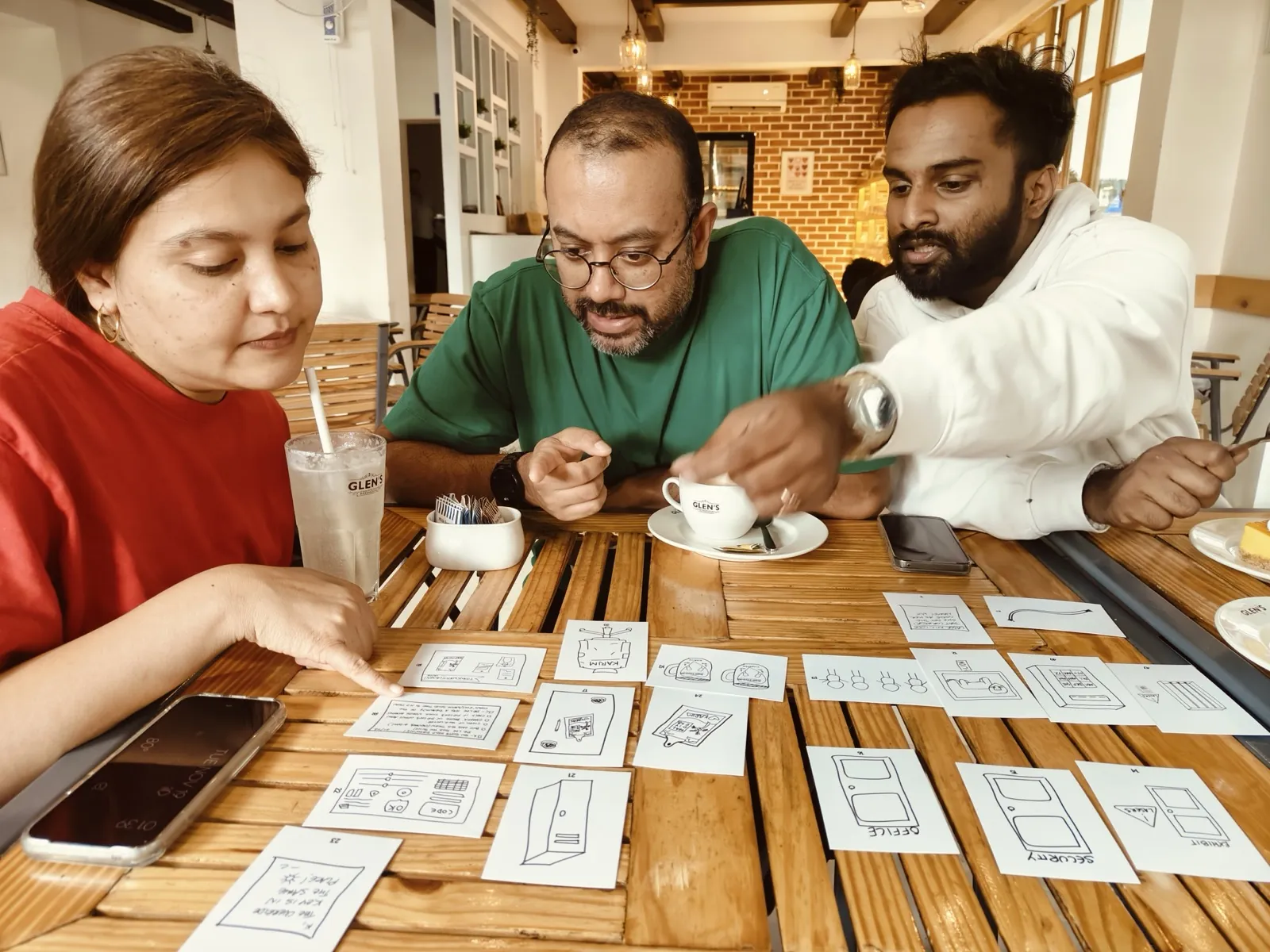
The debrief is where a pharma team's real dynamics get named, and it only works if the person leading it watched the room with their own eyes. So I don't hand it off. No associate delivery, no licensed facilitator working from my slides. The person who designed the simulation runs every session, watches how your functions behave when the pressure is on, and says it back to them plainly. That is the whole difference between a team that agrees collaboration is important and a team that can see, specifically, at what minute their own collaboration broke.
 Proof
Proof
I have run these programmes for a global pharmaceutical organisation and other regulated, technically deep companies with the same cross-functional dynamics - out of Bengaluru, in groups from 15 to 150. One programme at a Fortune 100 company scored 8.82/10 average satisfaction across 113 respondents over six session-days. And when that programme ended, they came back and commissioned a second, different one. That last bit matters to me more than the scores do.
What you get
- A discovery call and a written brief before we start, calibrated to your functions and your leadership level
- The game itself, half-day or full-day, run by me, the person who designed it
- An EPPA debrief, built to make behaviour visible and then say it out loud
- A written behaviour summary afterwards, ready to hand to a CHRO or leadership team
- A committed action plan from every single person in the room
And a promise. If the session doesn't surface at least three named leadership behaviour patterns worth changing, I redesign the next one at no cost. Nobody should pay for a session that showed them nothing.
What it costs
A day in the room runs between ₹60,000 and ₹1,00,000, plus taxes as applicable.
Half a day is half of that. So ₹30,000 to ₹50,000, plus taxes as applicable, on the same terms.
Both of those are ranges rather than a price list, and I do mean that. A short session with a lot built into it can land above a longer one with very little, so the clock is only part of it.
I put the range here because you should not have to sit through a call just to find out whether we are in the same ballpark. If that number is nowhere near your budget, you have saved yourself a fortnight and I would still rather you wrote to me and said so.
Where you land inside either of them comes down to five things, and none of them are a mystery:
- How long we are in the room. Half a day with one game and its debrief is one thing. A two-day programme is another.
- How many people are in the room, and how senior they are. Fifteen managers and sixty leaders are not the same day's work.
- How much I build from scratch. Running a game I already own costs less than designing your world, your constraints and your data into a new one.
- Whether I am leaving Bengaluru. Travel and stay are quoted separately, up front, so nothing appears on the invoice we did not talk about first.
- Whether it is one session or a series. Four batches of the same programme do not cost four times a single batch, because the design is built once.
A bespoke senior day, built from nothing, in another city, sits at the top of the band. A game I already run, one batch, here in Bengaluru, sits at the bottom. Most work lands somewhere in the middle, and I will tell you which end you are at in the first conversation rather than the third.
One honest thing about the calendar while we are being straight with each other. I take two or three engagements a month, mostly because I run every one of them myself, so dates go three or four weeks out. I would rather say that now than when you already have a date in mind.
Tell me roughly what you are trying to fix and you will have a real number, not a range, within a day of us speaking.

Frequently asked questions
Why do pharma and life sciences teams need serious games?
Because pharma promotes people for the science, and then asks them to lead across R&D, regulatory, quality, manufacturing and commercial - five functions with genuinely competing definitions of a good week. Speed versus compliance is not a slogan, it is somebody's Thursday. A serious game is a simulation of that exact squeeze, and it shows how your leaders really resolve it while the clock runs. A talk on cross-functional collaboration cannot show you that, because nobody is under any pressure during a talk.
Which serious game fits a pharma team?
Ripple Effect for cross-functional trust and silo behaviour, which maps almost embarrassingly well onto the R&D-quality-regulatory-commercial divide. Bloom for stakeholder management across functions you do not control. Chaos in the Kitchen for senior decision-making when priorities keep moving. In the pre-session brief I match the game to your specific gap.
Can serious games respect a compliance and quality culture?
Yes. The game never asks a single person to lower a standard. It surfaces how the standard-holders and the speed-seekers actually negotiate with each other in real time, and then names it out loud. That is useful precisely because the compliance culture is non-negotiable. The friction it creates is permanent, so it has to be led well rather than wished away.
Related
- Serious games for leadership development in India
- How to break down silos between teams
- Stakeholder management for managers
With love from Bengaluru, this is Arvindh saying over and out.