
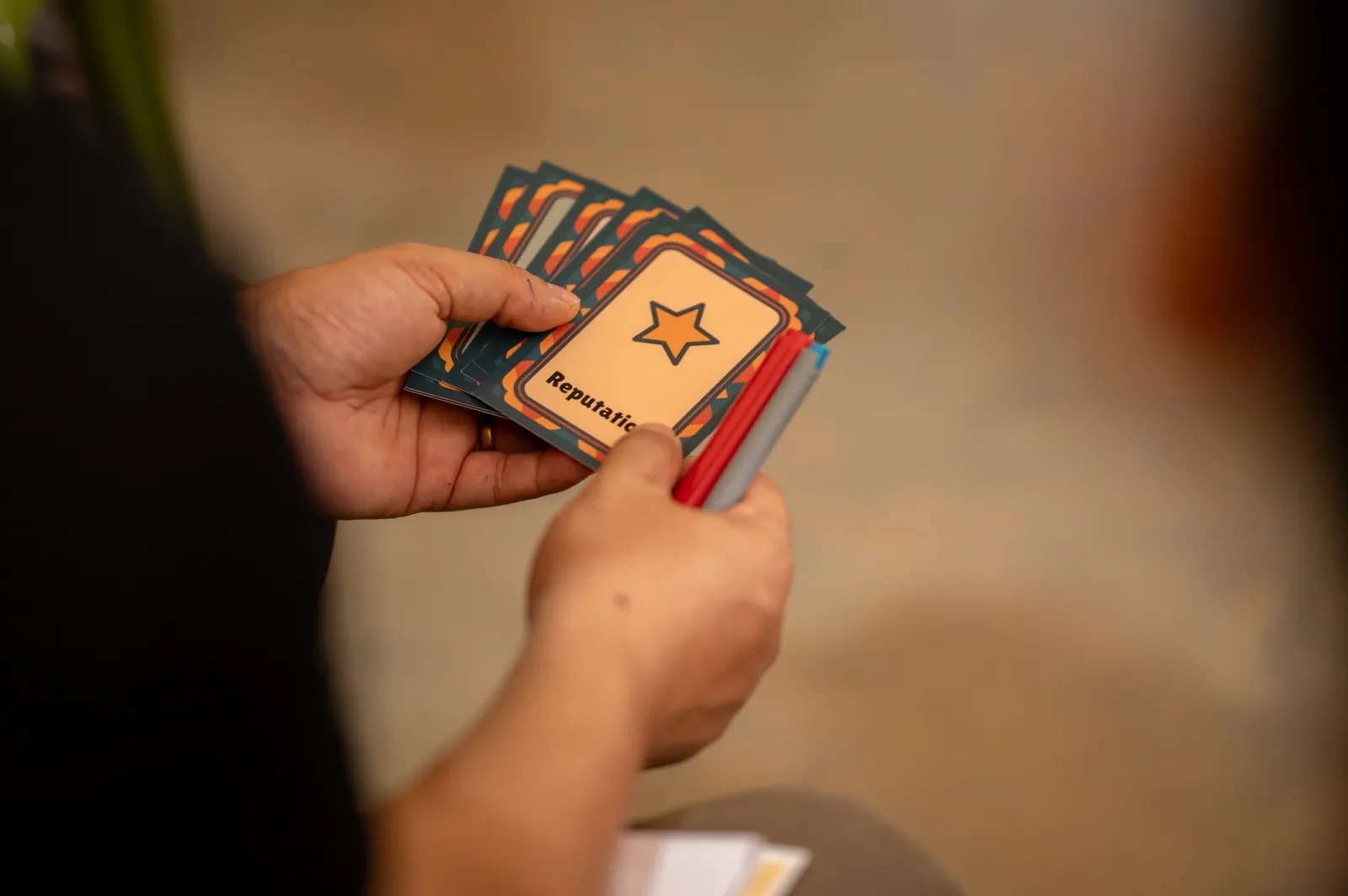
 Why EQ training usually fails
Here's the shape of most EQ training. Four quadrants. A self-assessment. Everyone goes home with a score and a bit of new vocabulary.
Then Tuesday happens, somebody pushes back hard in a meeting, and every single person reacts exactly the way they always have.
Because knowing the word empathy and being empathetic when you are being contradicted in front of your boss are not remotely the same skill. One is a definition. The other is a reflex.
EQ only ever shows up in the moment. When you are frustrated. When you are being challenged. When the person opposite needs something you were not braced for. A classroom carefully removes every one of those conditions. So it can describe emotional intelligence beautifully and develop none of it.
What a game surfaces about EQ
Put people in a live situation with something at stake and other humans to read, and nobody has to be asked to demonstrate anything. It just comes out:
- Who notices what a teammate actually needs - and who drives straight over it to finish their own point.
- Who stays steady when challenged - and who goes defensive and shuts the door.
- Who reads the room and changes tack - and who runs the same play louder.
- Who earns influence without any authority to lean on - and who reaches for a position they haven't got.
Then the debrief names it. Not "the team showed some defensiveness", but the actual moment, roughly forty minutes ago, that everyone in the room watched happen. And then we connect it to the person at work they are currently having this exact problem with.
That is the transfer. Never the model.
 The game we usually use
Bloom, most of the time. It is built around influence and stakeholder relationships - reading what somebody needs and responding well when you cannot simply tell them to get on with it. Which is the EQ moment that actually matters at work, rather than the one in the textbook. If your focus is elsewhere I will pair it with something else or swap it out. That gets decided in the brief, with you.
For the underlying skill, see stakeholder management for managers and how to build trust on a team.
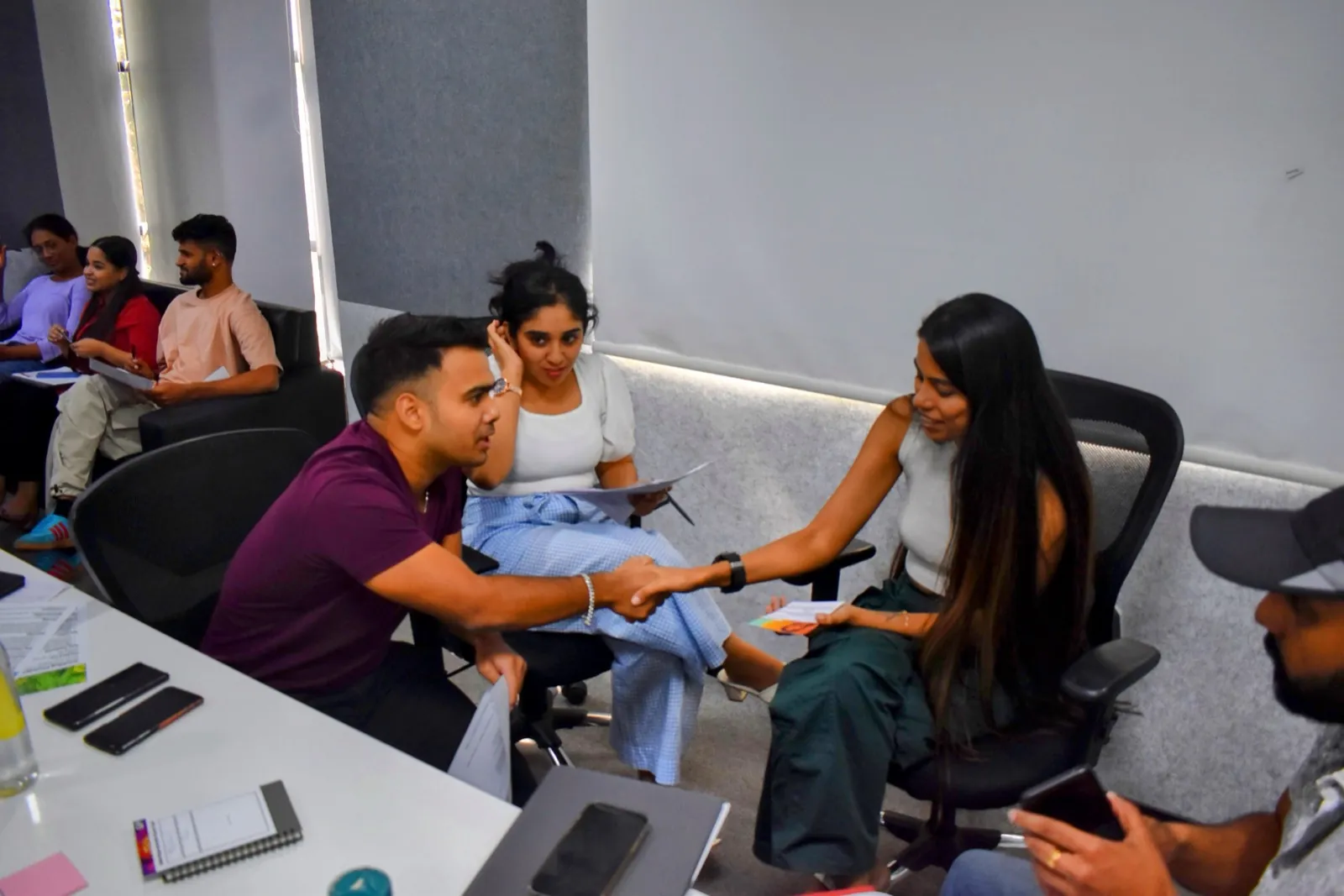
Why I run every session myself
Emotional behaviour is quiet. It happens in a half-second and then it is gone. You cannot read it back to somebody unless you were standing there watching for it.
So the person who built the game is the person in your room, naming the exact moment a leader read their teammate perfectly, or walked straight past them. No associates. No licensed hand-off. No B-team when my calendar gets tight.
 Proof
Proof
Designing and running these since 2019, for a Fortune-100 organisation and fast-growing companies, with founders in the US, Canada, Australia, Singapore and India.
A Fortune 100 company: 8.82 out of 10 average satisfaction, 113 respondents. Then they came back and commissioned a second, different programme.
Please don't take my word for any of it. Come and see a session.
What it costs
A day in the room runs between ₹60,000 and ₹1,00,000, plus taxes as applicable.
Half a day is half of that. So ₹30,000 to ₹50,000, plus taxes as applicable, on the same terms.
Both of those are ranges rather than a price list, and I do mean that. A short session with a lot built into it can land above a longer one with very little, so the clock is only part of it.
I put the range here because you should not have to sit through a call just to find out whether we are in the same ballpark. If that number is nowhere near your budget, you have saved yourself a fortnight and I would still rather you wrote to me and said so.
Where you land inside either of them comes down to five things, and none of them are a mystery:
- How long we are in the room. Half a day with one game and its debrief is one thing. A two-day programme is another.
- How many people are in the room, and how senior they are. Fifteen managers and sixty leaders are not the same day's work.
- How much I build from scratch. Running a game I already own costs less than designing your world, your constraints and your data into a new one.
- Whether I am leaving Bengaluru. Travel and stay are quoted separately, up front, so nothing appears on the invoice we did not talk about first.
- Whether it is one session or a series. Four batches of the same programme do not cost four times a single batch, because the design is built once.
A bespoke senior day, built from nothing, in another city, sits at the top of the band. A game I already run, one batch, here in Bengaluru, sits at the bottom. Most work lands somewhere in the middle, and I will tell you which end you are at in the first conversation rather than the third.
One honest thing about the calendar while we are being straight with each other. I take two or three engagements a month, mostly because I run every one of them myself, so dates go three or four weeks out. I would rather say that now than when you already have a date in mind.
Tell me roughly what you are trying to fix and you will have a real number, not a range, within a day of us speaking.
Book a discovery call WhatsApp Arvindh
Frequently asked questions
Can you actually train emotional intelligence?
You can develop the behaviours. Noticing what a person or a room is feeling, holding your own reaction steady under pressure, adjusting what you do next. What you cannot do is lecture it into anybody, because EQ only exists in the moment. The game makes the moment. The debrief names what you did with it.
How is this different from an EQ assessment?
An assessment gives you a score. A score has never changed anybody's behaviour. This puts people somewhere their emotional read has actual consequences and then holds up a mirror. Different job entirely.
Which game do you use?
Usually Bloom. Influence and stakeholder relationships, reading what people need without any formal authority to fall back on. I match the game to your focus once I know what you are actually trying to fix.
Related
- Bloom serious game
- Stakeholder management for managers
- How to build trust on a team
- Experiential leadership development
With love from Bengaluru, this is Arvindh saying over and out.