
Leadership and Management Training That Actually Changes Behaviour
"They learn great concepts. They answer all the right questions. They know what to include in the post-assessment. And then Monday happens."
That's the knowing-doing gap, and it's where most leadership training money quietly disappears.
The gap isn't between ignorance and knowledge. It's between knowing what good leadership looks like and being able to do it when things get difficult, when you're tired, when the person across the table wants something else entirely.
Closing it needs something most training formats simply aren't built to give you: real practice, under conditions that push back.
The Box-Ticking Problem
Most leadership training is either performative or purely cognitive, and usually both at once.
People learn frameworks, discuss cases, do a reflection, maybe a role-play. They know what they're meant to say. They know the right answers, and the system rewards them for knowing, because the assessment tests knowing.
The actual behaviour change - the thing that was paid for - is treated as an inevitable downstream side effect of information arriving in a head. It is almost never that.
This isn't a dig at the people designing these programmes. It's structural. If your measure of success is "did participants demonstrate understanding of the framework", you will design for that, every time. And the gap opens precisely because understanding and doing are two completely different acts. You can understand swimming in exquisite theoretical detail and still go under in the pool.
Then the bit that would bridge the gap - the how - gets sold separately, usually as coaching. Which is a good product and a strange solution. If the training left people knowing what to do but not how to do it, half a thing was delivered at full price.
What the Gap Actually Looks Like
The clearest one I've watched involved a startup that had scaled very fast. Two cultures inside one company. The founding team who built it, and the professional managers brought in to make it work at size.
Both groups knew the theory. Both could recite the values. Both had done the workshops.
What neither had done was actually work through the power dynamics between them. The resentment. The completely different assumptions about who decides things and who deserves deference and why. The training had handed them a shared vocabulary for leadership. It had not handed them a shared experience of getting through something hard together.
Culture was eroding. People were leaving.
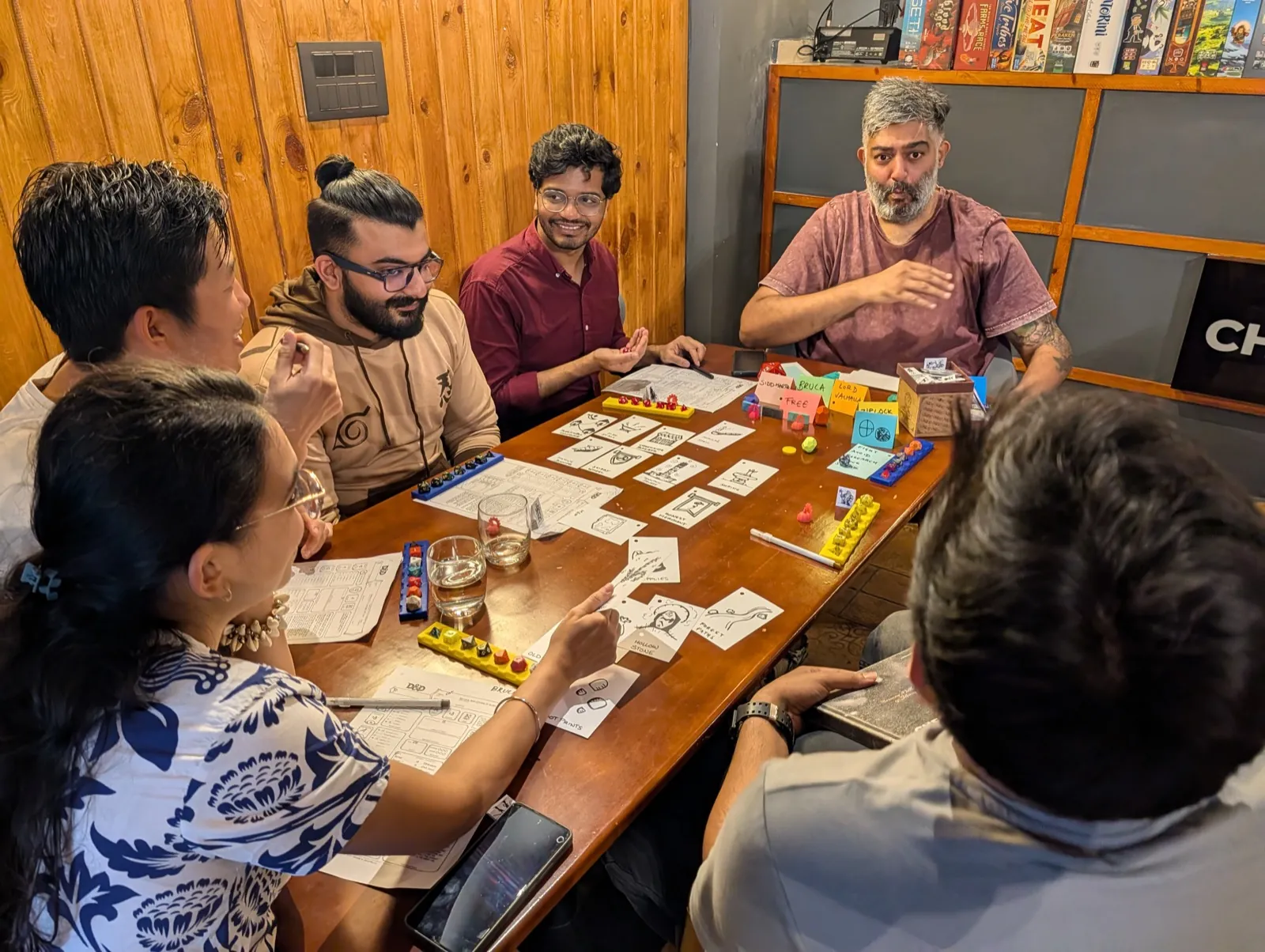
The thing that finally worked wasn't another values alignment workshop. It was a serious game where they had to make real trades, sit on real information, and deal with each other rather than perform dealing with each other.
No frameworks. No slides. And the debrief carried more content than any session I've run off a prepared deck, because what came up was actual behaviour rather than curated behaviour. That's the whole difference.
Why Experiential Learning Addresses This Specifically
In a serious game, people can't perform their professional persona. There isn't the bandwidth.
When somebody is trying to work a negotiation, hit a faction goal, and manage the fact that they know less than everyone else, all at once, there is nothing left over to also perform "thoughtful collaborative leader". So they just do what they do. Which is the most honest data you will get outside of watching them at work for six months.
The loop I use is EPPA. Experience, Patterns, Principles, Application.
People go through the experience fully, as themselves. I watch and take notes on specific things. In the debrief those patterns get put on the table and named. Then the group derives the principles - not principles handed down off a slide, principles they lived twenty minutes ago. And finally those get connected to named situations in their actual jobs.
The move that matters is between patterns and principles. When I ask "why did you hold that information back in round two?" and somebody sits with it for a second and says "because I didn't believe the other team would reciprocate"... that isn't a textbook answer. That's a real thing about how they operate, pulled out of a real thing they did.
That's what sticks.
What L&D Should Actually Be Evaluating
If your first question to a provider is "are they credentialed", you're asking the wrong question.
Credentials matter up to a point. They say almost nothing about whether the format produces behaviour change, because most credentialling frameworks don't assess for that either.
The question is: how will the behaviour change actually happen? Not what will people learn - that's the easy half. Where do they practise the skill, how do they get feedback on what they actually did rather than what they meant to do, and what holds it up after the facilitator has gone home?
If the answer is role-plays, ask whether people will perform the right behaviour or actually produce it under pressure. It's almost always the first one. Role-plays have their uses, but they're performative by construction. Everybody knows the correct way to behave and most people can deliver it on request. What you never see is the same person with genuine load on them.
If the answer is e-learning with game mechanics bolted on - points, badges, completion rates - ask what shared experience that produces. None. That's the answer. A gamified module beats a static one, but it's still something one person does alone at a screen, and leadership has never once been an individual experience. It happens in rooms, with other people, under ambiguity and competing interests. The training should look like that.
What Good Looks Like on the Other Side
The clients who get the clearest change have three things in common.
They came in with an honest problem, not the tidy version that reads well in a brief - the actual thing that's costing them. They gave the day genuine priority: right people, phones away, calendar protected. And they were willing to act on what came out of the debrief, including the parts they didn't enjoy hearing.
What they leave with isn't knowledge. It's a shared reference point. One specific experience the whole group went through, which they can point back at. "Remember round three?" becomes a live tool for that team, and the vocabulary doesn't evaporate when I leave, because they built it themselves out of something they did.
My design question is always the same one. What does the change look like, and how will I know it's happening? Everything else - mechanics, theme, debrief structure - is downstream of that.
If a provider can't answer that clearly for your specific context, keep looking. You've found someone who will sell you a day that feels valuable and is conveniently impossible to evaluate either way.
The knowing-doing gap doesn't close because somebody gave a good presentation about it. It closes because somebody put you in a situation where you had to do the thing, and then helped you look honestly at what you did.
With love from Bengaluru, this is Arvindh saying over and out.
See these ideas in action
Put The Player First runs serious game sessions for leadership teams across India. The designer is in the room for every session.
See the games Get in touch