
What Is a Serious Game?
A game built so that people learn or practise something real. Fun still turns up. It is just not what the thing was made for.
Short answer: A serious game is a game whose first purpose is learning, practice or discovery rather than entertainment. Board games, card games and social games all get used this way. The game produces the behaviour, and the conversation afterwards turns it into something a person can use at work on Monday.
If you arrived here because a quiz asked you what we call a game purposefully designed to help people train for something, the word you want is serious game. Clark Abt named it in a 1970 book called exactly that, so it has been sitting around for longer than most people assume.
And if you arrived because somebody in a meeting used the phrase and you nodded along, the rest of this page is for you. I have done the nodding too.
This is the short version. The long one, with how they get designed and what happens in the room, is over here: serious games for corporate training, what they are and why they work.
 The bit of the definition that does the work
Almost every definition you will read says something like "a game designed for a primary purpose other than pure entertainment", and that is correct as far as it goes.
It just does not tell you much.
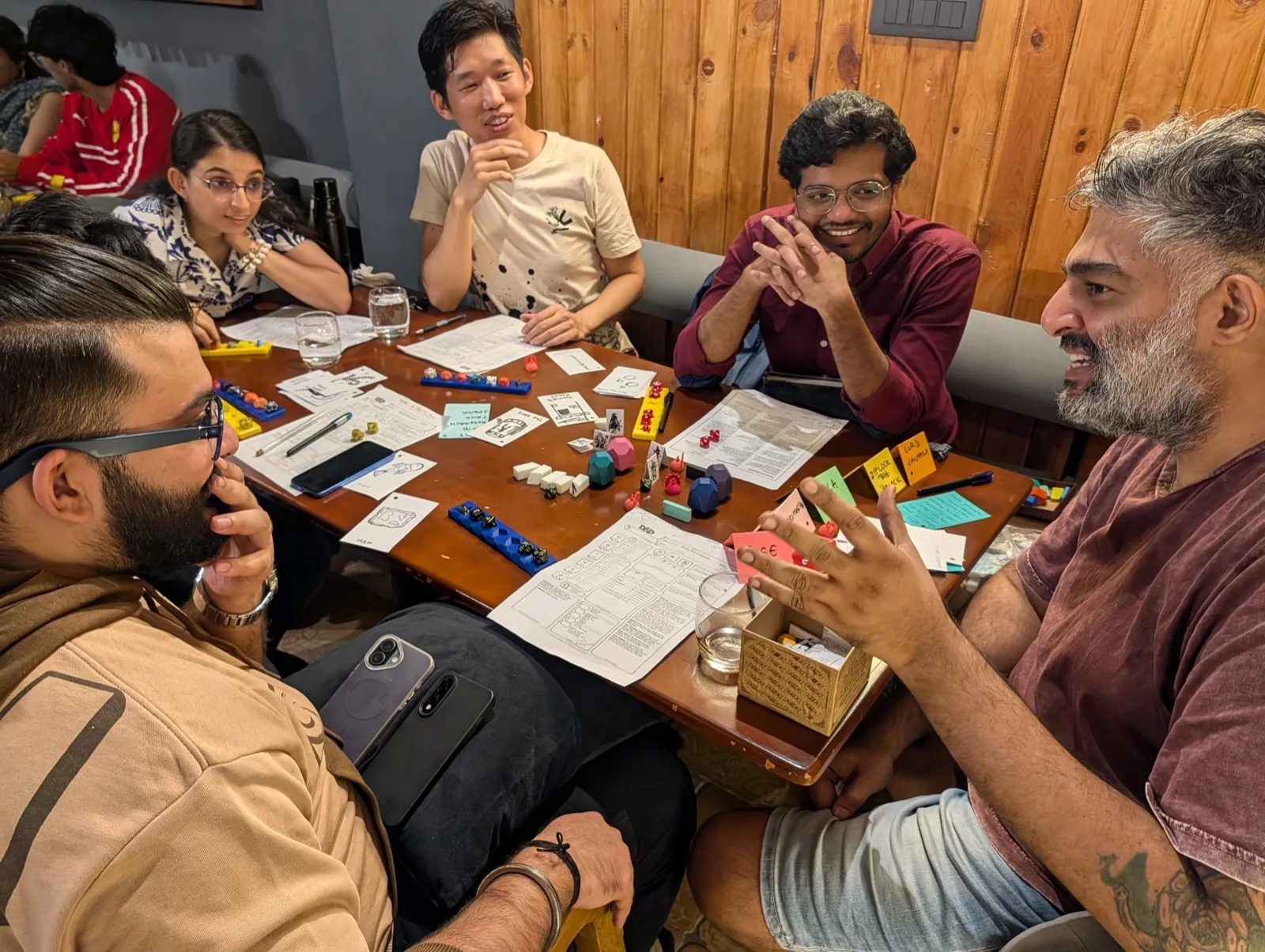
The part I would add, having built and run these for years, is that it has to still be a proper game. Rules, a goal, other players who want something different from you, and a real chance of losing.
Because the moment it stops being a game, people go back to performing. And performance is the thing you were trying to get underneath.
Designers call it the magic circle. What it means in a room is that somewhere in round two the manager voice drops away, and you are just watching a person play.
That is where the useful stuff is.
What has to be in one
Four things, more or less. Take one out and it is still a decent activity, it just stops showing you anything.
A goal people actually want. Not a learning objective printed on a card. Something they will argue about at the table.
Something scarce. Not enough time, money or information, usually all three, because a room with plenty of everything shows you very little.
Consequences that arrive later. A rubbish call in round one that wrecks round four. You cannot talk your way out of what already happened.
Somebody watching who can name it afterwards. The game makes the behaviour visible, and the debrief is where it becomes useful.
I have run sessions where I let that half get squeezed by the clock, and what we got instead was a good session that nobody could tell you anything about afterwards.
The rule I hold myself to is that every card and every mechanic has to earn its place by doing a job in the debrief. If I cannot point at a piece and say which question it sets up, out it goes.
I have cut things I loved. Genuinely nice mechanics, gone, because they were only fun.
 Serious game, gamification, simulation, role play
These four get swapped around constantly, and each of them is genuinely good at something. It is worth knowing which one you are asking for.
| The thing | What it actually is | Best at |
|---|---|---|
| Serious game | A whole game, built around a behaviour somebody wants to see | Surfacing how people really behave under pressure |
| Gamification | Game parts added to something that is not a game - points, badges, streaks | Keeping people doing a task they would otherwise drift away from |
| Simulation | A model of a real system, run over rounds | Building intuition for how numbers and decisions compound |
| Role play | A character and a scene handed to you to perform | Rehearsing a conversation you already know is coming |
The line between the first and the third is thinner than that table makes it look, by the way. Most of what I run is honestly a simulation as well, and I have written about that on the leadership simulation games page.
"Serious game" is the term the field uses. "Simulation" is the word a person reaches for when they are explaining to their boss what they want to book.
I spent years using the one that made my work harder to find. Which is a fairly silly thing to do to yourself, and I would rather admit it than keep quietly doing it.
If you want the longer comparison, there is a whole page on serious games vs gamification.
What they get used for
Skill and behaviour, mostly, rather than knowledge.
If somebody needs to memorise a compliance framework or learn a new process, there are faster and cheaper ways to do that, and I would point you at one.
But if you need a person to negotiate differently, or to hold authority without leaning on it, or to genuinely listen instead of waiting for their turn, that needs an experience rather than an explanation.
You cannot read your way into a rep.
Outside corporate rooms they turn up in medicine, in the military, in public health campaigns and in classrooms, and a lot of that work is digital. Which is probably why people assume screens when they hear the phrase.
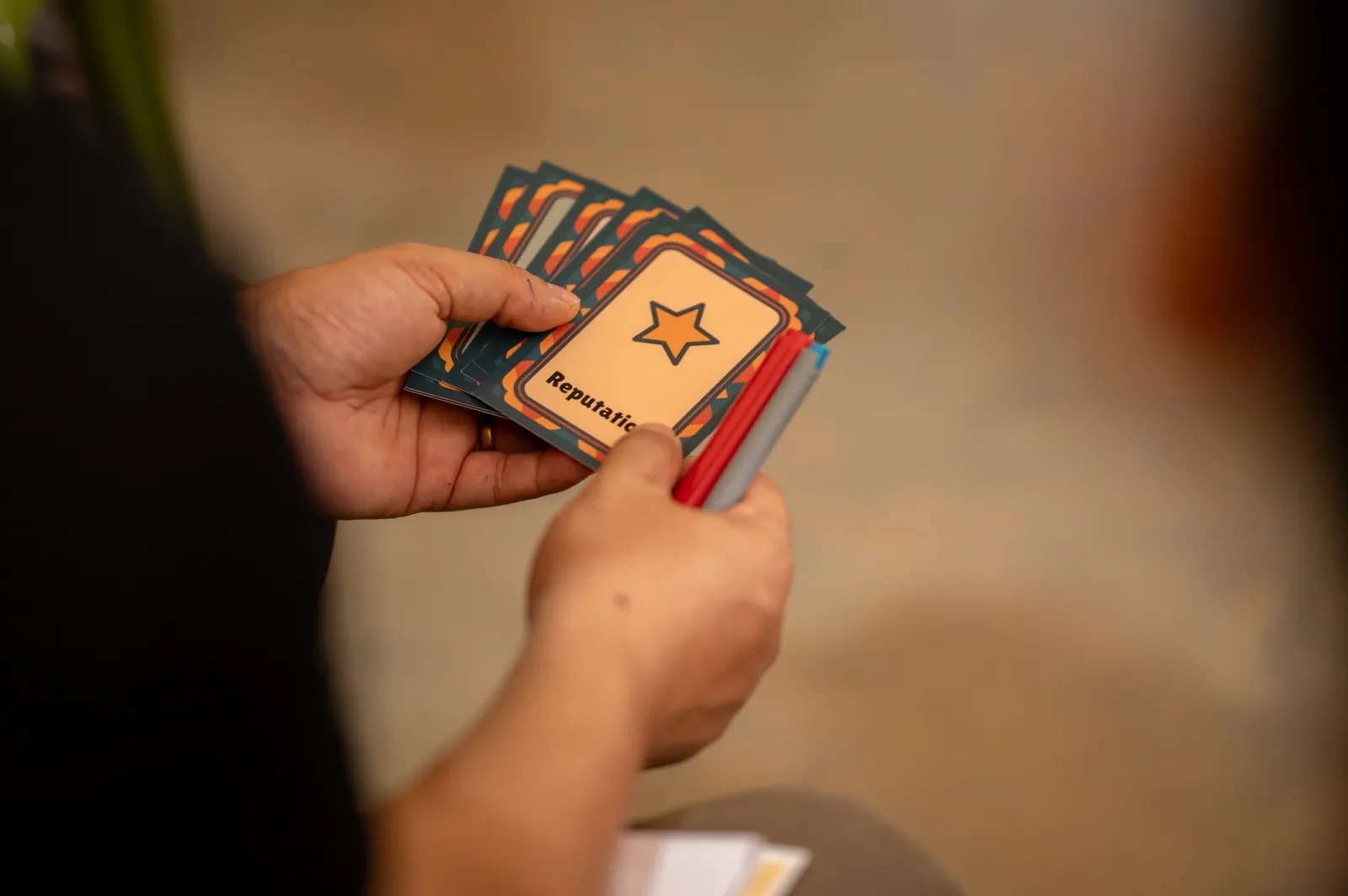
Mine are physical, because the things I get asked to look at are social. Who goes quiet when the pressure comes on, who takes the room without being handed it, who is quietly optimising for their own department.
A screen has a hard time seeing any of that. Not because there is anything wrong with a screen, it is just pointed at the wrong thing.
The ones I run
Seven of them, all designed by me, all played on a table. Forty-five minutes at the short end and six hours at the long one.
- Ripple Effect - 4 to 12 rival companies, one shared market. Cross-functional trust. 16-60 people, 75-90 minutes of play.
- Welcome to Zombiepuram - competing factions and no authority to fall back on. Negotiation and influence. 15-80 people, 6 hours.
- Planetfall - conditions shift and nobody gets the full picture, because at work nobody ever does. 8-20 people, 2 hours.
- Chaos in the Kitchen - big calls while the ground keeps moving. Strategic thinking. 15-50 people, 2 hours.
- Bloom - who treats a relationship as an asset and who treats it as a transaction. 12-40 people, 2 hours.
- Sticky Fingers - a card-based heist against a clock. What structure a team invents when you give them none. 12-150 people, 1 hour.
- The Potter from Belagavi - seven rounds to sell pots, and round five is when the person who stopped working overtakes the person who never did. 12-40 people, 45 minutes.
The reasoning underneath all seven is in the field guide to serious games for leadership development. And when none of them fits, there is custom design, which is where the more interesting problems tend to end up anyway.
 If you are looking into this for a team
Start from the sentence you would say to a friend if you were complaining about your leaders.
"They will not challenge each other." "Every function is looking after itself." "They freeze the moment the answer is not obvious."
That sentence is the brief, and the theme of the game is more or less decorative next to it.
Tell me the challenge, the group size and the seniority, and I will tell you which one fits. If none of them do, I will say that as well, because I have aimed a session at the wrong behaviour before and everybody had a nice time, which is not really what anyone paid for.
A Fortune-100 programme built this way ran six session-days and scored 8.82 out of 10 average satisfaction across 113 respondents. That is a satisfaction score and not a behaviour score, so take it for what it is.
Then they came back and commissioned a second, different programme, which is probably the more useful number of the two.
Common Questions
What do we call a game that is purposefully designed to help people train for something?
A serious game. The term was coined by Clark Abt in his 1970 book of that name, and it means a game whose first purpose is learning, practice or discovery rather than entertainment. Fun usually turns up anyway. It is just not the thing the game was built to produce.
What is a serious game?
A serious game is a proper game - rules, a goal, players competing or co-operating, a real chance of losing - that has been designed so that the way people behave inside it can be examined afterwards. Board games, card games and social games are all used this way. The game produces the behaviour and the debrief turns it into something usable.
Is a serious game the same as gamification?
No, though they get used interchangeably a lot. Gamification adds game parts - points, badges, leaderboards, streaks - to something that is not a game, usually to keep people doing it. A serious game is a whole game from the start, built around one behaviour somebody wants to see. Both are useful, and they are answering different questions.
Are serious games only digital?
Not at all. A lot of the academic literature is about digital and military simulations, which is probably why people assume screens. Mine are physical - cards, boards, pieces, a table and a clock - because the things I get asked to surface are social, and those show up between people rather than on a screen.

Related reading
- Serious games for corporate training: what they are and why they work
- Serious games for leadership development: the complete field guide
- Serious games vs gamification, and why the difference matters
- Leadership simulation games: what they are and how one runs
- How to build your own serious game
See the seven games Tell me your situation
With love from Bengaluru, this is Arvindh saying over and out.