
Leadership Simulation Games
Forty-five minutes, or a whole day, inside a decision that costs something. Then a conversation about what you actually did in there.
Or read the seven games first. Scroll down.
Short answer: A leadership simulation game is a built situation - scarce resources, missing information, other people with their own agendas - that a group of leaders has to run in real time. Nobody explains leadership to them.
They lead, in front of each other, and then we sit down and talk about what came out. I run seven of them, in person, and I designed all seven. Forty-five minutes at the short end, six hours at the long one.
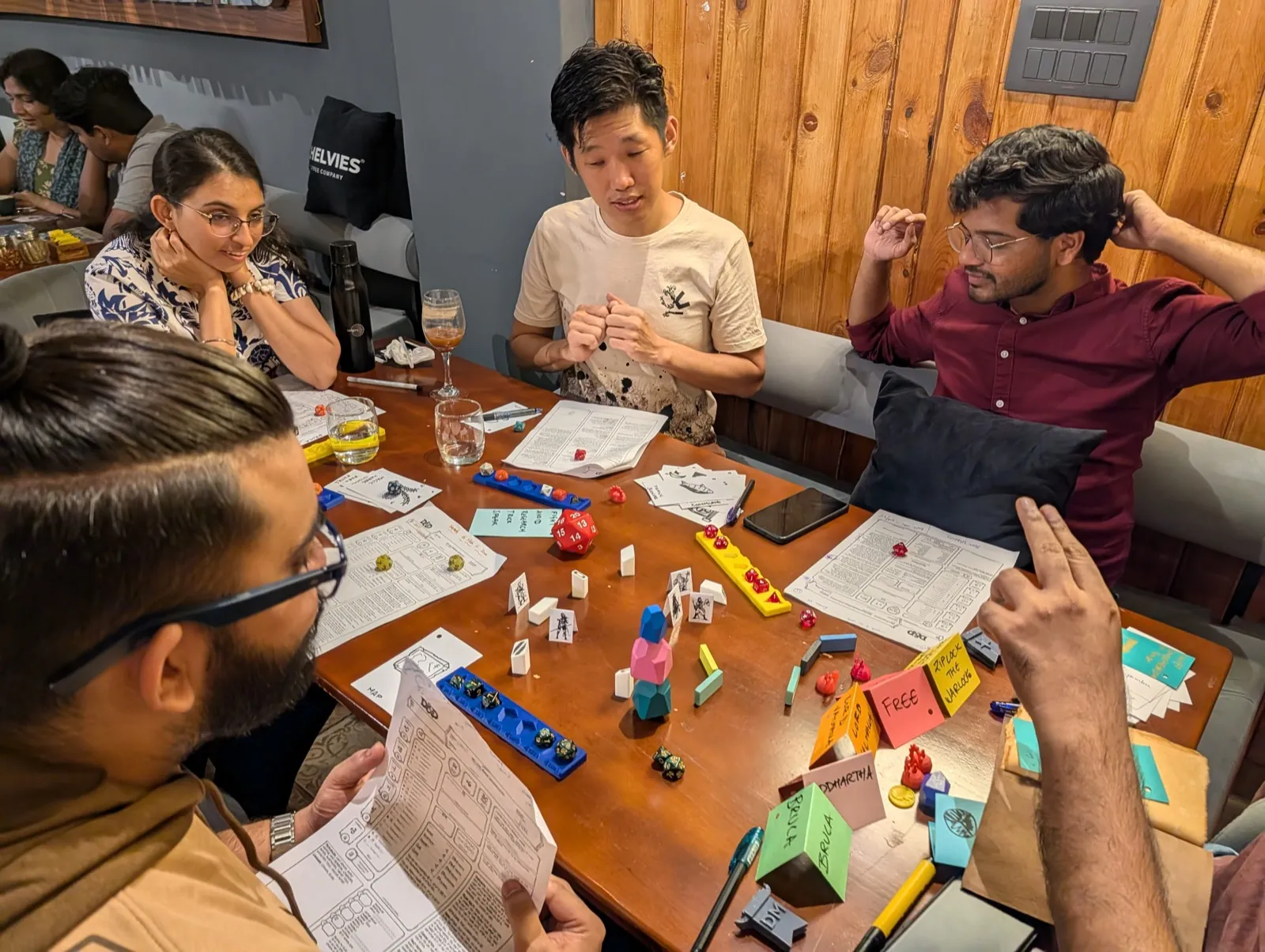
A word about the word
I have called these serious games for years now. On every page of this site, in every proposal, in every conversation where somebody politely waited for me to finish.
Most people call them simulations.
And they are right, more or less, because that is the honest description of what happens - you simulate a hard week of somebody's job and then you play it.
"Serious game" is the term the field uses. "Simulation" is the term a person uses when they are trying to explain to their boss what they want to book.
Same thing. And I have spent years using the word that made it harder to find, which is a fairly silly thing to do to your own work.
So this page uses the other one. If you came here looking for a leadership development simulation, that is what is underneath all of it.
 What is actually in one
Four things, and if any of them is missing you have an activity rather than a simulation.
A position worth protecting. Every player wants something specific, and the things they want do not all fit.
That is where behaviour comes from. Not from the theme.
Less than you need. Not enough money, not enough time, not enough information, usually all three.
Leadership is mostly the allocation of something scarce, and a room with plenty of everything shows you very little.
Consequences that arrive later. A rubbish call in round one that wrecks round four.
Which is the bit that separates a simulation from a discussion. You cannot argue your way out of what already happened at the table.
Somebody watching who can name it afterwards. The game produces the behaviour. The debrief is where it turns into something anyone can use on Monday.
The digital ones, and the ones with people in the room
When people say "business simulation" they often mean software - a multi-round model where teams set price and headcount and marketing spend, and a spreadsheet somewhere tells them how the quarter went.
Those are good, and I would recommend one for the job it does. Financial acumen, P&L intuition, the way six decisions compound into a result nobody predicted.
It models numbers over time better than any table full of cards ever will, and it scales to a thousand people in a way I never will.
Mine are the other kind. In-person, on a table, cards and pieces and a clock.
Ripple Effect is the one that sits closest to what people usually mean by a business simulation game for leadership - 4 to 12 rival companies in one shared market, trading and negotiating, and a market that only holds if the tables keep their promises.
Except the interesting part is never the numbers. It is which of the five decides to be the one who gives.
Because the things I get asked to surface are social. Who goes quiet when the pressure comes on, and who takes the room without being given it.
Who builds something for the whole company, and who is quietly looking after their own department.
A model cannot see any of that. And honestly neither can a facilitator who was not standing there when it happened.
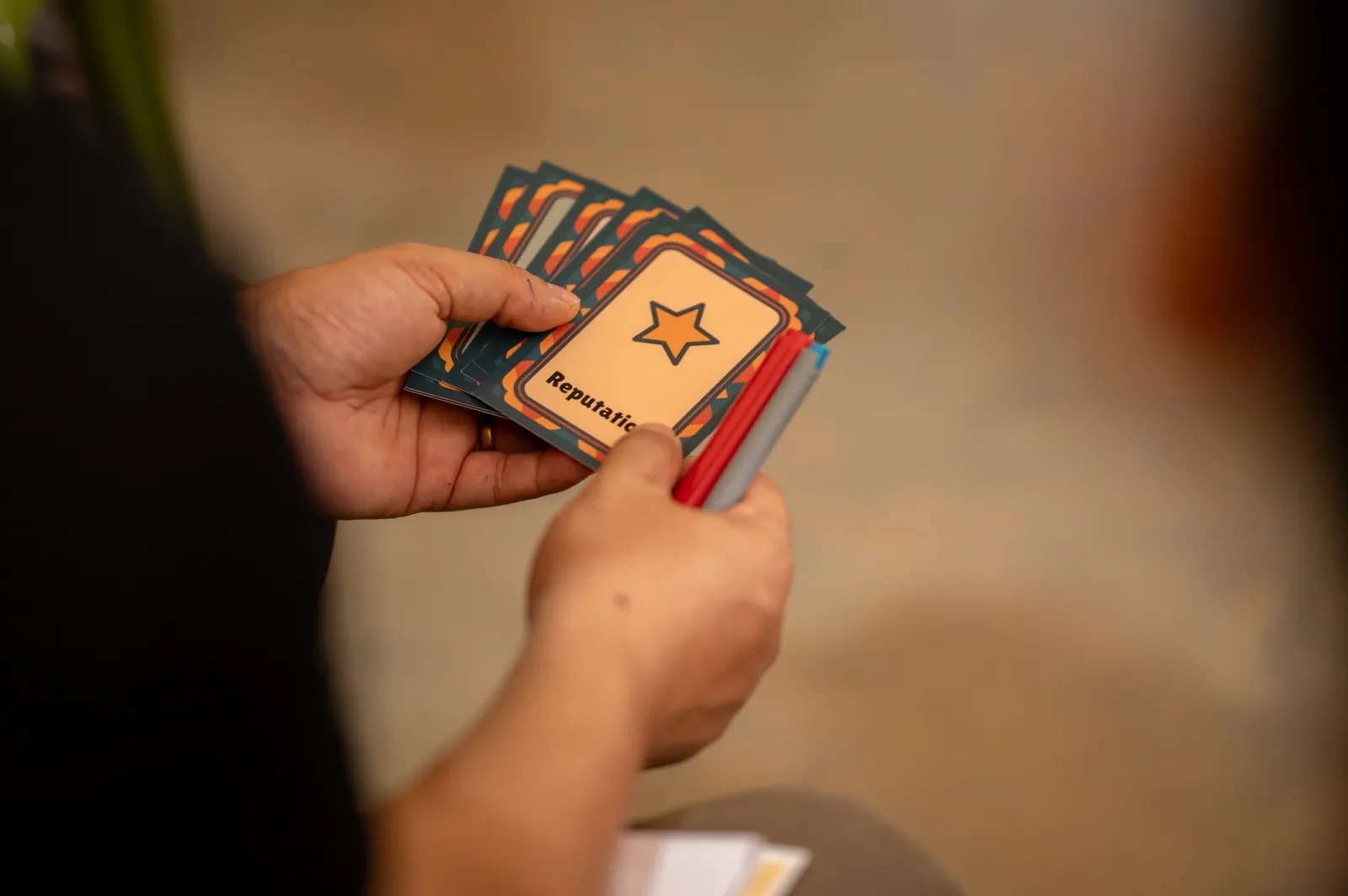
What changes when the decision costs something
A good training room is a good training room, and I have sat in plenty of them. The models are usually sound and most of the people teaching them know exactly what they are doing.
It is just built for a different job. A workshop is designed to transfer something cleanly, so it clears the noise away on purpose. A simulation puts the noise back, because the noise is the thing I have been hired to look at.
Side by side, more or less:
| Dimension | A workshop | A simulation |
|---|---|---|
| The job it is built for | Teaching the model clearly | Showing what the person does with it |
| What the person does | Talks through how they would handle it | Handles it, in front of people they work with |
| Information | Complete, so the idea lands | Partial, because somebody else has the rest of it |
| Failure | Kept safe, deliberately | Costs the round, and the room sees it |
| Where the value lands | In the notes and the framework | In the debrief, where somebody names the pattern |
Knowing situational leadership and using it at 4pm on a bad Thursday are two different skills. Only one of them can really be practised on a slide, and I would want my leaders to have both.
 The seven simulations I run
Choose by the behaviour you want to see rather than the theme you want to talk about. It sounds like a small distinction and it is the one that saves a wasted day.
- Ripple Effect - 4 to 12 rival companies, one shared market. Cross-functional trust, and who is really building for the whole room. 16-60 people, 75-90 minutes of play.
- Welcome to Zombiepuram - competing factions, no authority to fall back on. Negotiation, influence and coalition-building. 15-80 people, 6 hours.
- Planetfall - conditions shift and nobody ever gets the full picture, because at work nobody ever does. Decision-making under ambiguity. 8-20 people, 2 hours.
- Chaos in the Kitchen - big calls while the ground keeps moving. Strategic thinking and scenario planning for senior teams. 15-50 people, 2 hours.
- Bloom - who treats a relationship as an asset and who treats it as a transaction. Stakeholder management. 12-40 people, 2 hours.
- Sticky Fingers - a card-based heist against a clock. Who leads when the time is running out, and what structure a team invents when you give them none. 12-150 people, 1 hour.
- The Potter from Belagavi - seven rounds to sell pots, and round five is when the person who stopped working overtakes the person who never did. Working smarter instead of harder. 12-40 people, 45 minutes.
If you want the reasoning underneath all seven, the long version is in the field guide to serious games for leadership development. And if none of them fits your situation, there is custom design, which is where most of the interesting problems end up anyway.
What a session actually looks like
A short setup, because the rules have to be small enough that nobody is still learning them in round three.
Then the simulation runs. Rounds, decisions, consequences, an increasing amount of noise.
My longest game is six hours and my shortest is forty-five minutes. The length is set by the behaviour, not by how much of the day somebody has bought.
Then the debrief, which is the bit that matters.
I tell that specific room what I watched them do, in the moment they did it - which team went around the difficult conversation, which leader stayed in the discomfort anyway, who agreed with everything the second the stakes rose.
And the close is a commitment with a name on it. A specific thing, a specific situation, a specific date, said out loud in front of everybody before they leave.
One Fortune-100 programme built this way ran six session-days and scored 8.82 out of 10 average satisfaction across 113 respondents.
Which is a satisfaction score and not a behaviour score, so take it for what it is. People liked the day.
The thing I would actually point at is that they came back and commissioned a second, different programme.
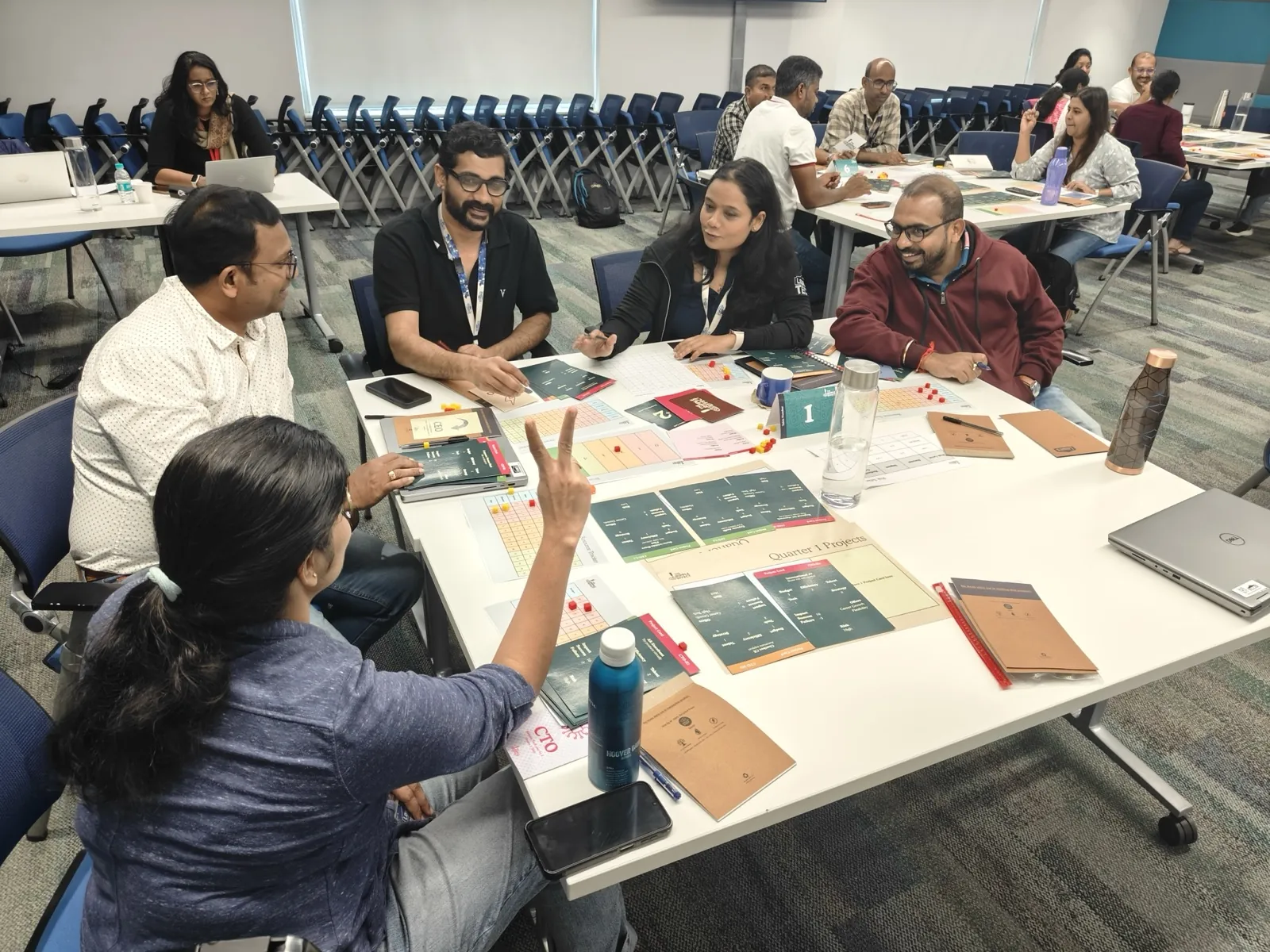
 How to choose one
I was early for a session a while ago, and hungry, so I walked into Kailash Parbat to kill an hour.
Everything on that menu was available to me. Time to spare, money in my pocket, the whole spread sitting right there.
I ordered curd rice.
Because I had heartburn, and the only thing I actually wanted was the thing that made it stop.
Younger me would have killed for that menu. That version of me just wanted the acidity to go away.
Which is more or less how anybody picks one of these, and I mention it because for years I pitched the menu.
Seven games, all the mechanics, look at the range. Very impressive. Completely useless to somebody who walked in with one specific thing hurting.
So start from the sentence you would say if you were complaining about your leaders to a friend.
"They will not challenge each other." "Every function is looking after itself." "They freeze when the answer is not obvious."
That sentence is the brief. Whichever simulation makes that specific thing happen on a table is the right one, and the theme is more or less decorative.
If you would rather not work it out from a page, tell me the challenge, the group size, the seniority and what you want people to walk out with. I will tell you which one fits.
And if none of them do, I will say that too. I have aimed a session at the wrong behaviour before, and everyone had a nice time, which is not really what anybody paid for.
I only take two or three programmes a month, mostly because I design and run all of them myself. So it does fill up, and I would rather mention that now than in October.
Common Questions
What is a leadership simulation game?
It is a built situation that a group of leaders has to run in real time, with scarce resources, incomplete information and other people who want something else. Nobody is answering questions about leadership. They are making calls and then living with them, which is the part a slide cannot reach.
Is a leadership simulation the same thing as a role play?
They overlap, and role play is genuinely useful for practising a conversation you already know is coming. The difference is that a role play hands you a character to perform, and a simulation hands you a position to protect. In the second one people stop acting after about ten minutes, because the thing they are trying to win becomes real to them.
Are these digital simulations or in-person ones?
In-person, all of them, played on a table with cards and pieces. Software business simulations are good at modelling numbers over many rounds and they scale in a way I never will. Mine are built for the human bit - who goes quiet, who takes the room, who quietly optimises for their own department - and that needs bodies in a room and somebody watching it happen.
Is this a business simulation game for leadership?
It depends which half of that phrase you lean on. If you mean a multi-round software model where teams set price and headcount and a spreadsheet reports the quarter, then no, that is a different product and a good one. If you mean a built business situation that leaders have to run against each other, with budgets and scarcity and somebody else's agenda in the way, then yes. Ripple Effect is that one.
Can a leadership development simulation run inside a longer programme?
Yes, and it usually works better that way, because a behaviour named in one session is easier to hold on to when the same room meets again. One Fortune-100 programme built this way ran six session-days and scored 8.82 out of 10 average satisfaction across 113 respondents. That is a satisfaction score and not a behaviour score, so take it for what it is. The thing I would point at instead is that they came back and commissioned a second, different programme.
How many people can play, and how long does one take?
Twelve people at the small end and up to a hundred and fifty at the big one, depending on which game it is. Forty-five minutes for The Potter from Belagavi, six hours for Welcome to Zombiepuram, and most of them sit at two or three hours. The length is set by the behaviour you want to see rather than by how much of the day somebody has bought.

Related reading
- Serious games for leadership development: the complete field guide
- Serious games vs gamification, and why the difference matters
- Decision-making under uncertainty
- Decision Labs: turning game decisions into behavioural data
Tell me the sentence
The seven are all linked further up, so you have already seen the menu. The bit I am actually useful for is the sentence.
Book a discovery call WhatsApp me
Or the form below, if that is easier. It all lands with me either way.
Or just tell me what you are trying to fix
I went back and forth on whether to put a form at the end of this page.
Because a form asks you to be tidy about something you are probably still working out. And the enquiries I enjoy most tend to arrive as three messy lines, written by someone who has not finished deciding what they want yet.
So there are two ways in, and I genuinely do not mind which one you use.
Write to me directly at arvindh@puttheplayerfirst.com and say roughly what you want to change. Three lines is plenty. I read my own email.
Or fill this in, if that is easier. It lands in the same inbox.
I answer these myself, usually within a day. Two if I am in a room somewhere with my phone in a bag.
And you are not committing to anything by writing in. Worst case we have a conversation, and you come out of it with a clearer brief than you had this morning.
With love from Bengaluru, this is Arvindh saying over and out.