
Live Facilitated vs Digital Simulations: Which Develops Leaders More Effectively?
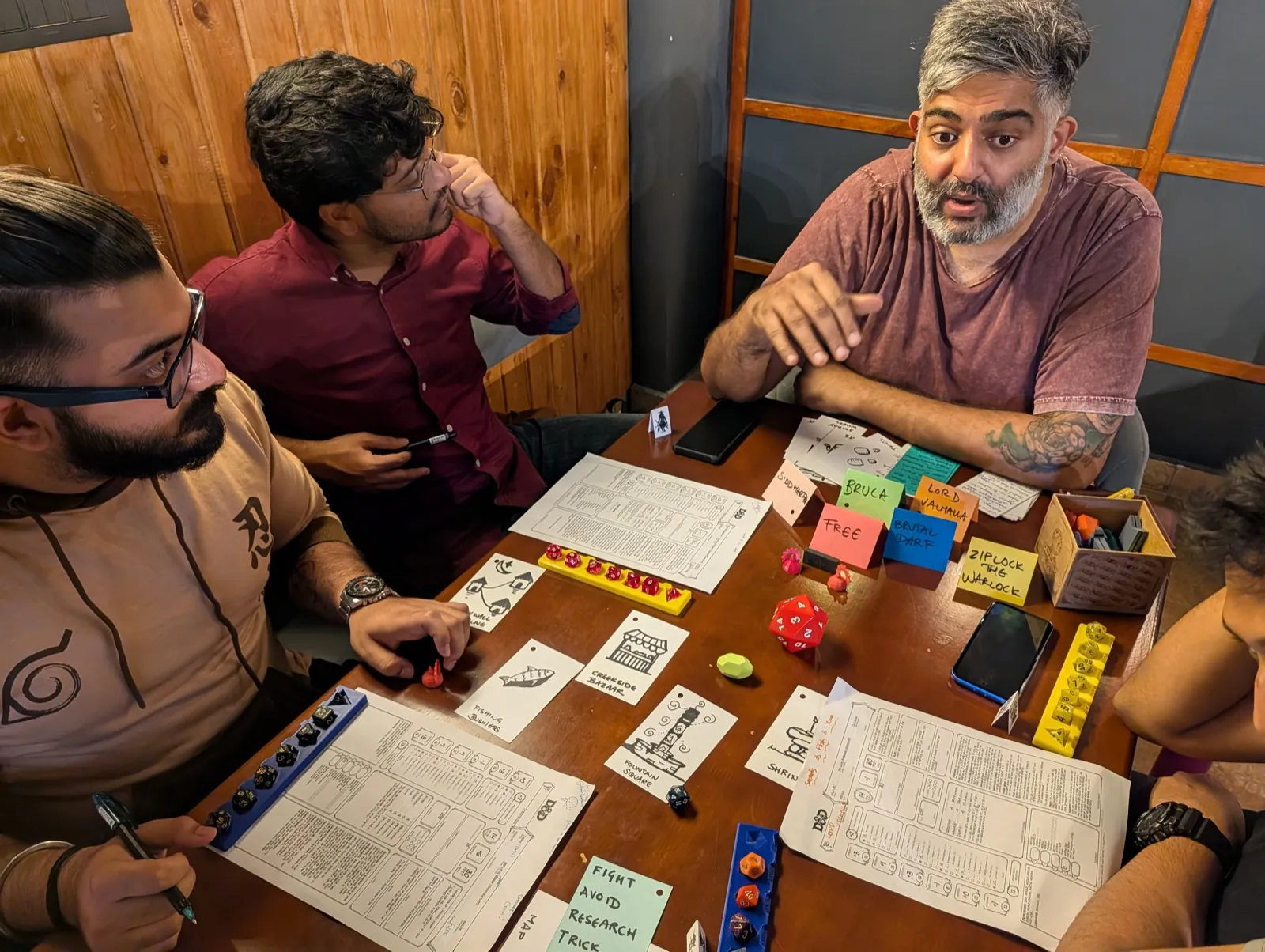
"A digital simulation tells you how someone decides on their own. A live facilitated game shows you how they behave with other people in the room - which is where leadership actually happens."
Digital simulations have got good. Genuinely good. Branching scenarios, difficulty that adapts, tracking on every click, production values that don't make you wince. You can reach a thousand leaders for the price of a decent offsite.
And live facilitated serious games keep producing something the digital ones can't touch.
That isn't loyalty talking. It comes down to what leadership actually is, and where it actually happens.
What Leadership Actually Is
Leadership is a social thing. It doesn't happen on your own.
It happens when you need something from someone whose interests point the other way. When you make a call that a room full of people quietly disagrees with. When you hold your position against someone who outranks you. When the comfortable consensus is forming in front of you and you know it's wrong and you have about four seconds to decide whether to say so.
All of that is relational. Reading someone. Feeling the resistance and adjusting. Managing your own face while paying attention to theirs. You cannot practise any of it alone.
Which is the structural problem with most digital simulations. They model leadership as a series of clean decisions taken by one person at a screen. The cleverest branching system ever built still cannot produce a real room of real people reacting to each other in ways nobody designed.
What Digital Simulations Do Well
Let me be fair, because there are things they do that I simply cannot.
Scale. A thousand leaders at once, with no extra facilitation cost. Live sessions need a skilled human in every room, and there are only so many rooms. If you have a big, scattered population and a consistent baseline matters more than depth, digital wins that argument outright.
Individual tracking. Every choice recorded, scored, turned into a personal report about someone's decision tendencies. That's genuinely useful for a coaching conversation, and it is not something I can hand you at the same resolution.
Repeatability. Identical every time. Same scenario, same options, same scoring. So you can measure one person's change over time with real precision. Live games are variable by nature, because the humans keep being different.
Accessibility. Remote leaders, awkward time zones, people who can never make a Tuesday. Asynchronous access removes the scheduling problem that quietly kills half the leadership programmes ever planned.
What Live Facilitated Games Do That Digital Simulations Cannot
Now the other side. And this isn't a marginal edge, it's a difference in kind.
Real social dynamics. Put twelve leaders round a table with something at stake and it all comes out. Actual influence attempts. Actual conflict avoidance. Actual decisions about who to trust, who to carry, who to quietly leave behind in round four. None of it scripted, none of it predictable, and all of it the raw material a good debrief turns into something people can't argue with.
What a facilitator sees. No tracking system catches the things a person catches. The half-second look before somebody agrees. The moment confidence leaves a leader's shoulders. Who gets asked and who gets talked over, every single round. The way authority drifts around a table over three hours and lands somewhere nobody expected. That's the material that lets a debrief name a behaviour instead of describing a category.
A shared memory. "Remember round three, when you blocked the alliance?" That sentence can be said in a team meeting six months later, and everyone in the room knows exactly what it means. That's a shortcut you cannot manufacture any other way. Digital simulations taken alone produce no shared anything - twelve private experiences, no common language.
The debrief. A live facilitator can use everything they just watched. They can see who went defensive, who went silent, who surprised themselves, and steer straight at it. Software can generate feedback. It cannot ask the follow-up question that nobody wanted to be asked.
When to Use Each
Go digital when scale is the binding constraint, when the gap is knowledge rather than social skill, when your people are spread across the map, or when clean individual measurement matters more than depth.
Go live when the development need is interpersonal, when the team needs to watch itself, when depth beats reach, or - and this is the common one - when you already ran the digital programme, everyone's decision scores improved, and absolutely nothing changed about how they behave in meetings.
Honestly, the strongest programmes use both, in order. Digital builds the individual knowledge and a shared vocabulary. Live then does the social and behavioural work, where the change has to happen anyway. Each format doing its own job, neither one asked to do the other's.
The Cost Comparison
Yes, digital costs less per head. But cost per head is the wrong number.
The number that matters is cost per unit of behaviour actually changed. If you've bought a digital programme for a problem that only a room can solve, the low per-head price is irrelevant. You've bought a cheap thing that doesn't do the job.
Works the other way too. Flying a facilitator round the country to push information into people is a spectacular waste of a high-touch resource. Send a deck.
These two aren't fighting for the same slot. Used properly they're complementary, each pointed at the part of the problem its mechanism is actually built for.
Not sure which half of that your problem sits in? Tell me what you're trying to change and I'll tell you straight, including if the answer is a platform and not me. Or have a look at the games and what each one is built to surface.
With love from Bengaluru, this is Arvindh saying over and out.