
Serious Games vs Traditional Workshops: What's the Difference?
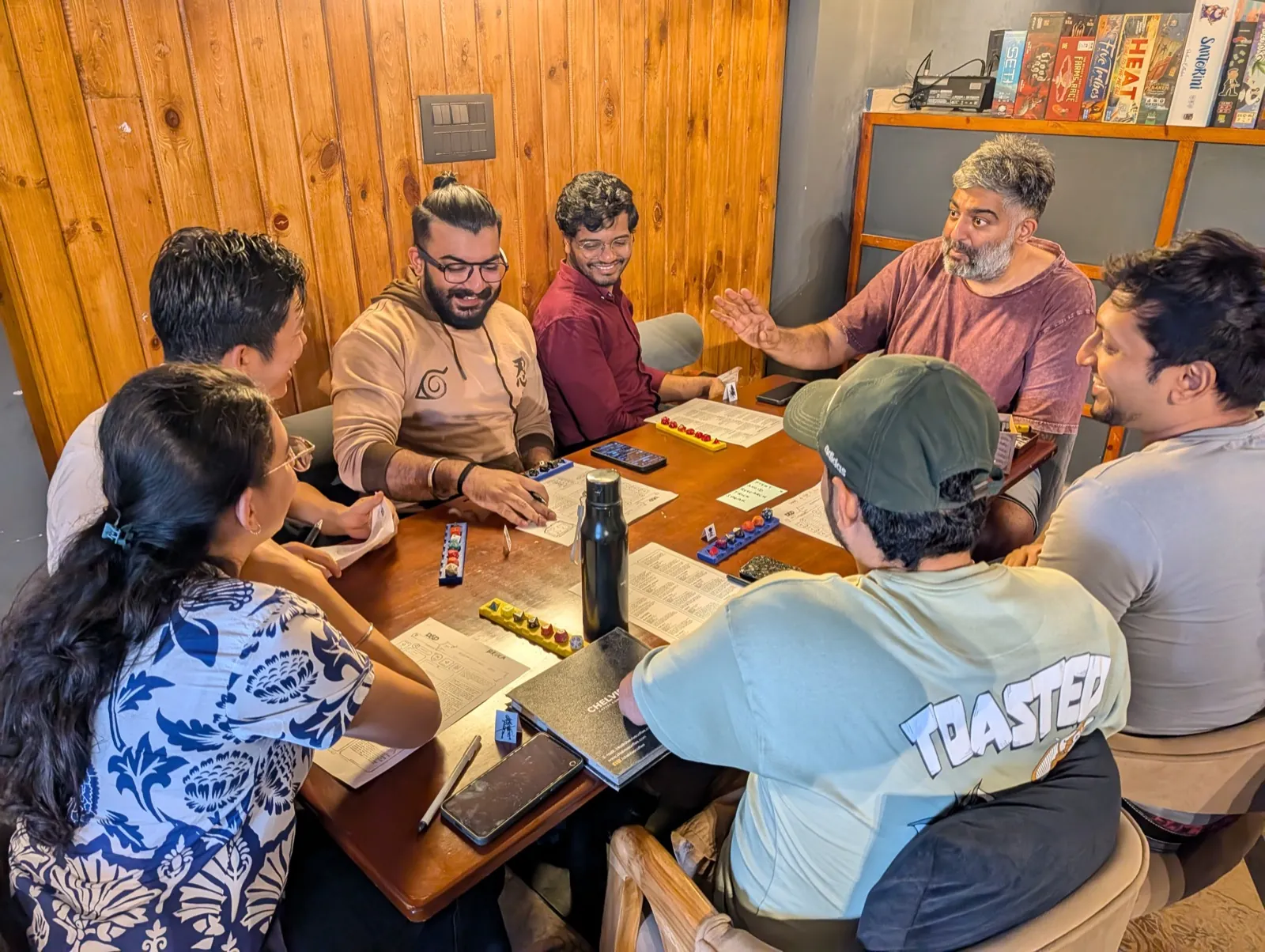
"A workshop tells your leaders what good leadership looks like. A serious game shows them what they actually do when it gets hard."
Both fill a day. Both have a facilitator. Both produce warm feedback forms. So from where a buyer sits, a serious game looks like a pricey variant of something they already know how to run.
It isn't. The differences are structural, not stylistic, and they decide whether anybody behaves differently afterwards or whether your leaders just come back with better vocabulary for exactly the same habits.
What Happens in a Traditional Workshop
You know the shape. Content goes out - slides, a case, a discussion. The skill gets demonstrated. Everyone practises in pairs. There's a structured reflection at the end and a commitment card.
This is not worthless. It's a genuinely efficient way to move a concept into a lot of heads, build shared language, and get people to say out loud what they intend to do. If a team needs to align on a model or a process, a workshop is the right tool. Fast, scalable, and in good hands, properly enjoyable.
The trouble is what it structurally cannot do. It can't create real stakes. It can't create real social dynamics. It can't apply the kind of pressure that makes people revert to who they actually are. And so it can't generate anything for the debrief to work with except opinions.
Because here's the bit everybody knows and nobody mentions. When people role-play, they know they're role-playing. So they perform the behaviour they know is expected of them. The facilitator watches the performance, not the leader. Then the day ends, the stakes come back, the performance drops off, and the old habit walks back in.
What Happens in a Serious Game
A serious game is a system with rules, resources, roles and something to win. You make a decision, the system reacts, and the reaction lands on other people, who then react to you. Nothing about that is scripted. It comes out of your actual tendencies colliding with constraints somebody built on purpose.
And that's the whole difference. In a workshop, you control how you come across. In a serious game, the game controls the conditions, and you behave honestly because keeping up a performance and playing a demanding game at the same time is more than anybody's brain will do for three hours. So people play as themselves. Their real patterns - influence, avoidance, how they take authority nobody offered them - just walk out into the open.
My job during play isn't to instruct. It's to watch. Who defers to whom. Who takes control uninvited. Who sits on information. Who argues for the group when it costs them personally. Who decides fast and alone. The debrief gets built out of that, from things that actually happened, in front of everybody.
The Debrief Difference
Both formats have a debrief. They are not comparable.
A workshop debrief asks people to reflect on what they learned. Which means the quality depends entirely on how self-aware each person already is. Self-aware people produce useful reflections. The people who most need the development produce reflections that confirm what they already believed about themselves. Very little new arrives.
A serious game debrief runs on evidence. I watched it. Everyone else in the room watched it too. So it can point at a specific moment, a specific decision, a specific pattern that nobody can quietly re-narrate afterwards. It can open the gap between how a leader thinks they operate and how twelve witnesses saw them operate.
That gap is the only place development actually starts.
On the AI-enablement work I ran for a Fortune 100 company - one programme, six session-days, 113 respondents, 8.82 out of 10 average satisfaction - the feedback that kept repeating wasn't "I learned something new". It was that people had seen themselves clearly, in a way earlier training had never managed. That's what the format buys you.
When to Use Each Format
Serious games are not always the answer, and I'll say so before you do. They cost more in design and facilitation time. They need somebody who can hold both the game and the debrief. They're at their best when the need is genuinely behavioural, and especially when you've already tried the content route and watched it not work.
Workshops are right for conceptual alignment, shared vocabulary, process rollout. Pushing a new performance management framework to 500 managers? Workshop, obviously. Getting those same 500 managers to hold a difficult conversation differently? A workshop will not get you there on its own, no matter how good the deck is.
The best programmes use both. Workshop to lay the concepts and the language. Game to turn concepts into visible behaviour. Coaching or action learning afterwards to keep it alive once everybody goes back to their inbox.
The Cost Comparison
Yes, serious games cost more per head. Higher design investment, harder facilitation, smaller rooms - because the social dynamics only work if people can actually interact with each other.
But per head is the wrong denominator.
A workshop that produces brilliant engagement and no lasting change has an enormous cost per unit of change, whatever the per-person fee says. A game that visibly shifts how a leadership team operates is far cheaper on the only measure anyone should care about.
That's a harder case to make in a budget meeting, I know. Organisations are set up to count cost per head, because heads are easy to count. But if the question is whether leadership developed, the denominator has to be change, not attendance.
The Facilitator Difference
In a workshop, the facilitator is the expert. Knows the content, demonstrates it, holds the energy, runs the debrief. A good one can take the same leadership content into twenty different companies, because content travels.
In a serious game, the facilitator has to be the designer - or at least understand the design well enough to work from what the game surfaces rather than from what they prepared. When the debrief is built live out of things people just did, you need someone who can translate a moment on a table into the thing that keeps happening in your business. That's a completely different preparation and a completely different skill.
Which is why I run every session myself. The debrief and the design intent are the same object. I know what each mechanic was put there to expose, because I put it there. Split design from delivery and the debrief becomes somebody interpreting a machine they didn't build.
Choosing Between Them
Not which is better. Which is right for what you're trying to move.
Conceptual alignment - workshop. Behaviour change in leaders who've had plenty of concepts and haven't budged - game. Both - build a programme that uses each where it's strongest and stop making one do the other's work.
The thing that should not decide it is familiarity. Workshops are familiar. Procurement knows how to score them. The feedback form already exists. Serious games ask more of the buyer, and that extra friction has quietly steered a lot of L&D money towards the format that is easier to purchase rather than the one that produces the change.
Have a look at the games, or come and tell me about your team and I'll tell you which of the two you actually need.
With love from Bengaluru, this is Arvindh saying over and out.