
Serious Games vs eLearning for Leadership Development
Leadership happens between people. You cannot practise it alone, at a screen, at 11pm, on 1.5x speed.
Short answer: Digital learning gets knowledge to thousands of people, at their own pace, alone, with nothing at stake. A serious game throws away the content and gives them a live simulation instead - other people, a running clock, and decisions that cost something. Use e-learning to build the foundation. Use the game when you need the behaviour to actually change.

Key takeaways
| Dimension | Digital learning / e-learning | Serious games |
|---|---|---|
| What it is | Content, a screen, and one person on their own | A live simulation full of other people with agendas |
| Best for | Technical skills, compliance, product knowledge, concepts | Leadership, influence, conflict, deciding when nothing is clear |
| Engagement vs behaviour | People engage. People learn. People carry on as before | People get caught doing the thing they always do |
| What it measures | Completion rates and a quiz score | What you chose when the choice actually cost something |
| Cost and scale | Enormous reach, almost no marginal cost, no facilitator | Small cohorts, live facilitation, a debrief that names things |
eLearning works well for...
Scale. Consistency. Anything a person can honestly learn on their own. Video courses, LMS modules, microlearning, the shiny new AI-personalised pathway - all of it solves a real problem, and it is a hard one. How do you get the same solid content to four thousand people across nine cities without putting any of them on a plane?
You cannot do that with a room. So if you run L&D for a big Indian enterprise, e-learning is not a compromise, it is infrastructure. Technical skills, compliance, product knowledge, the conceptual base under a leadership programme - all of it belongs on a platform. Most enterprises here built that infrastructure properly after 2020 and the money was well spent.
Then somebody decided the same platform should also produce better leaders, and that is where it quietly falls apart.
 Where it falls short for leadership development
E-learning solves a problem that has very little to do with leadership. E-learning is built for one person, alone, in conditions they fully control. Nobody is watching. Nothing arrives before you are ready. Nobody else's bad decision lands on your desk halfway through module four. The screen never pushes back... and leadership is entirely made of things pushing back.
Every leadership capability worth the name needs another human being present to even switch on. Influence needs somebody to influence. Conflict needs somebody being difficult. Trust needs a person who might let you down. You cannot develop any of it on your own with headphones in, no matter how good the content is.
Then there is the undo button. Most e-learning lets you try an option, see the feedback, back out, and pick the better one. For a technical skill that is exactly right - the goal is the correct answer. For leadership it is the opposite of useful. Real leaders commit under pressure, watch it go badly, and adjust. E-learning hands everybody a save point and then wonders why nobody grew.
The frameworks are learned. The completion rate is 94%. The behaviour is untouched.
 What serious games do differently
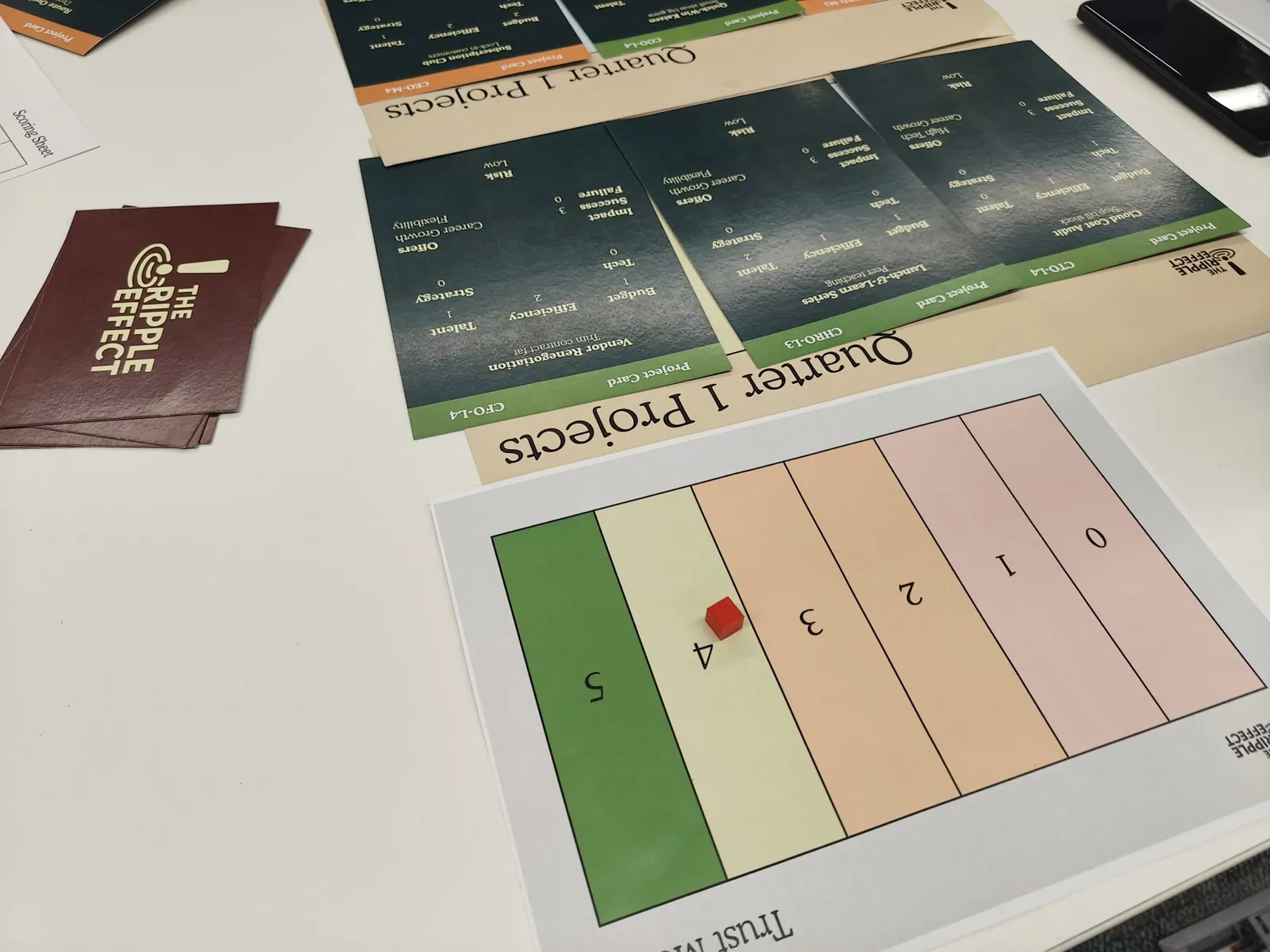
A serious game puts several people in the same simulation and lets their decisions collide. That collision is the entire teaching mechanism. In a Ripple Effect session, somebody protects their own function's numbers in round one, and two rounds later three other teams feel it. No pop-up explains what the better option would have been. Instead, a colleague looks up and says "wait, was that you?" That lands rather differently.
This is why a live simulation cannot be swapped out for a course. It manufactures the conditions in which leadership behaviour is forced into the open. Stress amplifies whatever pattern you already have. Time pressure strips off the careful version of yourself you were performing at 10am. Competing incentives create trade-offs you cannot read your way out of. None of that survives a screen, because all of it requires other humans in the room.
The stakes are made up. The feelings are not. People genuinely want their plan to work. They get properly annoyed when resources run dry, tense when an alliance breaks, and quietly gutted when the clever thing they did in round one collapses in round three. That last one is the whole point. A branching scenario and a completion certificate have never produced it.
The facilitation difference
E-learning has no facilitator, on purpose. The system leads, the dashboard tracks, and nobody is watching the pattern you keep repeating. For information transfer that is completely fine. Information does not care who receives it.
I design every game I run and I facilitate every session myself. Not because it scales - it obviously doesn't, and licensing these games out would be a far better business. I do it because the debrief is where the change happens, and the debrief only works if the person running it was standing there the whole time.
When a session ends, I am not reading from a standard debrief guide. I am working from what I saw. Who went quiet the moment things got complicated. Which team found something clever under pressure that broke every assumption they walked in with. Which leader pushed so hard for agreement that the group landed on a worse call than any one of them would have made alone. Those are the moments people carry back to work. No algorithm has ever noticed one.
 The bottom line
Keep the e-learning. It is your foundation layer - the concepts, the shared frameworks, the breadth nobody has time to cover in a room. Cheap, consistent, measurable, and good at what it is for.
The simulation is the practice layer. It is where those tidy frameworks meet other people and go sideways. Not because e-learning is wrong, but because knowledge that has never been tested under pressure is not capability, it is trivia. Leaders need to be caught in the act, see it themselves, and hear somebody name it plainly.
You cannot deliver that through a screen to a person sitting alone at 11pm. Leadership is a team sport. So is learning it.

Related reading
- Serious games for leadership development: the complete guide
- Decision Labs: turning game decisions into behavioural data
- Serious games vs gamification: why the difference matters
Frequently asked questions
Are serious games better than e-learning?
Neither is better, and anybody who says otherwise is selling one of them. E-learning is genuinely brilliant at its job - knowledge, frameworks, compliance, thousands of people, very little money. A serious game is a live simulation with other humans inside it, which happens to be the only place leadership behaviour has ever turned up. Use e-learning to lay the foundation. Use the game to find out whether anyone actually behaves differently.
When is digital learning the right choice?
When you need scale and consistency, and the thing can honestly be learned alone. Technical skills. Product knowledge. Compliance. The conceptual base under a leadership programme. Fourteen time zones, everybody gets the same content, nobody has to book a room in Whitefield. That is a real problem solved properly and I am not going to pretend otherwise.
Can e-learning change behaviour?
It changes what somebody knows. It almost never changes what they do. Leadership behaviour shows up in real time, in front of other people, when the consequence has already landed and cannot be taken back. E-learning is solo, self-paced and consequence-free by design - you can always reverse out and pick the other option. Every single condition that changes a leader has been carefully removed, and then we act surprised.
With love from Bengaluru, this is Arvindh saying over and out.