
 The promotion trap
Your best individual contributor became a manager. Your best manager is now expected to lead. Every jump rewards a different skill than the one it demands next, and the training most companies buy quietly pretends all three are the same job. It hands managers a stack of models about feedback and delegation, everyone rates it 4.6, and then the room is surprised that nothing about the team changed.
Nothing changed because management is a set of tasks you can be taught, and leadership is a set of behaviours you have to practise. Reading a team as a system. Building trust you can't mandate into existence. Deciding on partial information while everybody watches your face for the tone. None of that has ever lived on a slide.
Managing vs leading: what a game makes visible
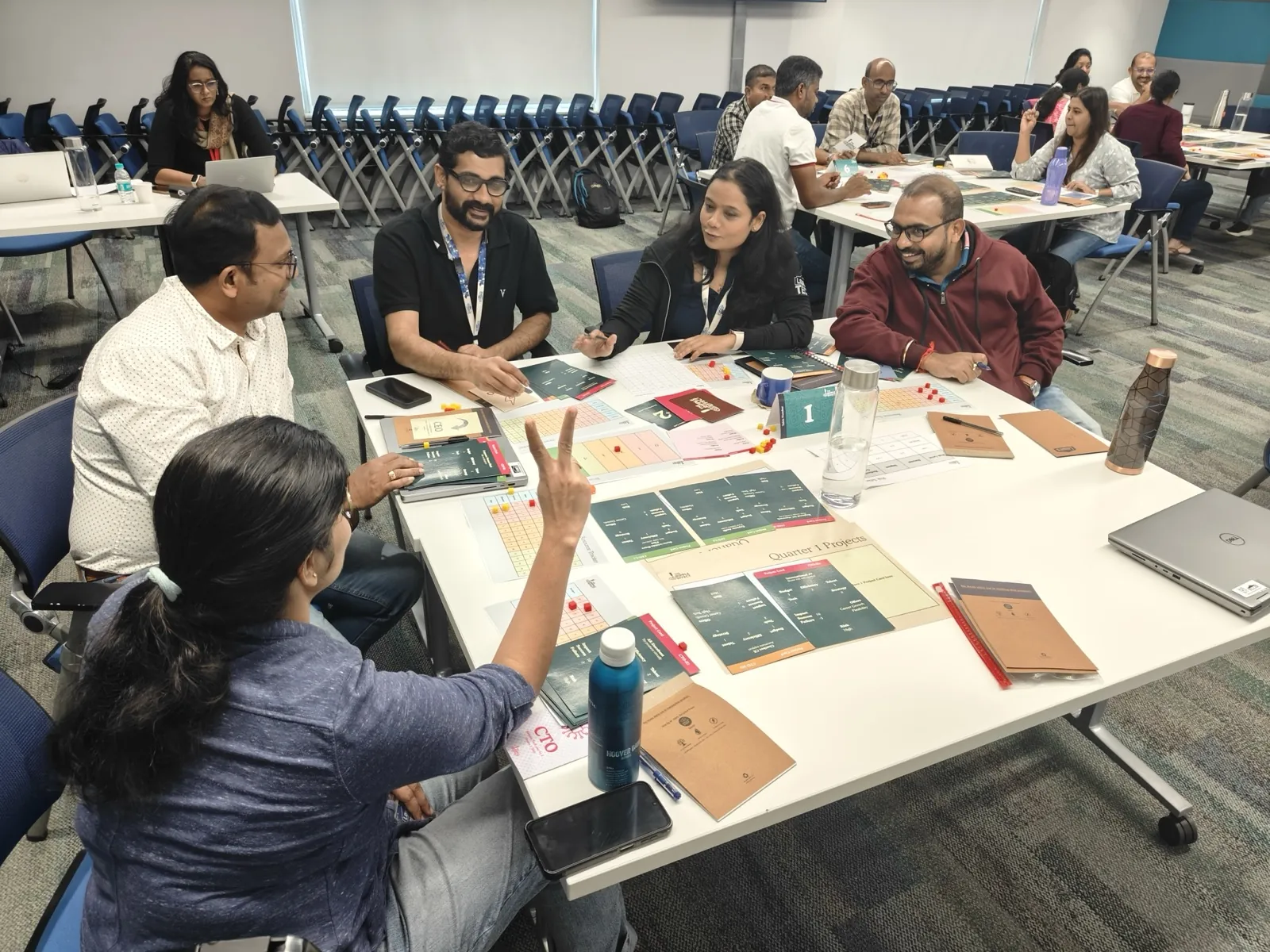
A serious game - a simulation, if that's the word your organisation uses - drops managers into a situation with real stakes and half the information missing. Then the difference between running tasks and leading people shows up all on its own:
- Who protects their own scorecard - and who acts for the whole team even when it costs them locally.
- Who waits for instructions - and who steps up and leads when no one appointed them.
- Who transmits pressure down the line - and who absorbs it and keeps the team steady.
- Who hoards the information they hold - and who shares the piece a teammate needed to move.
The debrief names those behaviours and ties them straight to Monday. That recognition is what turns a manager into a leader - not another framework.
 Which games we use
I match the game to the shift you need, not to a theme.
- Sticky Fingers - emergent leadership and collaboration under pressure. 12-150 people.
- Ripple Effect - reading a team as a system and cross-functional trust. 16-60 people.
- Bloom - influence without authority and stakeholder relationships.
- Chaos in the Kitchen - decision-making when conditions keep shifting.
New to the role? See the first-time manager guide.
Why I run every session myself
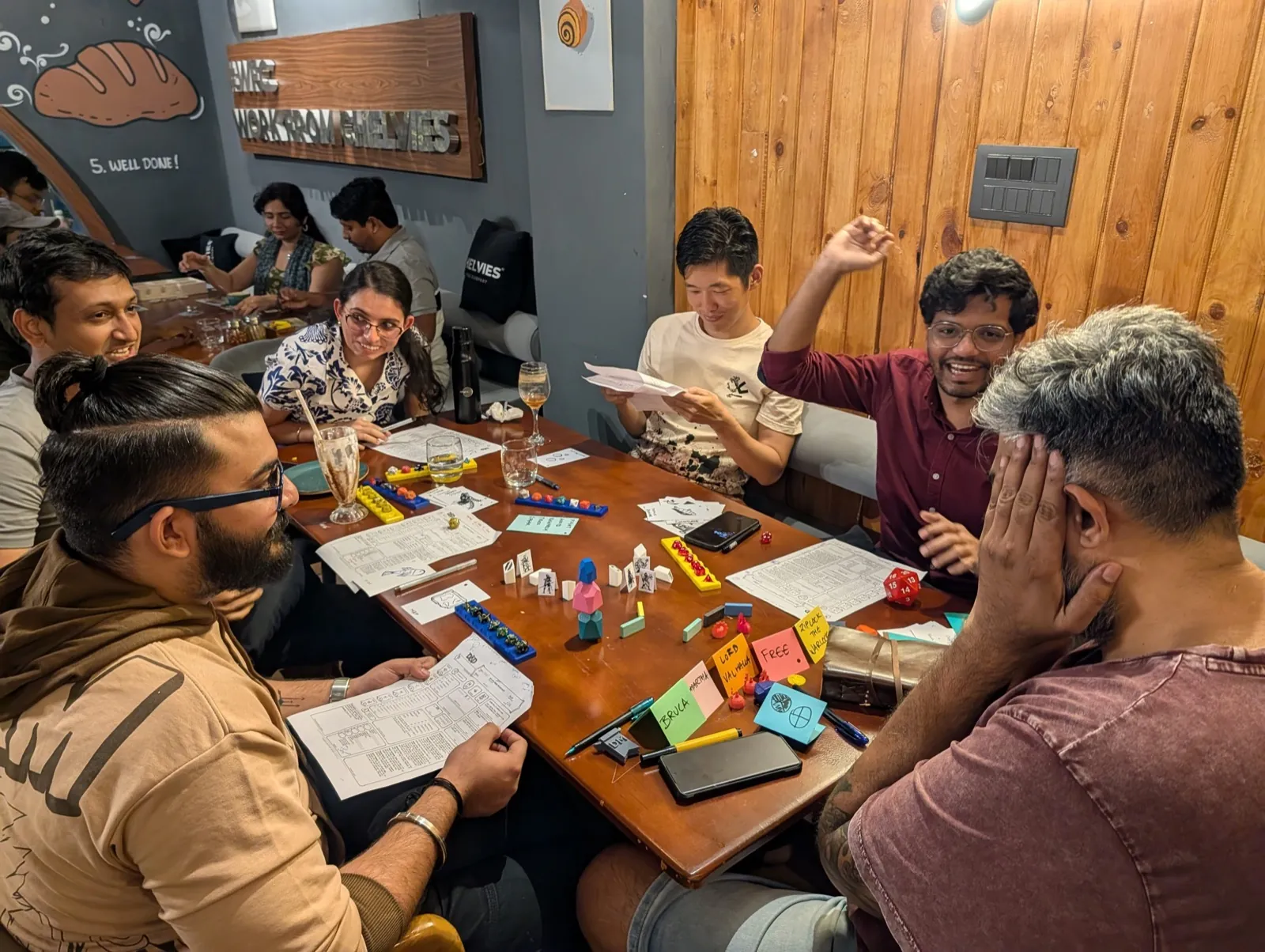
The debrief is the whole product, and it can't be scripted in advance. That's why the person who designed the game runs it - reading how your managers actually behave under pressure and naming it live. No associate delivery, no licensed hand-off.
 Proof
Proof
Designing and running these programs since 2019, for a Fortune-100 organisation and fast-growing companies, with leaders across five countries. One of those Fortune-100 programmes ran as serious games and scored 8.82/10 average satisfaction across 113 respondents - the game-based learning was the most-cited takeaway in every batch - then came back for a second program.
Pricing
Programs start at ₹50,000 for a group of 15-25 participants. Final pricing depends on group size, seniority, location and batch count. Send me a note and I'll quote within 24 hours of a discovery call. I take only 2-3 programs a month.
Book a discovery call WhatsApp Arvindh
Frequently asked questions
What's the difference between management and leadership training?
Management is running tasks, processes and resources well. Leadership is reading people and a team as a system, deciding under uncertainty, and taking a group somewhere it wouldn't go on its own. Most people get promoted for the first and are then measured on the second. This training builds the second job specifically, because that's the one training usually skips.
Is this for new managers or experienced ones?
Both. New managers use it to build the leadership behaviours nobody taught them; experienced managers use it to see the habits they've never had held up to a mirror. The brief calibrates the game and debrief to the group's level.
How is this delivered?
A facilitated serious game, half-day or full-day, run by me. Then a structured debrief and a written behaviour summary. For bigger populations I run it as multiple batches.
Related
- Leadership development programs
- Leadership training for managers
- First-time manager guide
- The complete guide to serious games for leadership development
With love from Bengaluru, this is Arvindh saying over and out.