
I've been trying to work out for a while why AI for managers so often ends up as a slightly faster search box.
Not unused, exactly. Underused.
Because the tools are usually fine. Most companies I talk to have a licence for everyone and a perfectly sensible policy document.
And the managers are sharp. They've tried it on an email or a summary, got something decent back, and then gone back to running their week the way they always have.
For me, the reason is that a manager's week isn't really made of tasks you can paste into a chat window.
It's made of a promise to another team that is starting to wobble. A decision that has been "waiting for more data" since August. A person you are not sure about. A negotiation on Thursday.
Nobody ever showed them where AI fits into that part. Which isn't anybody's fault, really.
I run my own business on these tools every day, and it took me a long, slightly embarrassing while to work it out for myself.
So that's the part this training spends its time on.
How it works: the game first, then the EPPA loop
Every programme runs on one loop. I call it EPPA - Experience, Patterns, Principles, Application.
- Experience. The game itself. Managers at a table, making real calls under a bit of pressure, in front of colleagues they respect.
- Patterns. The room names what kept repeating, before anybody is allowed to say what it means.
- Principles. They connect it to how they manage, in their own words. It lands because they got there themselves.
- Application. A named behaviour, a real situation and a date. This is the stage that usually gets cut when the clock runs out, and it's the only one that changes anything on Monday.
So that's where AI goes. Only there.
I'm fairly stubborn about keeping it out of the game. The game is where people find out how they actually behave, and I'd rather not put a screen between them and that moment.
And I think AI earns its place at Application mostly because it makes that last stage quicker. So it is a lot less likely to get cut.
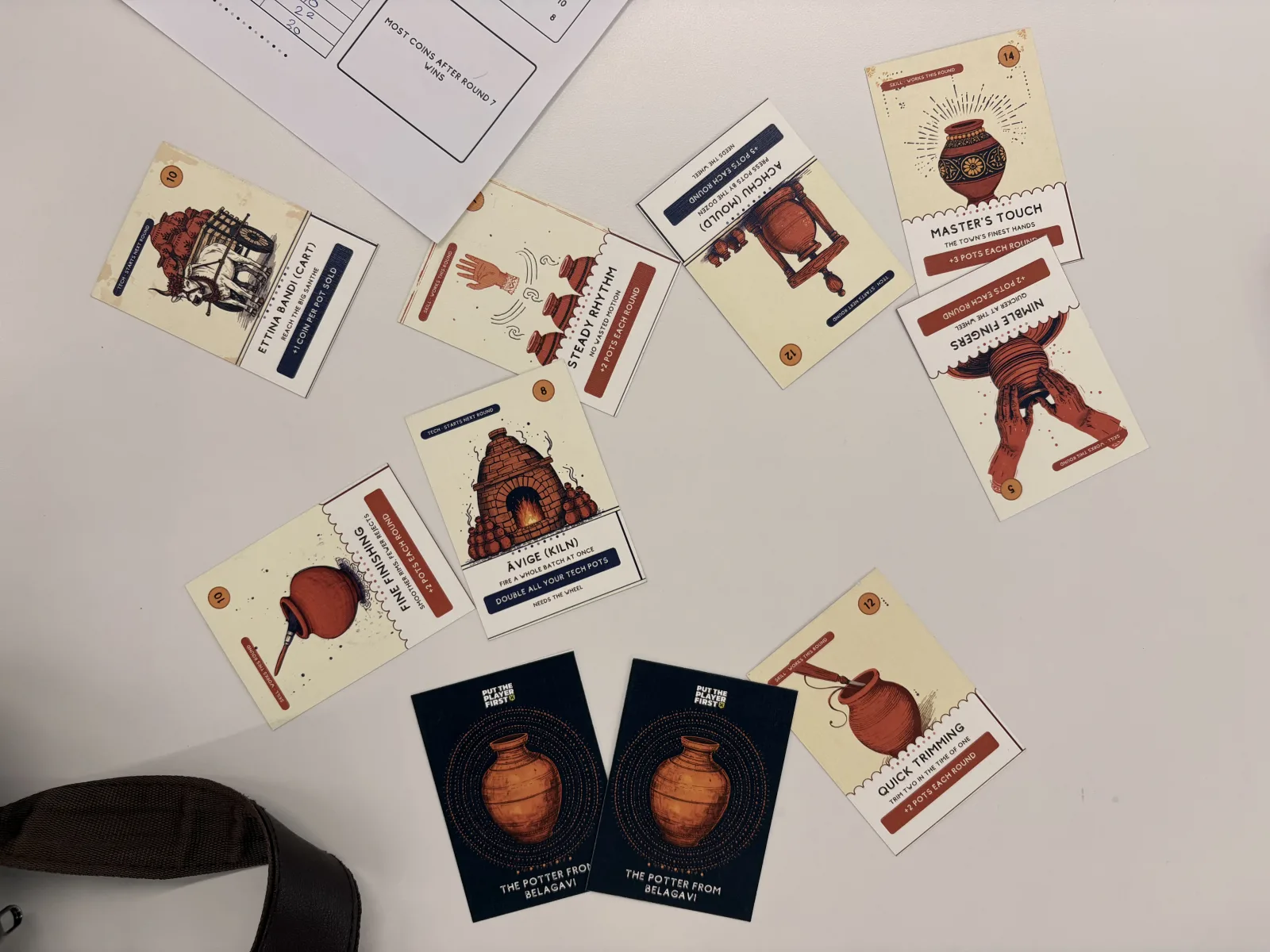
An early print of the Potter cards. A few numbers have changed since.
Where it usually starts: The Potter from Belagavi
Most of the time the day opens with The Potter from Belagavi, a 45-minute card game I designed about selling pots.
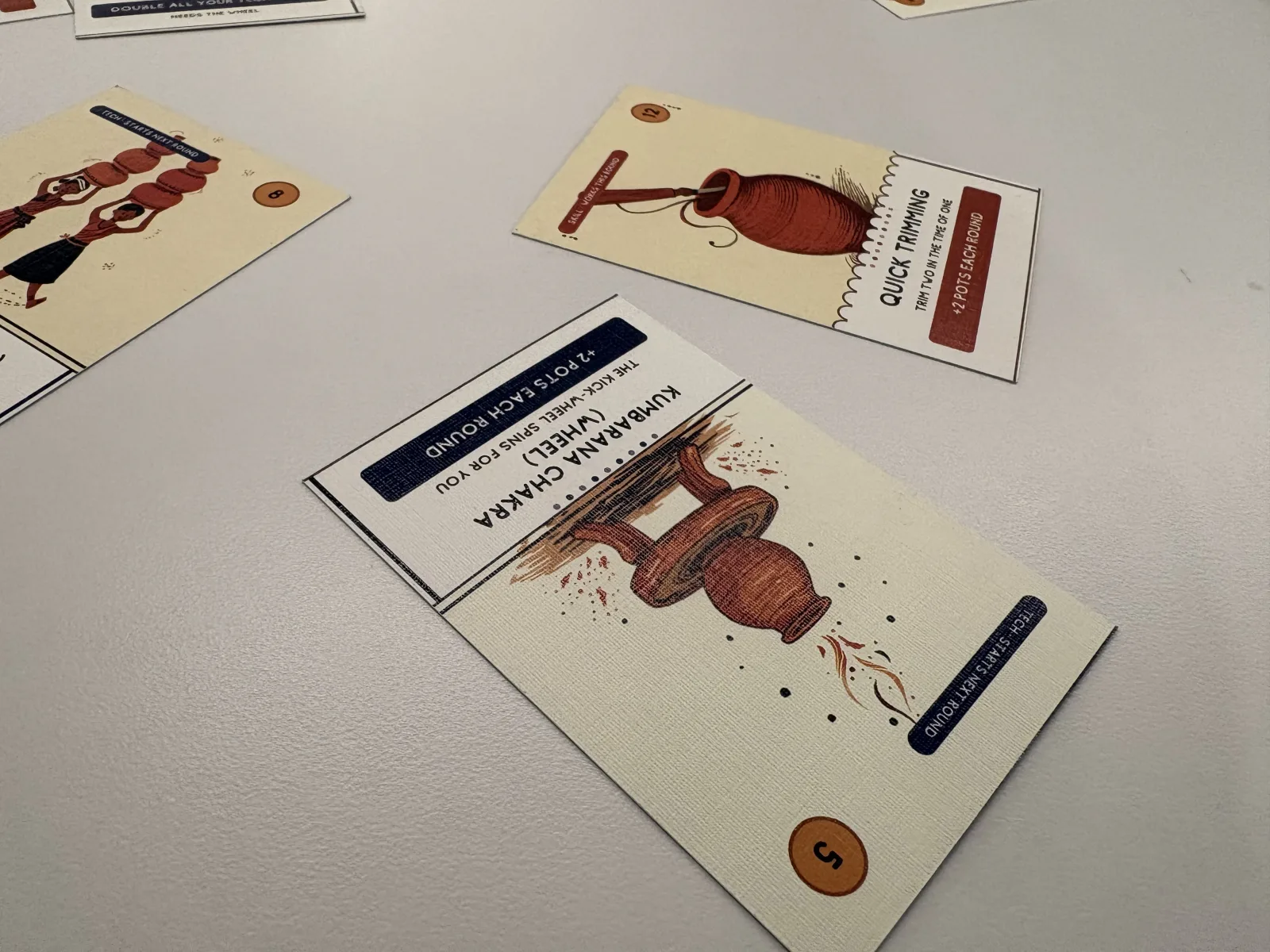
You can spend your coins on making more pots by hand. Or you can buy a wheel that makes nothing the round you buy it, and makes pots for you every round after.
The wheel does nothing on the round you buy it. Which is exactly why the busiest person at the table never quite gets round to it.
And somewhere around round five, the person who stopped to build overtakes the person who never did. In front of everyone.
It's a slightly silly game about pots. It's also, more or less, the whole argument for AI in a manager's week.
Afterwards, each manager names one thing they do by hand every week, builds the first rough system that does it with AI, and runs it once before they leave. One person, one AI assistant, supervised.
That's the first step on the ladder, and honestly it's plenty for one day.
Where AI fits in a manager's week
Potter is the usual opener. But I have seven games, each one built around a different part of the job, and every one ends the same way: AI on one real piece of the manager's own work.
Here is what the Application step looks like in each, with the one call that stays human.
- A promise you made to another team. AI maps who depends on it and what breaks if it slips. You write the keep-it or change-the-deal note, and send it by a date. Stays yours: whether to keep the promise when it costs you. (Ripple Effect)
- A live project where people aren't really talking. AI reads the team's own messages and drafts some talking rules - who shares what, when, and where. You edit it at the table and take it to the team by a date. Stays yours: deciding how the team talks. (Sticky Fingers)
- A decision stuck on "we need more data". You frame it first, with the Double Diamond. AI sorts what you know from what you don't, and drafts a rule: act when X. You set the date. Stays yours: when to stop debating and act. (Planetfall)
- The people your results depend on. AI turns your own notes into a one-line read per person - do they need water, a bigger pot, or space? You pick one person who can't pay you back yet and plan the first give. Stays yours: choosing to back them anyway. (Bloom)
- A negotiation that's coming up. AI plays the other side - their public goal, their likely private one, their next three moves. You test what to show and what to hold, then write the opening offer. Stays yours: what to reveal, and to whom. (Welcome to Zombiepuram)
- One thing you do by hand every week. You build the first rough system that does it, and run it once before you leave. Stays yours: what to stop doing by hand, and what the freed time is for. (The Potter from Belagavi)
- Next quarter's plan. AI writes three other futures and the early signal for each, Lotus Blossom style. You mark which calls can be undone, buy one option now, and set the date to decide again. Stays yours: telling a bad decision from a bad result. (Chaos in the Kitchen)
You'd normally pick one or two of these, by whichever part of the week feels most stuck. All seven games are on the games page if you'd like a proper look at them.
What your managers walk out with
- One real piece of their own work, moved. Not a practice prompt about a made-up company. Their actual Thursday.
- A first rough system they built and ran once, on something they were doing by hand that same morning. It will wobble. That's fine.
- A clear line between what they hand to AI and what they keep, worked out on a real example, so it is still there when the deadline isn't.
- A named behaviour, a real situation and a date. All three, or it didn't happen.
- Why the manager who feels most productive is often the one who bought nothing for three rounds. Busy and careful feel identical from the inside.
- A shared language for the team - the wheel, the round you have to spend - that is easy to remember, mostly because it is about pots.
The receipts
I've been training founders and leaders since 2019, with founders in the US, Canada, Australia, Singapore and India.
One programme at a Fortune 100 company scored 8.82/10 as a satisfaction score, across 113 respondents and six session-days. That's one programme, so I'd rather not stretch it.
Across every scored session-day I have, it's 8.40/10 across 244 respondents. A bit lower, and probably the fairer number to hold me to.
I've also run AI training for marketing teams at a Fortune 100 company.
None of those is a score for this exact programme, to be clear. They're just the most honest picture I have of what a room with me in it tends to feel like.
Who it fits
- Managers who have AI access and aren't getting much from it yet. They've tried it. It was fine. Their week looks the same.
- L&D and HR teams asked to "get managers using AI properly", who'd like it to last past the launch email.
- New and mid-level managers whose week is mostly other people, promises and decisions, with very little of it in a spreadsheet.
- Companies happy to let real work into the room. That's where the whole thing happens.
Who would get more from something else
- Teams of individual contributors who want hands-on AI practice on their tasks. I run an AI bootcamp built for exactly that, and it's on the programmes page.
- A senior leadership team that wants the executive version, with the thinking frameworks underneath. That one is on the programmes page too.
- Anyone after a tool demo or a features walkthrough. Your vendor's own training probably does that better than I would.
- Engineers who want technical depth. That's a different, much more technical room, and I'd rather say so than take the booking.
- When real work can't come into the room for policy reasons. The Application step needs it, so we'd be doing half the job.
Fair questions
"Our managers have already done AI training."
That's fair, and it was probably fine. What I've found is that most AI training for managers teaches the tool. The bit that goes quiet is using it on a real promise or a real decision the following week, and that's the only bit this spends its time on.
"Why a game? They're busy."
That's a fair worry, and honestly it was mine too. Potter takes 45 minutes. What I've found is that it's the 45 minutes that makes the AI part land, because by the end nobody needs convincing that the round is worth spending.
"Do they need to be technical?"
I don't think so, no. The games are cards and conversation. The AI step is pointed at their own work, in plain English, and the first thing anyone builds is rough on purpose.
"Can AI really help with the people side of managing?"
With part of it, I think. It is quick at mapping, sorting notes and arguing the other side. It doesn't choose who to back, or what to reveal, and it isn't asked to. Every programme names the call that stays with the manager.
"Will it work with the tools we're allowed to use?"
It should. I build the Application step around whichever tool your managers are actually allowed to use, and around your real policy limits, including what is off the table.
"How long is it?"
Each programme is sized around its game and your group, so it depends which part of the week you'd like to move. I'll tell you on the call what I think it needs, rather than squeeze it.
Worst case? We have a conversation and you come out of it with a clearer brief.
Come and see if it fits your managers
Roughly how many managers, which AI tools they're allowed to use, and the part of their week you'd most like to see change. I'll tell you which game fits, or if none of them do.
Come and have a look at the calendar
I only take two or three programmes a month, mostly because I run all of them myself. So it does fill up, and I'd rather tell you that now than when you have a date in mind.
Or just tell me what you're trying to fix
I went back and forth on whether to put a form at the end of this page.
Because a form asks you to be tidy about something you are probably still working out. And the enquiries I enjoy most tend to arrive as three messy lines, written by someone who has not finished deciding what they want yet.
So there are two ways in, and I genuinely do not mind which one you use.
Write to me directly at arvindh@puttheplayerfirst.com and say roughly what you want to change. Three lines is plenty. I read my own email.
Or fill this in, if that is easier. It lands in the same inbox.
I answer these myself, usually within a day. Two if I am in a room somewhere with my phone in a bag.
And you are not committing to anything by writing in. Worst case we have a conversation, and you come out of it with a clearer brief than you had this morning.
None of this will turn a manager into an AI expert in a day, to be fair. It just gets one real thing off their plate, with the thinking still theirs, which is probably where it should have started anyway.
With love from Bengaluru, this is Arvindh saying over and out.