
I've been trying to work out for a while why systems thinking is so easy to agree with and so hard to actually do.
Not hard to understand, exactly. Hard to start.
Because most of the systems thinking material I've come across is perfectly sound. Feedback loops, stocks and flows, the bit where everything turns out to be connected to everything else.
People nod along. It makes sense on a whiteboard.
And then they go back to their desks and build the same report, the same way, by hand, very carefully, because they are genuinely very good at it.
I don't think that's stubbornness.
I think building a system costs you a round, and the deadline is today. So the round never gets spent.
Week after week.
I know this one from the inside, by the way. I did everything by hand for years, and I would not have thanked anybody for pointing it out. (I'd have been too busy.)
So this training starts a long way from the whiteboard, and a long way from a laptop.
How it works: play, then the EPPA loop
The programme runs on one loop, and I call it EPPA. Experience, Patterns, Principles, Application.
The Experience is the game. Seven rounds of The Potter from Belagavi, with cards and a pencil.
Then we unpack it. Patterns first - what kept repeating at the table. Who bought nothing. Who bought every skill. When the table started copying the wheel.
Then Principles, in the room's own words. Effort adds, systems multiply. I don't lecture that in. It lands because they got there.
And then Application, which is the bit that usually gets squeezed when the clock runs out. It's also the only bit that changes anything on Monday.
So that is where the AI goes. Only there.
Never inside the game. The Potter from Belagavi is cards, a pencil and people across a table, and it stays that way.
The game at the heart of it: The Potter from Belagavi
You are a potter in Belagavi. You start with five coins and a pair of hands, and you have seven rounds to sell as many pots as you can.
Every round runs the same three steps. Invest in one card, or none. Make your pots. Sell them at the santhe.
Your hands make three pots a round. Keep at it for seven rounds and you'll have a perfectly respectable pile of coins.
You will also lose.
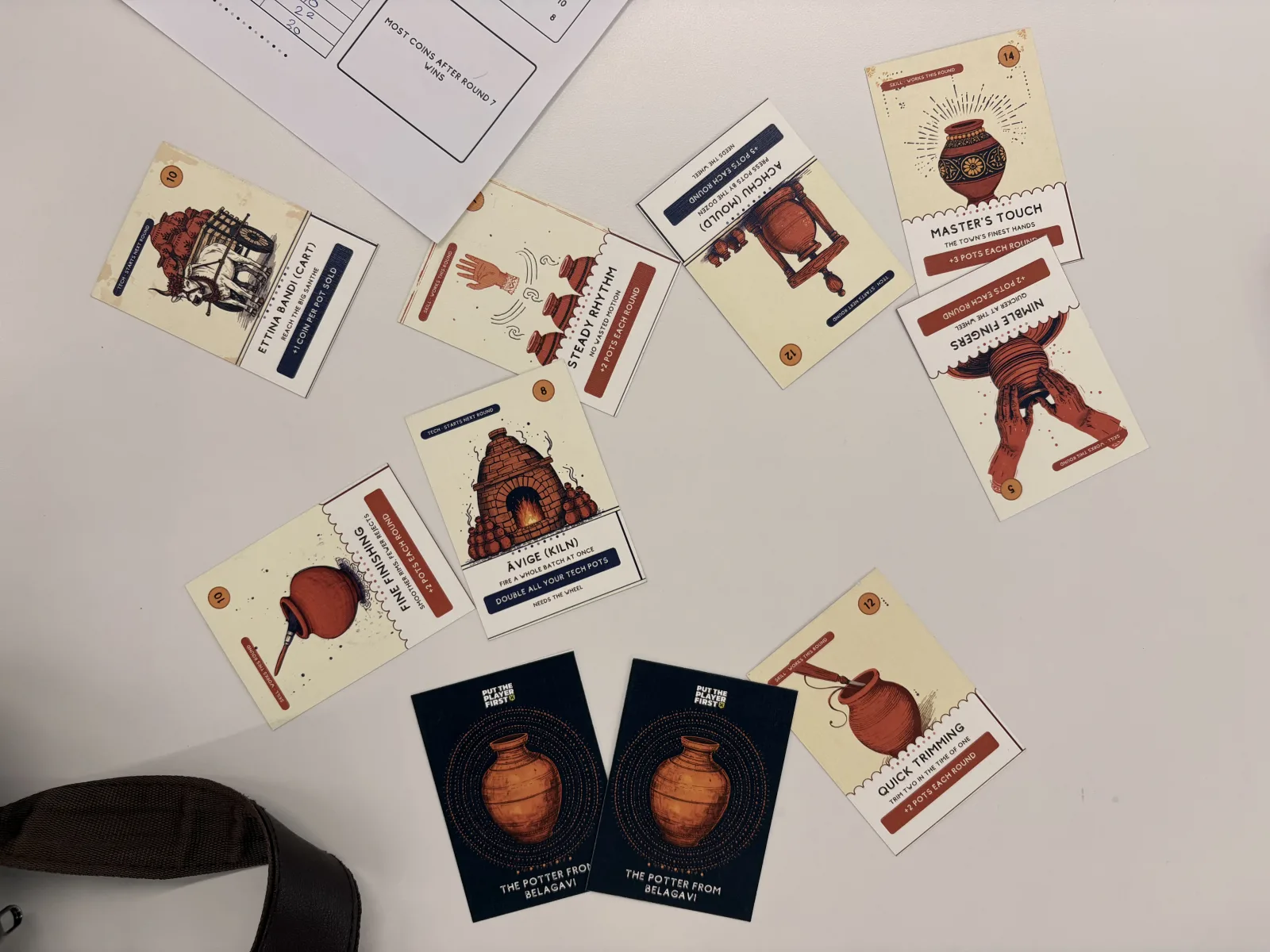
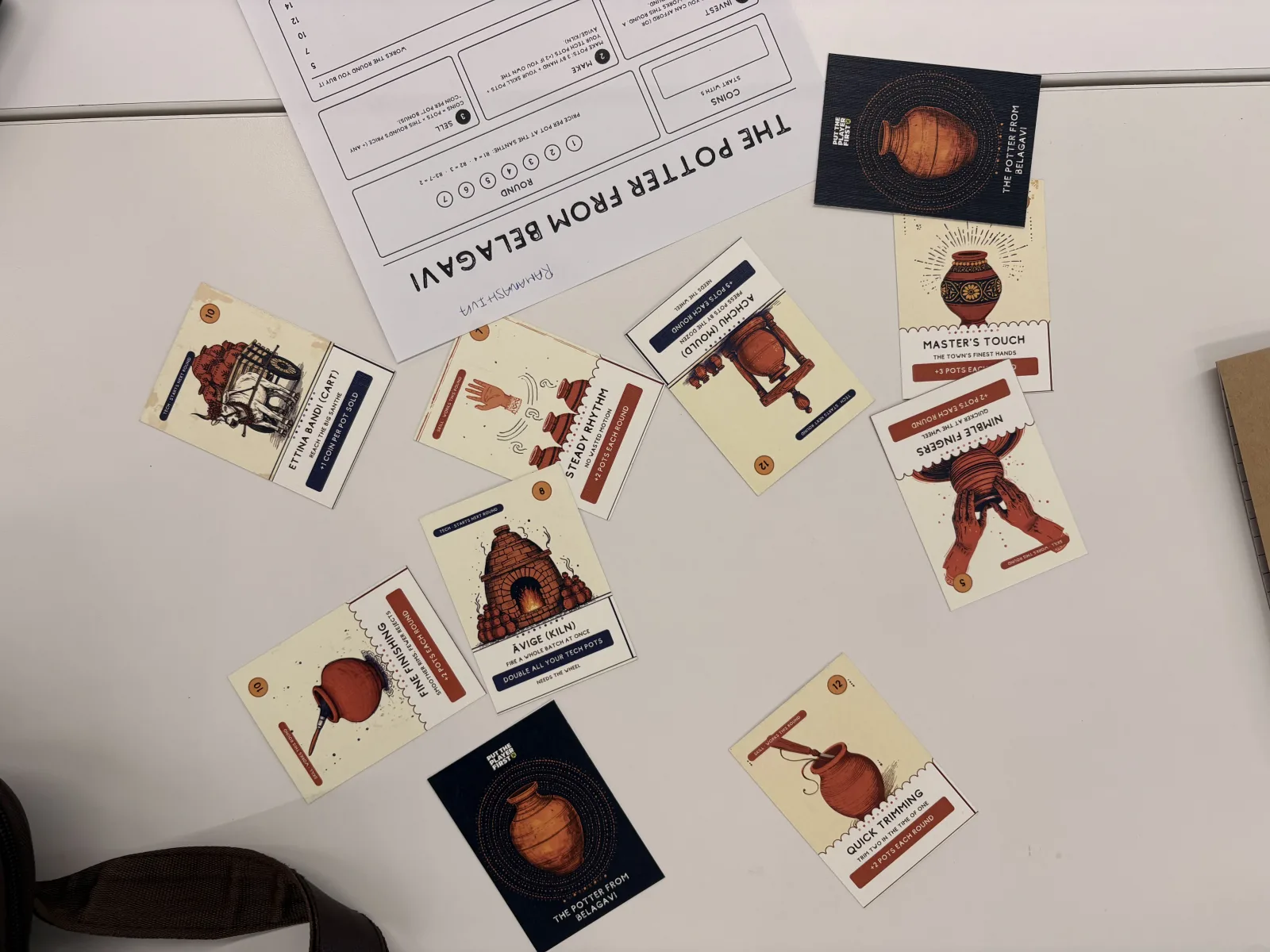
The photos show an early print of the cards. A few numbers have changed since, and the rules on this page are the current ones.
Because there are two kinds of card on the table.
Skill cards make you a slightly better potter, straight away, the round you buy them. They feel brilliant to buy.
Tech cards - the wheel, the mould, the kiln, the helpers, the cart - do nothing at all on the round you buy them, and they need each other to work.
The kiln adds four pots every round, but only once the wheel is already running. The cart adds a coin on every pot you sell, up to 12 pots.
And on rounds five and seven you are away at the santhe yourself, so your hands make nothing. The workshop keeps going without you.
Skills stop when you stop. Tech keeps going.
The game never says this out loud. The scorecard does, in round five, in front of everyone.
It's a slightly silly game about pots, honestly. It's also, more or less, the whole of systems thinking that matters on a Monday morning, in one sitting.
What 45 minutes at the table quietly tells you
Put a scorecard in front of people and they stop describing how they work. They just work. Here is what the game is built to bring out:
- Why the person who buys nothing for three rounds feels the most productive at the table. Three pots a round, coins piling up nicely. It feels a lot like being careful. It's mostly being busy, and the two feel identical from the inside.
- The skill-card collector, and the ceiling they can't see coming. Fast, satisfying, visible progress every round, right up until round five.
- The quiet one who takes the early loss to build in round two. Occasionally insufferable about it later. Watch how long the table takes to copy them.
- The moment somebody says "wait, show me your sheet." This is where the session turns, and nothing I say beforehand creates it. Somebody loses to a person doing less work and really needs to know how.
- The late convert in round six. They buy the wheel, knowing it is too late, and buy it anyway. That is probably the most useful thing anyone feels all day.
In a lot of teams I've worked with, the busiest person is quietly the one the team leans on hardest, and the one with the least room to change anything.
That's an uncomfortable thing to notice about somebody who is clearly trying so hard. Which is probably why it mostly goes unnoticed.
Where AI comes in: the Application step
By the time we reach Application, the room has already named its own patterns and its own principles. Nobody needed a machine for that.
Then the laptops come out, for the first time all day, and each person turns to their own real work. Here is what that looks like:
- Name one wheel. Each person names one thing they do by hand every week. A small give-away while we're here: if you do it every Monday and could explain it to a new joiner in five minutes, it's probably a wheel.
- Build it rough, with AI. The first rough system that does it. Rough on purpose. A wheel that wobbles still beats three pots by hand.
- Run it once before they leave. One person, one AI assistant, supervised, on their own real work. That's the first step on the AI adoption ladder, and it's plenty for a first step.
- Put a date on it. A named behaviour, a real situation, a date. All three, or it didn't happen.
Imagine somebody walking back to their desk with a small, slightly wobbly system they built and ran on a task they were doing by hand that very morning.
That's the whole point of the programme, more or less.
What stays human
AI drafts the system. It doesn't decide what to stop doing by hand, and it doesn't decide what the freed time is for.
Those two calls stay with the person. Which is, I think, exactly where they belong.
What your people walk out with
- One weekly task, turned into a rough system, built with AI and already run once on their own real work.
- A date for the next run, so Application is a diary entry and not a good intention.
- "Effort adds, systems multiply", in their own words, because the room worked it out rather than being told.
- A five-minute test for spotting the next wheel, which they can run on their own week without me in the room.
- A shared, slightly silly language for the team. "Is that a wheel?" is a fairly handy question to have in a planning meeting.
A little about the person running it
I've been training founders and leaders since 2019. The founders have been in the US, Canada, Australia, Singapore and India.
One programme at a Fortune 100 company scored 8.82/10 as a satisfaction score, across 113 respondents and six session-days. That is one programme, so I won't pretend it is all of them.
Across every scored session-day I have, it is 8.40/10 across 244 respondents. A bit lower, and a lot more honest.
And on a separate one-day programme for a leading HR-tech platform, 12 of the 13 people in the room said they would apply what they learned. Which is probably the more useful number of the lot.
None of those is a score for this exact programme, to be clear. They're just the most honest picture I have of what a room with me in it tends to feel like.
Who it fits
- Individual contributors and team leads who are very good at their job, and doing all of it by hand. The people everyone leans on, mostly.
- Teams who've been given AI tools and are quietly not using them. Usually because learning the tool costs a round and the deadline is today, which is fair enough.
- L&D and HR teams who want systems thinking training that ends with something built. Built with AI, and already run once, before anybody leaves the room.
- A team day that needs an opener people will still be talking about at lunch. Forty-five minutes of pots tends to do that.
Who would get more from something else
- When the real problem is that nobody has time. The game says invest a round now to earn more every round after. If your people genuinely have no round to spare, it will feel like a taunt. Fixing the load first would probably help them more, and I'll say so.
- When you want to work on how a team talks to each other. This one is about how one person spends their own effort. One of the team programmes would serve you better, and they're all on the programmes page.
- When you need training on one specific platform. There's no tool demo here. A vendor's own training does that job well, and this can sit in front of it to make people want it.
Fair questions
"We've already done systems thinking training."
That's fair, and honestly it was probably fine. This one spends most of its time on a single thing: getting one real task off somebody's plate, built and run once, before they leave the room.
"My people don't have time for a game."
That's a fair worry, and it was mine too. The game is forty-five minutes. What I've found is that it's the forty-five minutes that makes the AI part land, because by then nobody needs convincing that the round is worth spending.
"Will this work for people who aren't technical?"
I think so, yes. The game is cards and a pencil, and the first system each person builds is rough on purpose. The only real ask is noticing one thing they do by hand.
"Which AI tools would we use?"
Whichever ones your people are actually allowed to use. I build the Application step around those, and around your real policy limits, including what's off the table.
Worst case? We have a conversation and you come out of it with a clearer brief, whether or not it's this programme.
Come and see if it fits your team
Twenty minutes on a call. Your people, the work they do by hand, and my honest answer on whether this is the right programme for them.
Tell me what you're trying to fix
I went back and forth on whether to put a form at the end of this page.
Because a form asks you to be tidy about something you are probably still working out. And the enquiries I enjoy most tend to arrive as three messy lines, written by someone who has not finished deciding what they want yet.
So there are two ways in, and I genuinely do not mind which one you use.
Write to me directly at arvindh@puttheplayerfirst.com and say roughly what you want to change. Three lines is plenty. I read my own email.
Or fill this in, if that is easier. It lands in the same inbox.
I answer these myself, usually within a day. Two if I am in a room somewhere with my phone in a bag.
And you are not committing to anything by writing in. Worst case we have a conversation, and you come out of it with a clearer brief than you had this morning.
It won't turn anybody into a systems thinker overnight. It just makes the first wheel a lot more likely to get built, which, for most people, is the hard part anyway.
With love from Bengaluru, this is Arvindh saying over and out.