
And if you would rather skip straight to what I run, my leadership training programs for managers are all on one page.
 The room that taught me what I was actually selling
Early in the first COVID lockdown I was in a session for a large technology company, running a mastery programme online. I was not leading it. I was the second person on the call.
And the session was going helter-skelter. Energy low, people switched off, nobody really caring what was happening on the screen.
The person running it had the credentials. They were running the session the way that kind of session is supposed to be run, and it just was not working, because the room was not a room any more. It was a grid of small squares and a lot of people who could quietly stop listening at any moment.
They wanted a break. I stepped in and took the session.
I think it was the first time anybody ever rated me highly on anything.
Here is the part that matters for your shortlist, though. I had no facilitation training. None.
What I had was that I was a streamer. I was running Dungeons and Dragons campaigns online, I was making YouTube videos, and all of those turned out to be transferable skills.
The other person was not bad at their job. They were good at a job that had changed underneath all of us, and they were too set in how a session ought to run to move with it.
Afterwards somebody told me I needed to chill out, because I was putting in too much energy.
And I remember thinking, genuinely, what the hell does that mean.
Looking back it was probably a fair note, and I have still not done anything about it.
I do not save anything for the way back
There is a film called Gattaca that I saw as a kid in Chennai, and it has stayed with me because of one scene.
There is a swimming race. Somebody asks the man who keeps winning how he does it.
And he says he does not save anything for the way back.
That is more or less how I have run every session since. When I walk into a room, everyone in it is getting everything I have. Not as a slogan, and not as a work ethic thing. Just because I have never found a way to hold a room at half power that was worth doing.
Which is also, honestly, why I cannot scale the way a large firm scales. I will come back to that.
 The one question I would ask every name on your list
It is this. Who is actually going to be standing in the room on the day, and what has that specific person run before?
The firm's record and the facilitator's record are two different things, and in a lot of this market only one of them turns up on the day. The proposal is written by the founder, the credibility comes from the logos, and then the session is delivered by an associate the buying side has never met.
That is not a scam and I want to be careful here. It is how a business grows past one person, and plenty of associates are excellent. It does mean the thing you evaluated and the thing you bought are not quite the same object, and I think you should at least know that going in.
So ask for the facilitator's name before you sign, and ask what that person has run in the last year. If the answer comes back vague, I would want to know why before I signed.
The four kinds of leadership training company in India
Roughly speaking, and I am simplifying, everyone you are looking at falls into one of four groups. Each of them is genuinely the right choice for somebody.
- The global brand. A well-known international name with an India arm, running their own licensed curriculum. Consistent, well-produced, and low risk to defend internally. Best when you need one identical programme delivered to a very large population across many locations, and when the brand on the certificate matters to your people.
- The Indian corporate training firm. A local company with a bench of facilitators and a broad catalogue - communication, first-time manager, POSH, sales, leadership, all of it. Best when you have a full calendar to fill and you would rather have one vendor relationship than nine. Volume and coverage are the real product here.
- The simulation reseller. Firms that license a business simulation built abroad and facilitate it here. The sims are usually good and the data they produce is genuinely useful. Best when you want a rigorous, repeatable business-acumen experience and you do not need it to be about your organisation specifically.
- The small studio. One designer, sometimes two, building the thing and running it themselves. Best when a specific cohort needs to behave differently and you are willing to trade scale for depth. This is the group I am in.
None of those four is the smart choice in general. They are the smart choice for different problems, and the mistake I see most often is a shortlist that has quietly mixed all four together and is trying to compare them on price.
Where I fit, and where I do not
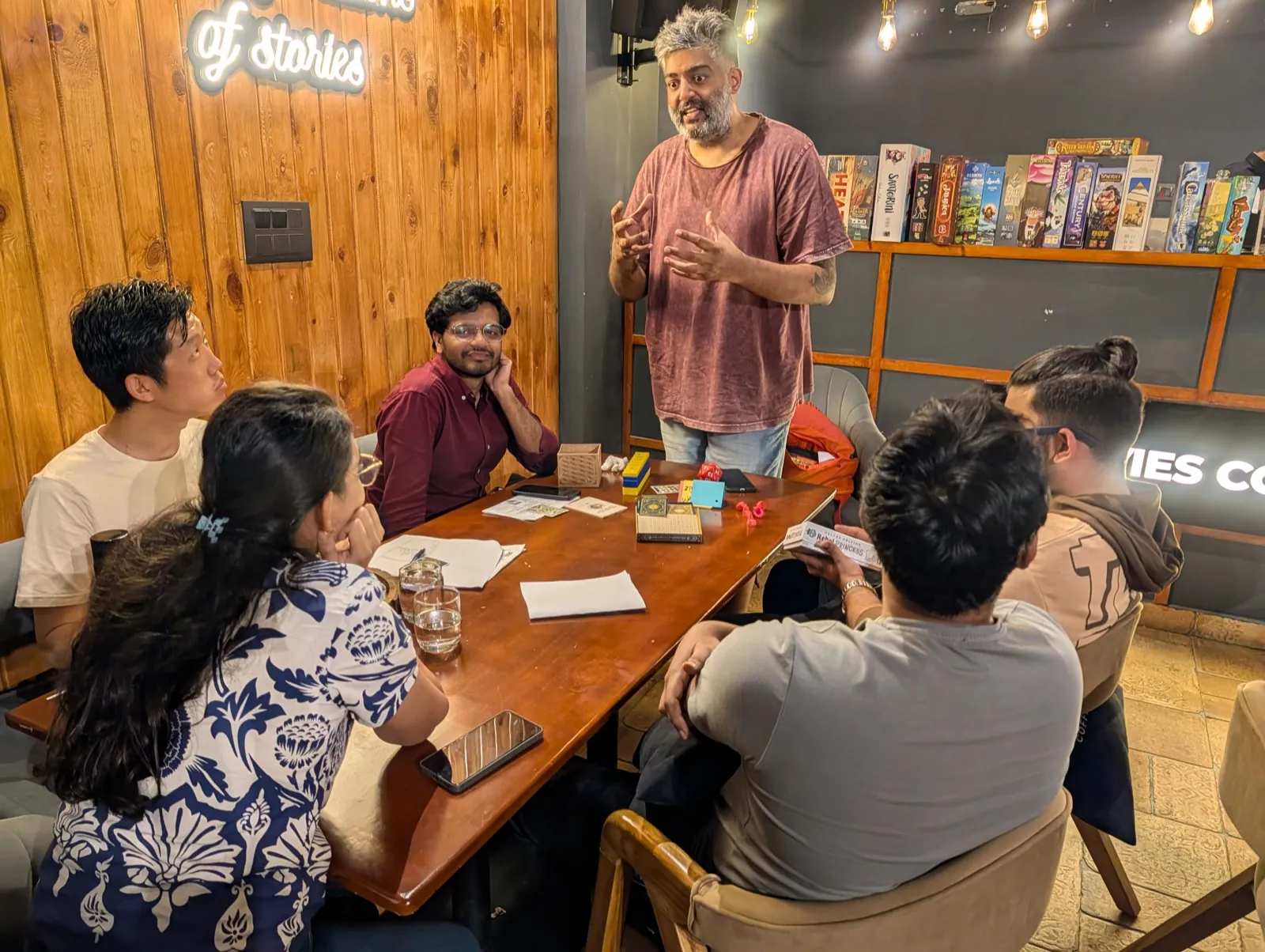
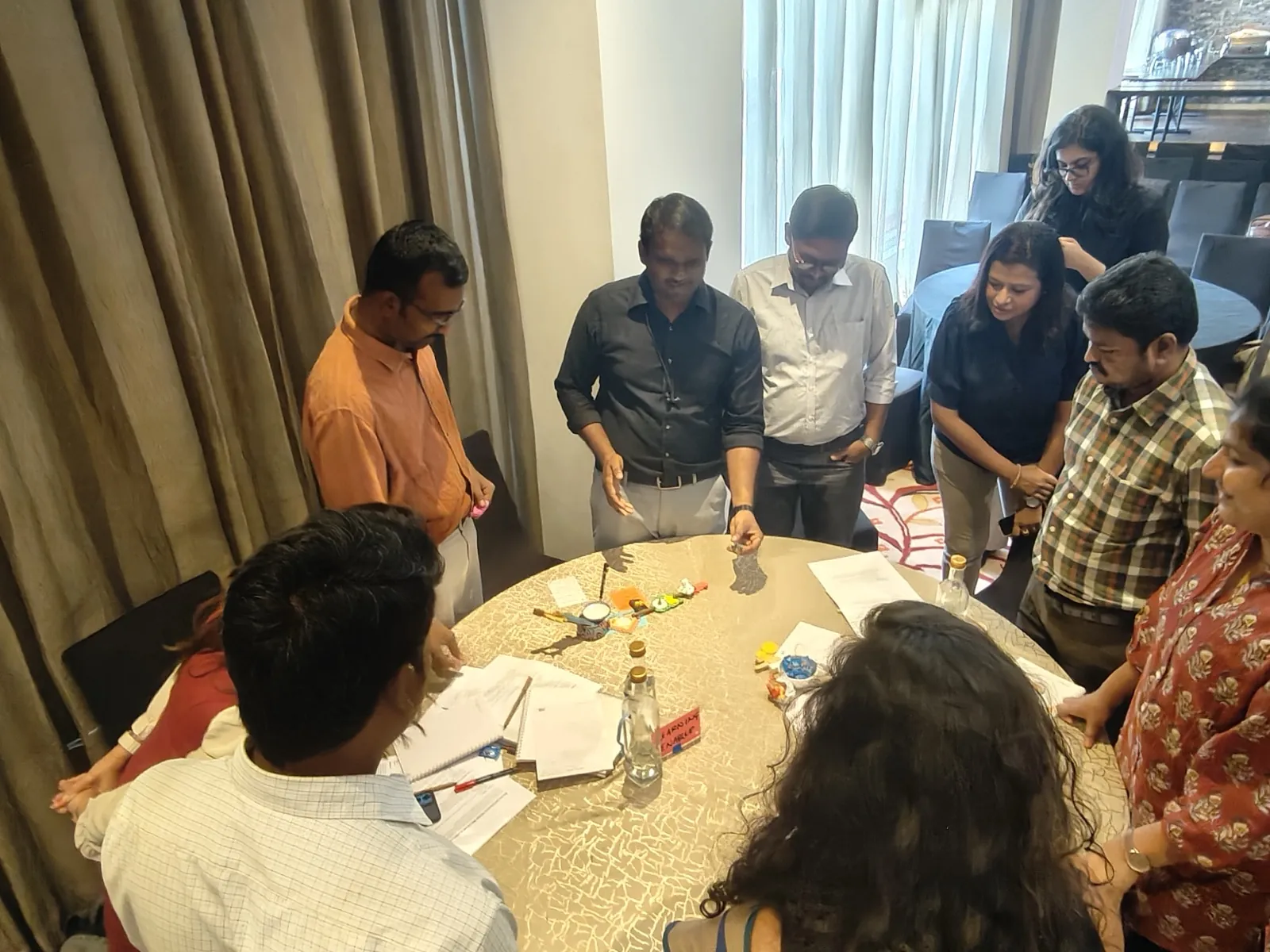
I run leadership training as a serious game. A designed situation with a running clock, other people with their own agendas, and consequences that arrive whether or not anybody was ready. Then a debrief that says out loud what just happened in the room.
The reason I work this way is that leadership is a behaviour, and you cannot really develop a behaviour nobody can see. A framework deck tells people what good looks like. It has never once given anybody a rep at doing it. Which is not the deck's fault, really. It is just not what a deck is for.
I design every game and I facilitate every session myself. No associate delivery, no licensed hand-off.
So here is the honest limit of that, and I would rather say it here than after you have signed.
- I can only be in one room at a time. My calendar is a real ceiling, and it is the direct cost of the previous paragraph.
- I am not the answer for a four-thousand-person rollout. If that is your brief, a large firm with a trained bench is the right call and I will tell you so on the first call.
- I am not a catalogue. If you need eleven different topics covered this quarter, a broad-catalogue vendor will serve you better than I will.
- I deliver in person, in India, and I travel for it. Bengaluru is home. Online works and I have done plenty of it, though I will push for the room if the calendar allows.
What I am good for is one cohort, one behaviour that matters, and a room that gets to watch itself do that behaviour, live.
 The proof, with its limits attached
I have been designing and running these since 2019, for a Fortune 100 company and for fast-growing companies, with founders in the US, Canada, Australia, Singapore and India. I have taught with SHRM India at IIM Bangalore and IIM Indore.
One programme at that Fortune 100 company ran six session-days and scored 8.82/10 as a satisfaction score, across 113 respondents.
Then they came back and commissioned a second, different programme, which is probably the more useful number of the two.
And a caveat I would want if I were reading this. That 8.82 is a satisfaction score and not a behaviour score, so take it for what it is. It tells you the room enjoyed the day and found it worth their time. It does not tell you what anybody did differently on the Tuesday.
I quote it because you will see numbers like it on every page you look at this week, and you should probably know what mine is. I would just treat all of them, mine included, as the floor rather than the proof.
The repeat commission is the better signal, I think. It is also quite hard to fake.
Why I care about this more than is strictly reasonable
A few years ago I was at a games event, playing a tabletop roleplaying game at one of a handful of tables. Someone came over and asked whether we could go and play somewhere else, because the space was needed for board games.
He was playing Power Grid at the time. Which is a game I like. And standing there I suddenly felt like an outsider in my own home.
So I went and asked a few friends whether they wanted to run a convention that was only for tabletop roleplaying games. They said yes, in language I will not reproduce here.
The first edition was gut-wrenching. I was in the red by almost 50,000 rupees.
I have said since that I saw it as an investment. Well. I would be lying if I said I saw it as an investment at the time. I was terrified. The thought actually going through my head was how the hell am I going to tell my wife that I lost this much money, and it was a particularly bad year to be losing it.
We ran a second edition anyway. It was bigger and it was much better.
I am telling you this because it is the thing my credentials page does not say. What I actually do for a living is build rooms where people behave differently than they do outside them, and I have paid for that belief out of my own pocket, in a year when I could not afford to.
That is not a reason to hire me. It is just the honest answer to why I am still doing this.
Pricing, plainly
A day in the room runs between ₹60,000 and ₹1,00,000, plus taxes as applicable.
Half a day is half of that. So ₹30,000 to ₹50,000, plus taxes as applicable, on the same terms.
Both of those are ranges rather than a price list, and I do mean that. A short session with a lot built into it can land above a longer one with very little, so the clock is only part of it.
I put the range here because you should not have to sit through a call just to find out whether we are in the same ballpark. If that number is nowhere near your budget, you have saved yourself a fortnight and I would still rather you wrote to me and said so.
Where you land inside either of them comes down to five things, and none of them are a mystery:
- How long we are in the room. Half a day with one game and its debrief is one thing. A two-day programme is another.
- How many people are in the room, and how senior they are. Fifteen managers and sixty leaders are not the same day's work.
- How much I build from scratch. Running a game I already own costs less than designing your world, your constraints and your data into a new one.
- Whether I am leaving Bengaluru. Travel and stay are quoted separately, up front, so nothing appears on the invoice we did not talk about first.
- Whether it is one session or a series. Four batches of the same programme do not cost four times a single batch, because the design is built once.
A bespoke senior day, built from nothing, in another city, sits at the top of the band. A game I already run, one batch, here in Bengaluru, sits at the bottom. Most work lands somewhere in the middle, and I will tell you which end you are at in the first conversation rather than the third.
Tell me roughly what you are trying to fix and you will have a real number, not a range, within a day of us speaking.
If you would like to talk it through, there are a few ways to reach me and I genuinely do not mind which one you use.
Book a discovery call WhatsApp me Send me a note
Whichever one you pick lands with me and not with a queue.
Frequently asked questions
How do I choose between leadership training companies in India?
Ask who is actually going to be in the room on the day, and what that specific person has run before. Most shortlists are decided on the credentials of the firm, and then the session is delivered by an associate nobody on the buying side has ever met. The firm's track record and the facilitator's track record are two different things, and only one of them is in the room with your leaders.
What does leadership training cost in India?
It varies enormously by the kind of provider. A global brand running a licensed programme, an Indian corporate training firm with a bench of associates, and a small studio where the designer facilitates are three different price shapes for three different things. For my own programmes, a day in the room runs between ₹60,000 and ₹1,00,000, plus taxes as applicable. Half a day is half of that.
Is a big leadership training company better than a small one?
It depends on what you actually need. If you are rolling out one consistent programme to four thousand people across many locations, a large firm with a trained bench is genuinely the right answer and I would tell you so. If you need one cohort of senior people to behave differently on Monday, a smaller outfit where the person who designed the thing also runs it will usually go deeper.
Do you deliver leadership training outside Bangalore?
Yes. I am based in Bengaluru and I travel for sessions, and most of my work is delivered in person, in the room. I have also run these online when that was the only option, though I will usually push for in person if the calendar allows it.
Related
- Experiential leadership development
- The complete guide to serious games for leadership development
- Every one of my leadership training programs for managers, in one place
- More about me, if you would rather see the person before the offer
Tell me what you're trying to fix
I went back and forth on whether to put a form at the end of this page.
Because a form asks you to be tidy about something you are probably still working out. And the enquiries I enjoy most tend to arrive as three messy lines, written by someone who has not finished deciding what they want yet.
So there are two ways in, and I genuinely do not mind which one you use.
Write to me directly at arvindh@puttheplayerfirst.com and say roughly what you want to change. Three lines is plenty. I read my own email.
Or fill this in, if that is easier. It lands in the same inbox.
I answer these myself, usually within a day. Two if I am in a room somewhere with my phone in a bag.
And you are not committing to anything by writing in. Worst case we have a conversation, and you come out of it with a clearer brief than you had this morning.
With love from Bengaluru, this is Arvindh saying over and out.