
We Were Texting Each Other. At The Same Table. And It Worked. Notes for Workshop Facilitation
"I had CJ figured out. Two hours in, I had motive, I had opportunity, I had a whole psychological profile built out of WhatsApp messages with four other people who were just as certain as me. Then I flipped the suspect cards. CJ wasn't there. Not a red herring. Not a twist. Just... absent. The game had never heard of CJ."
That is the moment Alice is Missing broke my heart and handed me a design masterclass in the same breath. An evening with one of the most immersive tabletop games I have played. Nobody speaks for ninety minutes. The whole investigation happens in a WhatsApp group. A timer counts down while five people try to work out what happened to Alice. The immersion was real. The feeling was real. And the mystery was never mine to solve.
Beautiful design carries a trap: a game can be brilliant and still be quietly lying to you about what it is. Alice is Missing doesn't fail. It just shows you, very precisely, what immersion costs when you mistake a guided story for an open investigation.
The WhatsApp Move Is the Whole Point
The whole game rests on one decision that sounds too obvious to call brilliant: you talk only through WhatsApp. No dramatic voices. No dice. No pointing at a map. The same texting box you used this morning to say you were five minutes away. The gap between "I am playing a character in a fictional mystery" and "I am texting my mates" closes in about a minute. That closing is the mechanic.
A normal tabletop RPG asks for an enormous imaginative leap. Picture the dungeon. Be the character. Do the voice. Argue the fiction out loud in front of everyone while tracking your stats. Lovely workout for the brain. Also a permanent wall for anyone who cannot hold a fiction at arm's length from their own self-consciousness. Alice is Missing just walks around the wall. You already know how to text. You already know the feeling of typing something alarming and watching the three dots appear on the other side. The game borrows a fluency you already have.
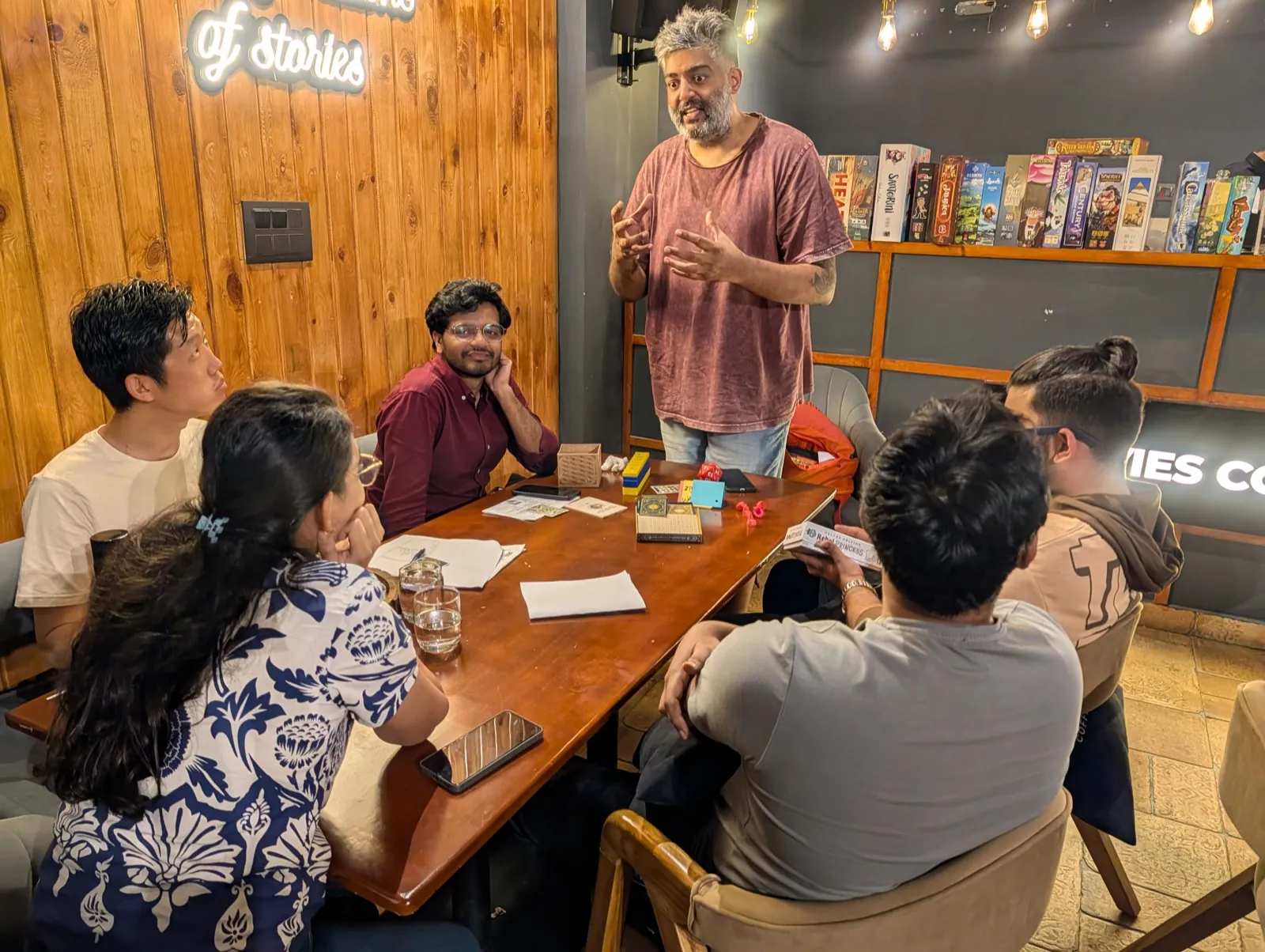
I watched it land. Five adults around a table with their phones out, looking slightly ridiculous, and about fifteen minutes later nobody was performing anything at all. People were in. Minimal displacement, if you want the tidy name for it: the closer a mechanic sits to something you already do every day, the faster the self-consciousness dissolves. Good design going invisible. That is the job.
The Timer Doesn't Need to Say Anything
Handing emotional tension over to a clock is a quietly brilliant move. The countdown never announces itself. It never asks you to feel urgent. It just runs. At ninety minutes you flip a card. At eighty you flip another. The story walks into your group chat whether or not you are ready for it. Nobody had to manufacture the pressure. It was already sitting there, structural and completely indifferent, like a deadline that doesn't care how you're feeling.
Facilitators spend years trying to do that with their voice, their presence, and a set of carefully built questions. The timer does it for free. Every glance at the countdown, every clue card that fires, every message landing while you are still reading the last one - it builds a rhythm nobody can opt out of and nobody needs to be asked to feel. The structure is doing the facilitation. The clock is the co-facilitator, and it never gets nervous.
I have designed enough corporate learning games to know how rarely this happens on its own. Usually tension has to be coaxed, propped up, occasionally faked outright. Watching a mechanic produce real stakes with no human touching it is the sort of thing you study carefully and then steal, respectfully.
The Debrief Doesn't Stand a Chance
Here is the problem the game may have built for itself on purpose: it works so well that talking about it straight afterwards feels almost rude. The debrief, that sacred moment where you pull out the meaning and turn feeling into learning, landed flat for me. Not because it was designed badly. Because the game was still going on inside everyone's chest, and we were being asked to use words.
I know this tension from my own rooms. When an experience actually lands, when it produces real emotion instead of polite engagement, the gap between the doing and the discussing has to be wider than most facilitators allow. The reflex is to debrief immediately, while it is fresh, before anyone gets clever about it. But there is a kind of fresh that just means raw. Dropping a reflection framework on that is like asking someone to write a book report while they are still crying at the end of the film. The debrief didn't fail. The timing did.
So, the lesson, shrunk to the size it deserves. If your game does its job, the room needs a minute to breathe before it is asked to think. That's it. That's the whole note.
I Built a Theory About Someone Who Doesn't Exist
The most useful failure in the whole evening is the gap between "detective game" and what this actually is. The setup promises a mystery. The art promises a mystery. Sitting in a group chat gathering clues and building a case against someone with means and motive promises a mystery. Then you find out the clues were never tools for deduction. They were narrative injections. They were telling you what happened. They were never inviting you to work it out.
CJ came out of improv. My group built that theory from the texture of the conversation and the emotional logic of the fiction we were making together. Genuinely lovely collaborative storytelling. Not mystery solving. The clue structure didn't hold it up because it was never built to - it was built to deliver a story through a group chat, and it does that beautifully. What it does not do is let you be right. There is no right to be. There is only story.
Which matters more than it sounds. The framing leans hard on the detective look and sets players up for an experience the mechanics cannot hand over. I walked in to solve something. I walked out having felt something. Both are worth having. They are not the same thing, and one of them was not what I signed up for.
What You Can Actually Steal From This
Three of these mechanics are going straight into my own work. Minimal displacement first: build the activity out of something people already do every day. Not because it is clever, but because it kills the activation energy. Nobody has to learn a new grammar before they can start, so they get to the actual content faster and stay there longer.
Timer-as-structure next. Put the tension outside the human. Don't make a facilitator generate urgency with their personality - build it into the mechanic so the person in the room can watch and listen instead of perform. And the triggered card: content that arrives at a fixed moment rather than on request. Control when things get revealed and you control the emotional arc. Simple as that.
The one thing you should not copy is the framing. If your experience has a mystery in it, tell people what kind of game they are in before you start. Solving or feeling? Detective or improviser? Both are fine. Neither is a surprise anyone should have to recover from at the end.
TLDR - Stop Pretending Participation Is the Same as Immersion
- If your mechanic mirrors what people already do every day, you don't have to convince anyone to engage.
- A countdown timer is a co-facilitator that never gets tired or nervous.
- Emotional saturation is a design outcome, not a happy accident - plan the debrief accordingly.
- Narrative injection and puzzle design are different contracts with the player. Sign the right one.
- Expectation framing is not marketing copy. It is part of the design.
- If your "mystery" game doesn't actually let players solve anything, call it something more honest.
- The clue that doesn't lead anywhere isn't a red herring. It's a broken promise.
What This Means for PutThePlayerFirst
The principle behind Alice is Missing's most successful mechanic - that proximity to daily behaviour accelerates immersion - is something I've been working toward in corporate game design for years, often without this clean a label for it. The best serious games I've built aren't the most elaborate ones. They're the ones where participants stop feeling like they're doing a training activity and start feeling like they're handling a real situation. The mechanic that achieves this isn't always a board or a card deck. Sometimes it's a familiar gesture - a conversation, a decision, a constraint that mirrors the actual texture of their working lives.
The timer lesson lands differently in an L&D context, where facilitated sessions often rely on the facilitator's personal energy to sustain engagement. I've been in rooms where the entire emotional momentum of a session was a function of one person's charisma - and watched it collapse the moment that person needed a glass of water. Structure is more reliable than performance. When tension is built into the mechanics, the human facilitator is freed up to watch, to listen, to intervene at the moments that actually need a human. That's a better use of everyone in the room.
The expectation framing critique cuts closest to home. I've watched participants in well-designed simulations become frustrated not because the experience was bad, but because they arrived expecting one type of challenge and encountered another. A negotiation simulation that's secretly about listening. A strategy game that's actually about managing uncertainty. These aren't failures - they're misaligned promises. Part of my job is to brief participants honestly about the nature of the experience before it begins, so the discomfort they encounter is productive rather than betrayed.
Alice is Missing reminded me that great design and honest design are not always the same thing. And that the gap between the two is always felt by the person sitting at the table, even when they can't name it.
I still think about CJ, though. Lovely bloke. Never existed.
With love from Bengaluru, this is Arvindh saying over and out.
See these ideas in action
Put The Player First runs serious game sessions for leadership teams across India. The designer is in the room for every session.
See the games Get in touch