Influencing Without Authority: The Game-Based Approach That Works
"You don't need a title to have power. But you do need to know how to use the power you actually have."
Most organisations work this out only after somebody has burned through their goodwill, missed three deliverables that depended on other people, or managed upward so clumsily that they're now politically radioactive and nobody has told them.
Influencing without authority is not a soft skill that some lucky people were born with. It's learnable, practisable, and probably the highest-leverage thing a professional can build at any level.
Here's what it actually involves, why it's harder than it looks, and what a game does with it that nothing else quite manages.
Why This Skill Is More Critical Than People Admit
In most organisations, the work that matters happens across lines your authority doesn't cross.
You need something from a peer in another function. You need a senior leader to care about something that isn't currently on their list. You need a team that doesn't report to you to move faster, or care more, or change direction entirely.
In every one of those, your title is either irrelevant or actively working against you. Ordering people who don't work for you around is a strategy with a very short and very well-documented shelf life.
It gets sharper in fast-scaling companies. The "just get it done" culture meets a bigger organisation where processes exist for reasons and everyone has three other priorities. The people who built the place on sheer force of will find that force of will now generates resistance instead of results. The people who joined from structured environments are baffled that their title buys them nothing at all. Both groups are lost, in opposite directions.
And the capabilities that would close that gap - working out what other people actually need, reading power accurately, negotiating without either caving or bullying, building enough trust that people move before you've formally asked - are missing from most leadership curricula. They're assumed to arrive by osmosis.
For some people they do. For most people they don't, and it shows up on the books as attrition, missed dates, and a culture nobody quite enjoys any more.
What a Game-Based Session on This Topic Actually Looks Like
Welcome to Zombiepuram is the game I built for exactly this.
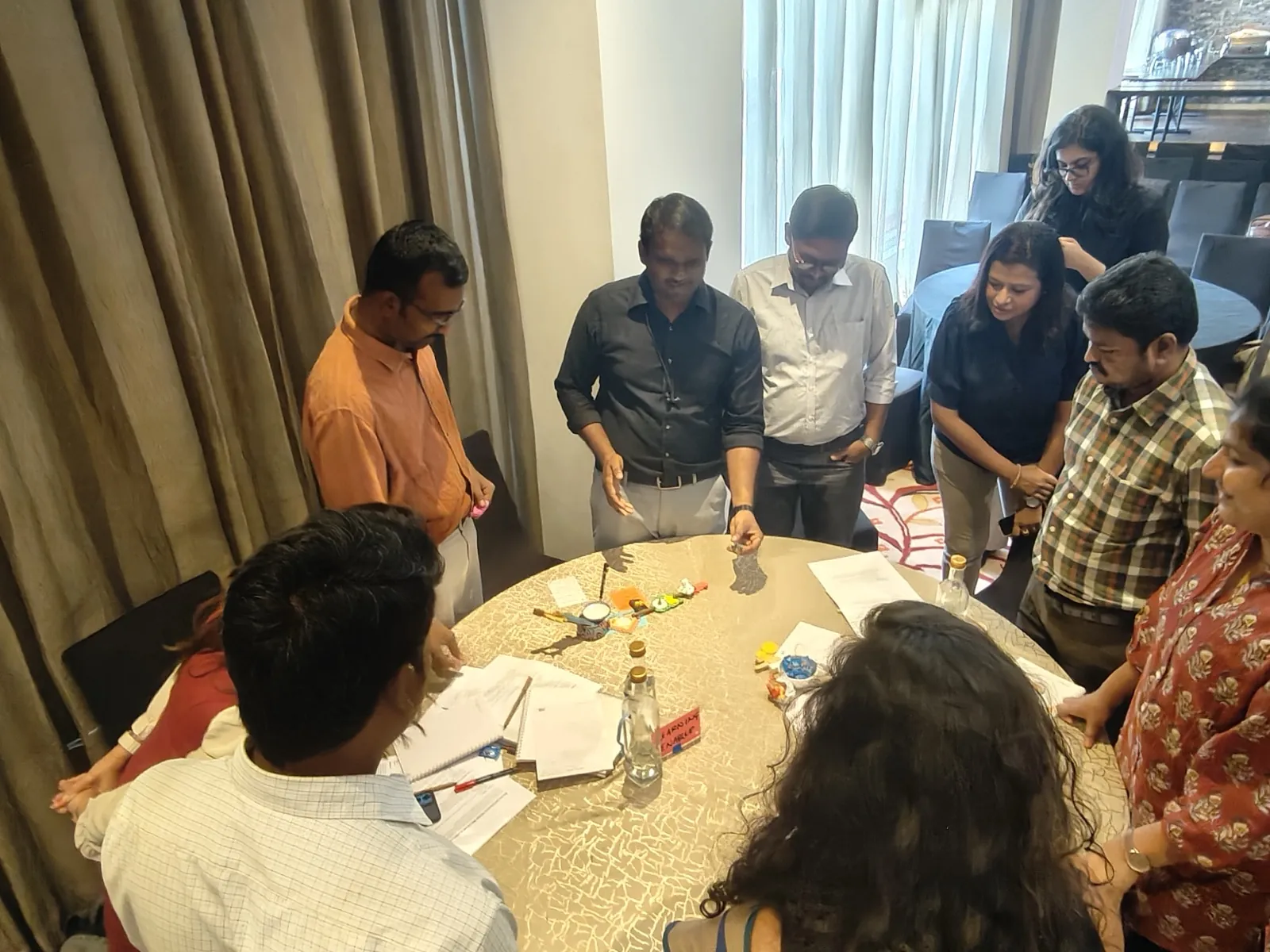
Premise: a zombie apocalypse has arrived in Bangalore. Players belong to factions. Each faction has its own goals, its own resources, and its own pieces of information nobody else has. Every player also carries a personal objective that may quietly contradict their own faction. And there's a collective goal - survival - which needs cooperation between groups with every reason to distrust each other.
Early rounds are lovely. Resources are plentiful, the threat is abstract, everyone is civil and generous.
Then it tightens. Resources thin out. Information that was freely shared an hour ago becomes a bargaining chip. Personal missions start pulling against faction ones. The map opens up a threat that needs two groups to cooperate who have already had a bad experience with each other.
And somewhere in there people stop performing how they think they should behave and just... behave.
What you get is influence, live. You can watch who builds trust through reliability and who builds it through charm. Who withholds information strategically and who does it out of pure reflex. Who negotiates towards something mutual and who treats every conversation as a thing to win. And who ignores the room's power structure entirely, right up until they get quietly frozen out of the alliance that mattered.
The Mechanics That Make It Work
A few mechanics do most of the heavy lifting.
Hidden information, so different people know different things. That maps straight onto real organisational life. The person who works out what others know and need, and trades on it, gets real leverage. The person who hoards it gets routed around, usually without ever being told.
Variable powers. Different factions can do different things. Learning to work with what you've got rather than sulking about what somebody else got is a direct rehearsal for every organisation ever, because resources are never distributed the way you'd design them.
Hidden and public goals, which create the exact tension between personal ambition and collective obligation that every professional lives inside all week.
Auctions and trading, which force negotiation into the open. Normally this stuff happens implicitly, in email threads and corridors. Put it on a table and everyone can see it happening.
None of these are decoration. Each one is in there because it produces behaviour that has a job in the debrief.
What Shifts After
The change I see after this session is more specific than framework training produces.
People stop treating influence as a thing that either works or doesn't and start treating it as something they can take apart. They build sharper maps of the power dynamics in their actual organisation - who the informal influencers are, what people genuinely care about, where information flows and where it goes to die.
They also get much clearer on the upward-sideways-downward distinction. Managing up is not managing peers, which is not leading people who don't report to you. Different read, different tactics, different timing. Zombiepuram puts you in all three at once, which gives you a felt sense of the difference that no diagram on a slide has ever produced.
And they get honest about the assertiveness spectrum. The accommodators find out what accommodating costs them. The pushers find out exactly where pushing turns into resistance. The point isn't to shove everyone towards a sensible middle. It's to widen the range of moves available, so people can choose instead of default.
The Startup That Made It Concrete
The clearest one I've got involved a company that had grown from a tight founding team into something much bigger and was not enjoying the transition.
The founders ran on trust, speed and things that never needed saying. The new hires expected process, clarity and for a title to mean something. Neither group was wrong. Both were behaving perfectly sensibly for the company they'd joined. Together they were producing friction, attrition and a lot of quietly hurt feelings.
The fix was not a slide explaining the difference between startup culture and scaled culture. It was not a values alignment session.
It was putting both groups in a game that demanded exactly the influence, negotiation and power navigation that was going wrong outside, and then sitting down afterwards and talking about what had just happened. They got a shared experience of the problem rather than a shared understanding of it. After that, the conversation about how they wanted to work together had something real underneath it.
That's what this work is for. Not to teach a model of influence, though models are useful and I'll happily give you one. To build a situation complicated enough that your actual patterns come out, and then help you see them clearly enough to choose differently next Tuesday.
That's the gap between knowing and doing. The game is the bridge.
With love from Bengaluru, this is Arvindh saying over and out.
See these ideas in action
Put The Player First runs serious game sessions for leadership teams across India. The designer is in the room for every session.
See the games Get in touch