
Innovation Workshop: How to Run One That Actually Changes Behaviour
A good innovation workshop doesn't teach people to be creative. It stages the conditions where real problem-solving behaviour comes out, then holds up a mirror so it sticks.
Most workshops skip the second half entirely. Great energy on Friday, and then Monday arrives and not much of it survives the inbox.
If you're shopping for an innovation workshop, this is what to look for, what to avoid, and why the format matters more than the topic.
Key takeaways
| Question | Short answer |
|---|---|
| What is an innovation workshop? | A structured session to build a team's problem-solving and idea-execution behaviour - ideally through practice, not lecture. |
| Why do most fail? | They reward brainstorming performance, produce sticky notes, and never change behaviour. |
| What makes a good one? | Real stakes, incomplete information, and a debrief that connects the experience to real work. |
| Best format? | A serious game beats slides - it makes actual behaviour visible and coachable. |
| Who should run it? | Someone who designs AND facilitates, so they can read the room and debrief live. |
What an innovation workshop is (and what it's not)
An innovation workshop is a session designed to improve how a team finds, frames, and solves problems - and turns ideas into action. That's the promise.
What it usually is: a facilitator, a slide deck about design thinking, a timed brainstorm, and a photo of a whiteboard covered in Post-its that nobody opens again.
Those are not the same thing. The first changes how people behave. The second changes how the afternoon felt.
Why most innovation workshops fail
Because a brainstorm rewards the wrong things. The loud, the confident, and the already-senior. It looks productive - lots of ideas, lots of noise - but most of it is performance. People say the thing that sounds smart rather than the thing that's true, because nothing whatsoever is at stake.
And you can't develop a behaviour you can't see. A whiteboard hides the exact things you're trying to build: how someone frames a messy problem, whether they listen to the quiet person with the actual answer, what they do when the obvious move fails.
I used to run it that way myself. When I was younger I taught the techniques straight - Lotus Blossom, the Two Tiger Jump, a randomisation engine to force new combinations. I was good at selling it, too; people came, attended, nodded along. But nobody thinks about what happens after the session, and most of those programs fail for the same reason: they're a band-aid. They don't solve the real problem, which is that the room never practised the behaviour - it just heard about it.
So I stopped starting with technique. Now I get people playing first, run them through a structured debrief (experience, patterns, principles, apply - EPPA), and only then bring in the brainstorming techniques, once the collaboration habit is already installed. You almost never innovate as an individual, and constraints are what make people reach for each other. Which is most of what a technique is standing on, when it works.
And the room usually tells you this before the workshop even starts. I opened a session at a Fortune 100 company once where nobody wanted to be there. Phones out, laptops open, Teams chats running. Apprehensive and shut down. No brainstorm was ever going to survive that room, because the problem was not a shortage of ideas. It was the environment.
What a good innovation workshop actually does
1. Real stakes, not hypotheticals
People behave differently when a choice has a consequence, even a playful one. Stakes strip away the performance and show you how someone actually thinks under pressure.
2. Incomplete information, on purpose
Innovation almost never fails for lack of ideas. It fails because the information is split up - across functions, across seniority, across the people who talk in meetings and the people who don't - and nobody puts the pieces together. A good workshop reproduces that on purpose, so the team has to practise doing it.
3. A debrief that reaches Monday
The half everyone skips. The activity creates the memory. The debrief turns it into a behaviour. Skip it and you've run an icebreaker with a bigger invoice.
What it looks like when it works
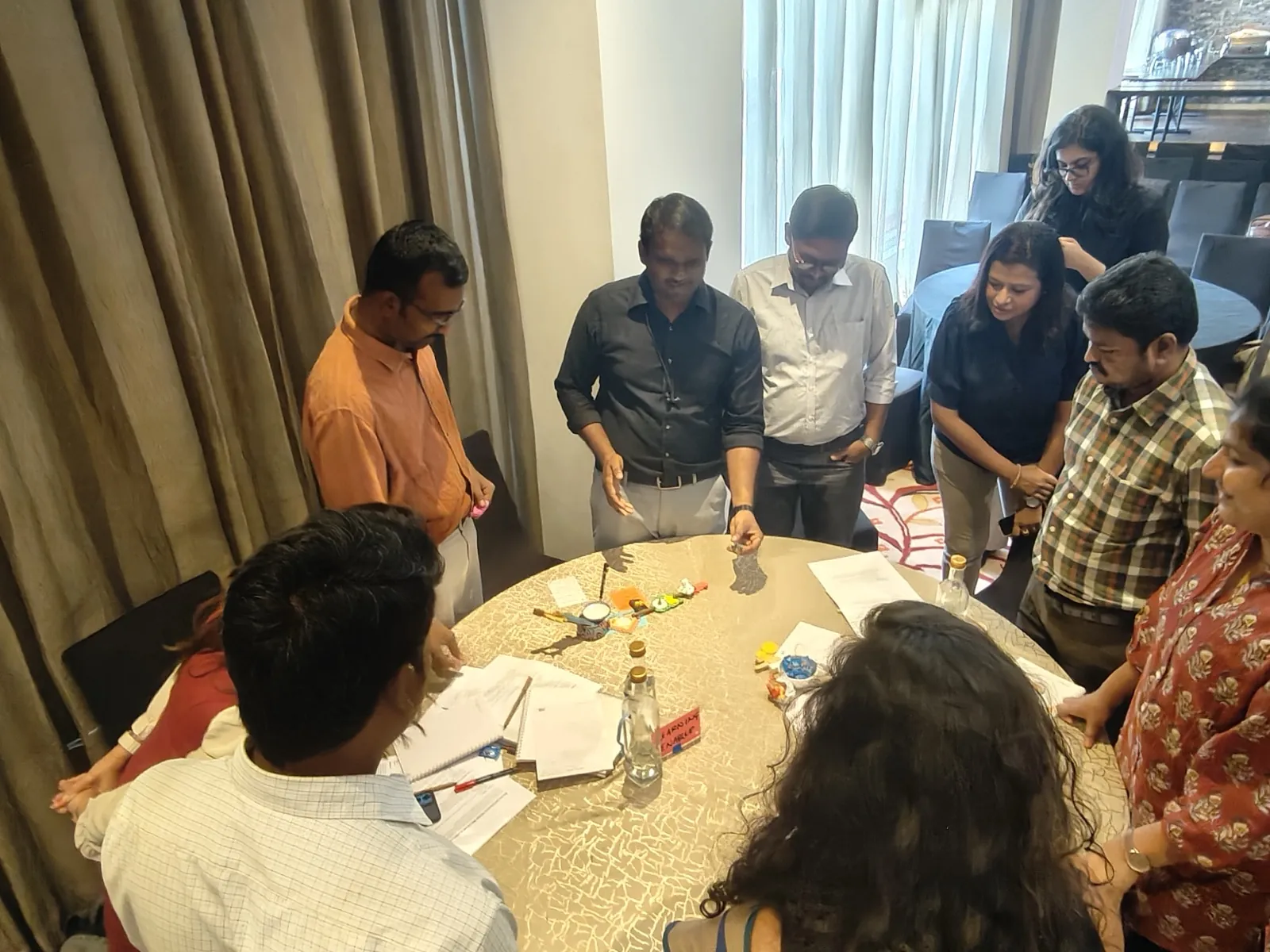
Back to that room. I opened with a game I designed called the Auction Game, which lets people feel how optimising for their own local win quietly sinks the company. That is the mindset you have to install first. Once it was in, the room was a different room.
Then we ran Lotus Blossom on a problem they actually cared about: lift the conversion rate on a key customer journey and lift the average transaction value. Cross-functional teams, mixed on purpose.
Three things changed, and I watched all three happen:
- The ideas got more inclusive. Fewer heroes, more of the room in each one.
- The ideas started combining functions instead of staying inside one team's lane.
- People began asking other functions how their work really operated, then reshaping their own idea around the answer. That is the behaviour I was after. Or most of it, anyway.
What they walked out with was not a photo of a wall. It was a shared best-practices document, the start of a Centre of Excellence, written by them. That is the most valuable thing that came out of the day, and it came out of the room rather than out of my deck.
Run it as a game, not a lecture
The fastest way to make problem-solving behaviour visible is a serious game - a designed environment with real stakes and consequences that respond to people's choices. Not gamification (points bolted onto a course). An actual game.
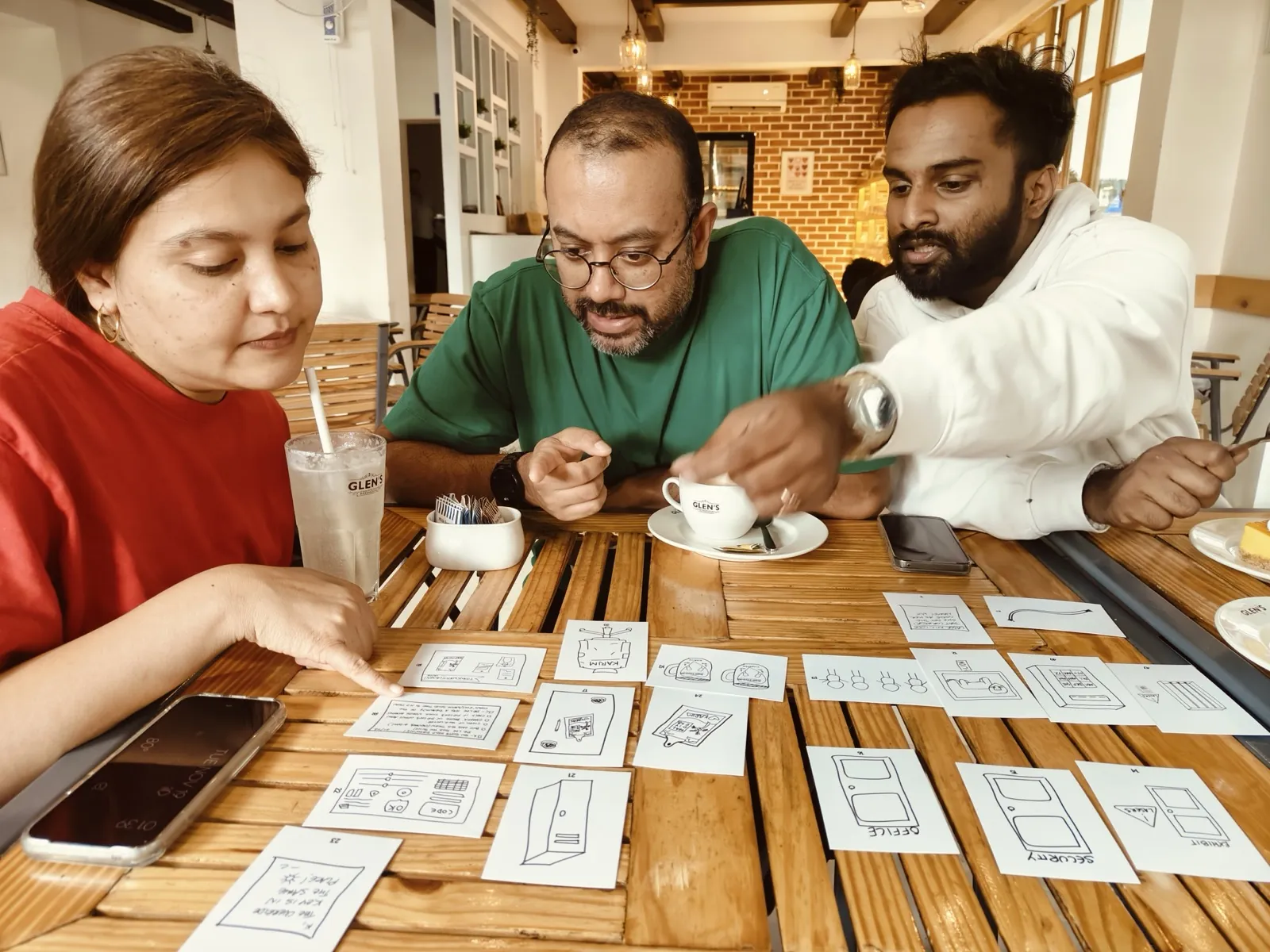
One I run for this is Sticky Fingers: an escape room in a deck of cards, where the clues are pictures split across the whole team and no one can see everything. To win, people have to listen, combine what they each hold, and separate signal from noise - under a clock. It runs at the typical 20-40 and scales up to the largest run so far - 150 people, with two additional facilitators. And the behaviour it surfaces is the same behaviour that makes or breaks innovation at work.
The debrief then does the real work: where at your job are you sitting on a card someone else needs? Whose card have you not asked for?
How to choose an innovation workshop (5 questions to ask a vendor)
- Does the person designing it also run it? If design and delivery are split, nobody can read the room and adapt the debrief live.
- What's the ratio of practice to lecture? You want participants doing most of the work, not watching slides.
- What happens in the debrief? If they can't describe how the session connects to Monday, it won't.
- Is it a game or is it gamification? Real stakes and consequences, or points and badges on a talk? These are not the same.
- What behaviour will I be able to see afterwards? A good answer names specific behaviours. A weak one says "increased engagement."
If you want the long version of this, here's my full guide on how to choose a serious games vendor.
Run it as a full programme
If you want this as a packaged, outcome-led engagement rather than a one-off session, it lives inside Practical Innovation - a program built to turn problem-solving from a slogan into a repeatable team behaviour.
Frequently asked questions
How long should an innovation workshop be?
Long enough to play, fail, and debrief. A rushed 60-minute slot almost never gets past the activity into the learning. I run these as a half-day or a full day; half a day is the sensible floor for a game-based workshop.
In-person or remote?
Both. In-person surfaces team behaviour more richly, because you can read the room. Remote works well too. Typical group size is 20-40, and I have run it for as many as 150 with additional facilitators.
Is this the same as a design thinking workshop?
Overlapping but not identical. Design thinking is one framework; running innovation as a game is about building the underlying behaviour, whatever framework sits on top.
How is this different from a team-building activity?
A team-building activity aims for bonding. An innovation workshop aims for a specific, coachable behaviour change - the game is the method, not the point.
Run an innovation workshop with your team
I design these games and I run every one of them myself. Not out of stubbornness - the value isn't the game, it's reading the room live and running the debrief that ties it to your actual work, and I can only do that with a thing I built.
If you want an innovation workshop that changes what people do on Monday, come and talk to me.
Book a discovery call WhatsApp Arvindh
Related
- Practical Innovation program
- Sticky Fingers serious game
- The complete guide to serious games for leadership development
- Serious games vs gamification
With love from Bengaluru, this is Arvindh saying over and out.