
Case Studies › Team Dynamics Pilot
Sticky Fingers: proving team dynamics in the room
A global precision-manufacturing company had a fair question. Can a game actually change how people coordinate under pressure, or is that just something game people say? One session. Their own people. Let's find out.
The Challenge
Prove the format before the rollout
They wanted better coordination under pressure. Fine, everybody wants that. What they were not willing to do was buy a rollout on the strength of a proposal.
Completely reasonable. So the pilot was the test. Prove the format on their own people, in their own building, and then talk about a rollout. I'd rather be judged that way anyway.
The Approach
The mechanic is the message
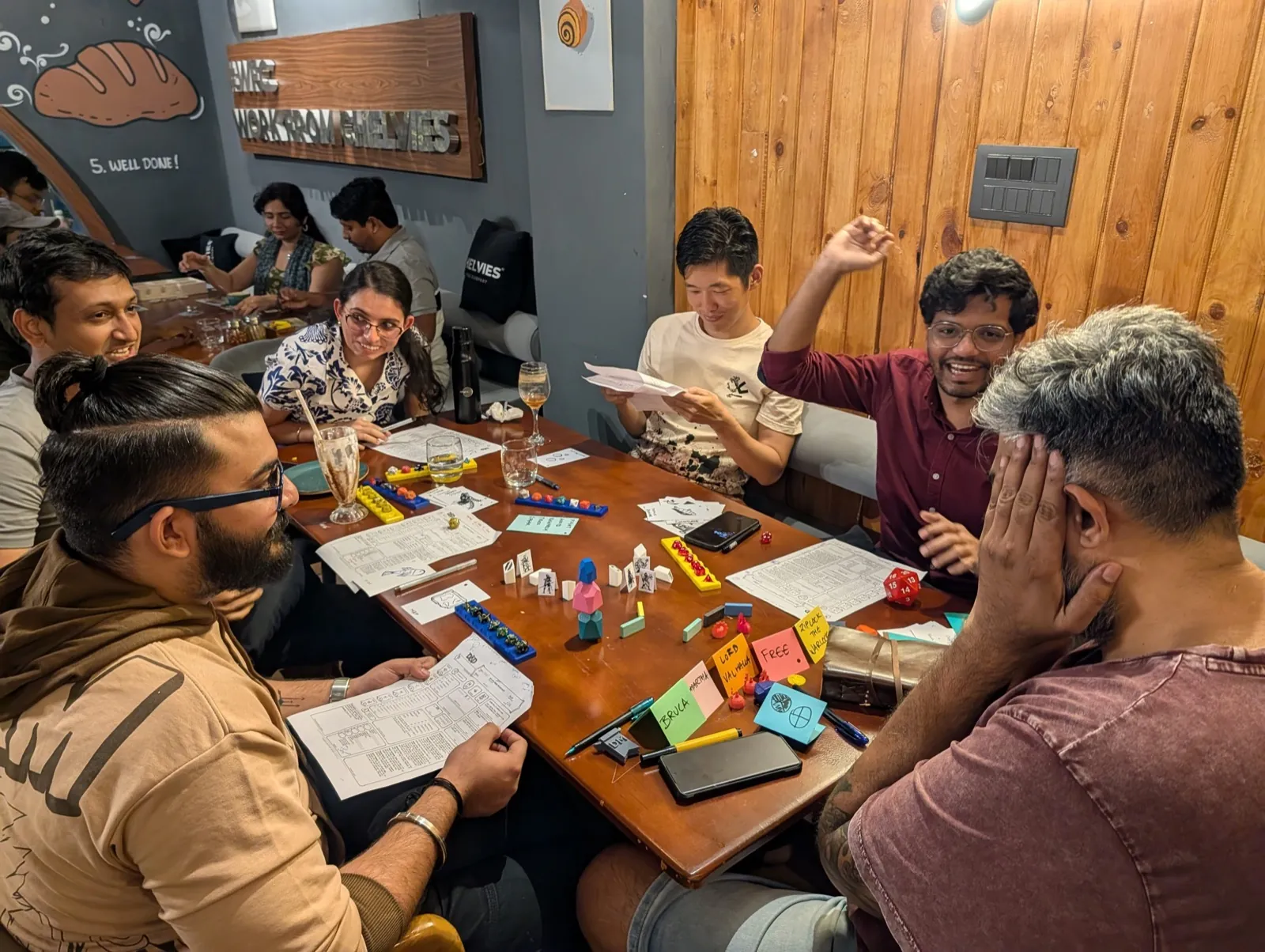
Short framing, then straight into Sticky Fingers. A card-based heist played by the whole group against a clock, with every single clue sitting in one shared pile in the middle of the table.
That pile is the entire design. Ten people, one pile, a timer running. There is no way through except self-organising. Somebody has to split the pile. Somebody has to track what has already been found. Somebody has to notice that one person has quietly gathered nine cards and stopped talking.
Nobody puts "communicate more" on a slide. The game just makes it the only thing that works, and then everybody watches themselves fail to do it for the first four minutes.
Facilitation was live and adaptive, because I designed the thing and I was standing there. So the flow bends to what the client actually asked for while it is happening. There is a tiered hint protocol held in reserve for the stuck moments, so a rough patch never sinks the session. Then the debrief maps what just happened back to collaboration, communication, and the only question that matters at the end: what are you taking back to your team on Monday?
Results
A rollout signal, not just applause
Being straight with you: this was a qualitative pilot and no feedback scores were collected on the day. So I am not going to put a number on this page that I don't have.
What it did produce is the only signal that counts at this stage.
The senior decision-maker sat in and watched the whole thing. Proof by experience rather than by pitch. Nobody had to take my word for anything.
And a multi-batch rollout went into live consideration. They already had a run of small-cohort team events planned, 8 to 10 people each. So one pilot turned into a conversation about the whole series.
Why It Worked
Four reasons the room turned
- The game forced the behaviour. One pile, one clock. Self-organising was not the recommended approach, it was the only door. They lived it instead of hearing about it.
- The person who built it was the person in the room. So the session bent towards their actual goal while it was running. A vendor who licenses a game and sends a separate facilitator cannot do that. Not won't. Can't.
- The decision-maker watched it happen. Nobody had to be persuaded afterwards. They had already seen it. Shortest path from pilot to rollout there is.
- It produced a rollout signal, not applause. Applause is lovely and means nothing by Wednesday. A series of cohorts already on the calendar means something.
Want to prove team dynamics on your own people?
Run a pilot. Watch it yourself. I design and run every one of these games personally, so there are no associates, no licensing and nobody in the middle. Come and see.
With love from Bengaluru, this is Arvindh saying over and out.