
Business Simulation for Leadership Training
Most of what ranks for this phrase is licensed software sold to everyone. This is the other kind, built around your business and played on a table.
Short answer: if you mean a multi-round model where teams set price and headcount and a spreadsheet reports the quarter, that is a real product and a good one, and it is not what I build. If you mean a situation built around your actual business that your leaders have to run against each other, in a room, with something real at stake, that is mine.
Both are called a business simulation. That is not a marketing accident, it is just an overloaded phrase, and I would rather clear it up in the first paragraph than have you find out three emails in.
The shelf model, and the one built for you
Every name that ranks ahead of this page on a clean SERP is reselling a licensed model. Built once, sold many times, the same board and the same numbers whether your business sells retail or runs a hospital.
And to be fair to them, that is not a small achievement. Getting a spreadsheet to behave like a believable quarter, and to do it consistently for a thousand different companies, is genuinely hard work. I would not want to build it myself.
It is just a different job from the one I do.
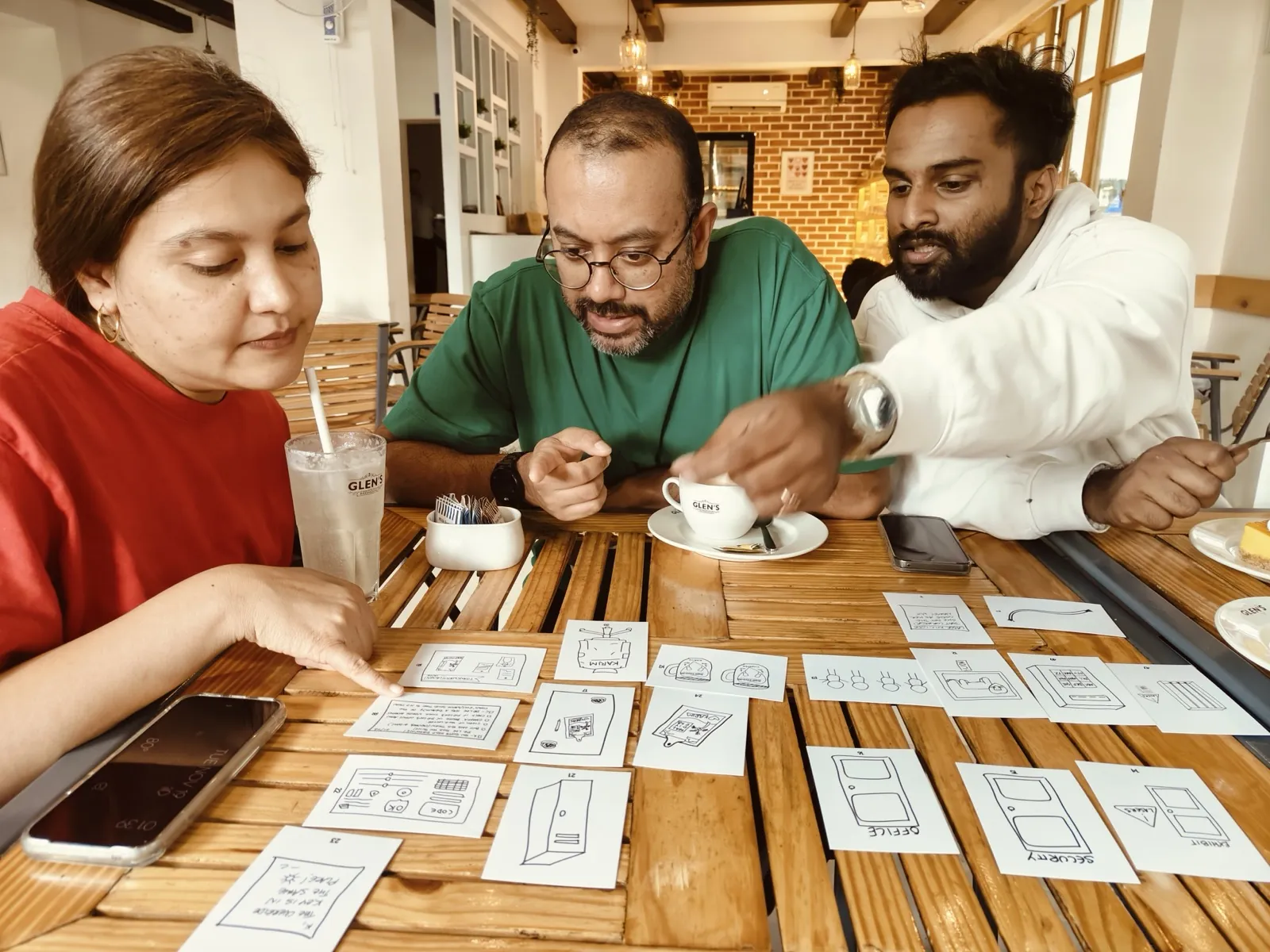
Mine is not licensed anywhere, because it is built from scratch for the business asking for it. Your org chart, your kind of scarcity, the trade-off your leadership team actually avoids in the Monday meeting. Then it goes on a table, with cards and pieces and a clock, and I sit in the room and watch what happens.
Side by side, more or less:
| Dimension | The licensed model | One built for your business |
|---|---|---|
| What it models | A generic company, applicable to most | Your company's own scarcity and trade-offs |
| Where it runs | Software, often unfacilitated | In the room, with a facilitator watching |
| What it is best at | Financial acumen, P&L intuition, scale | Who goes quiet, who takes the room, who protects their own patch |
| How it scales | To a thousand people, easily | To one room at a time, which is the point |
Financial acumen genuinely is better taught by the model that has done it for a thousand companies before yours. I would say that to your face on a discovery call. What a licensed model cannot see is which of your leaders quietly optimises for their own department when the pressure comes on, because that behaviour is specific to your team, not to business in general.
What that looks like, concretely
Ripple Effect is the simulation that sits closest to this phrase. Five players, five CXO roles, one fictional company called Ripple Water Retail. Each starts with a different resource, and there are more good projects on the table than the company can actually fund.
So they bid, they trade, they negotiate. And the interesting part is never the arithmetic.
It is which of the five decides to give something up for a project that is not theirs. Almost every group I have run it with optimises department by department, individually rational and collectively worse off, and nobody planned to do that. It is just how each of them got promoted.
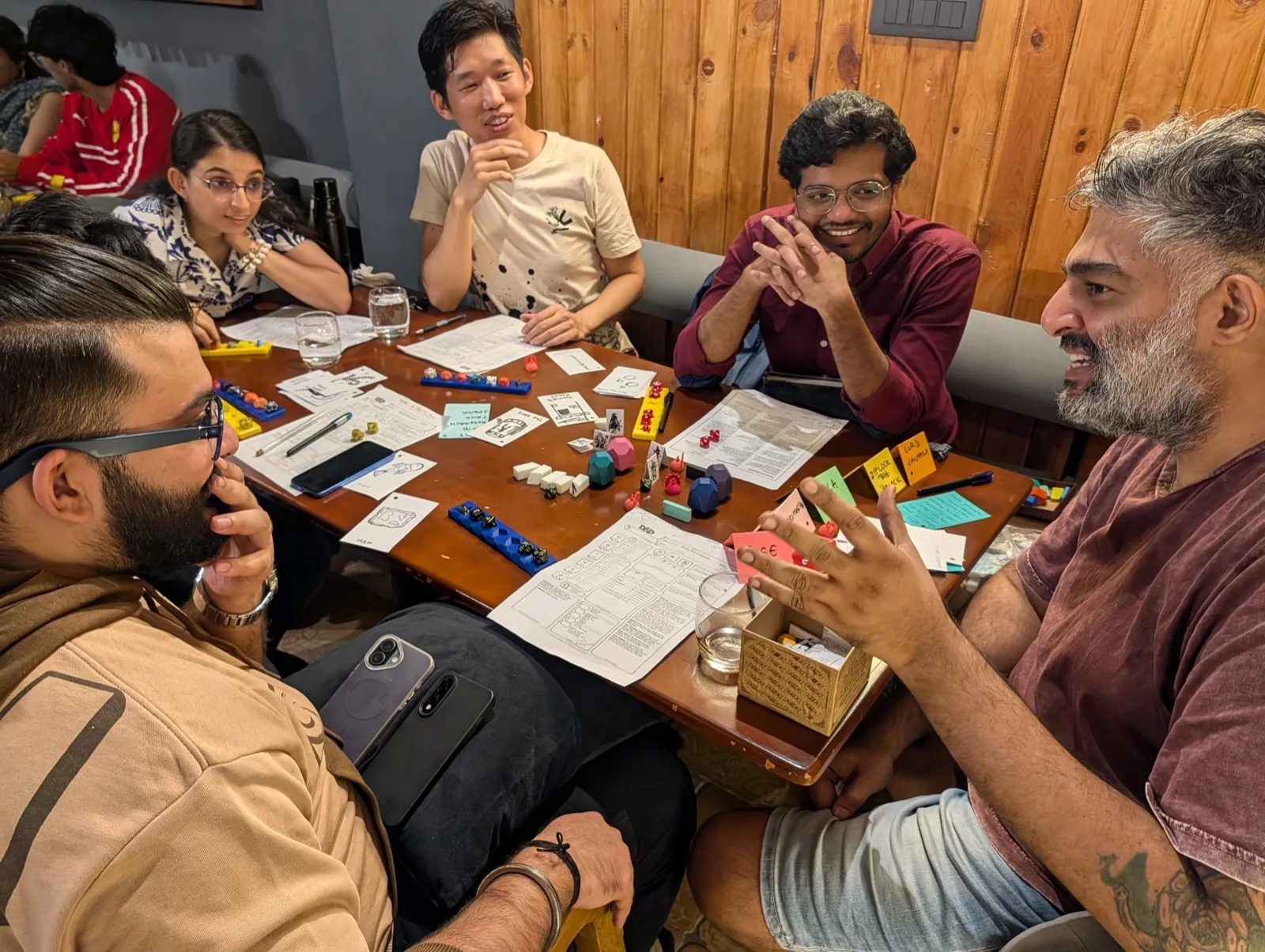
Sixteen to sixty people, about three hours including the debrief, and the debrief is where I tell that specific room what I watched them do, not a generic script about cross-functional trust.
The proof, and its limit
One Fortune-100 leadership programme ran this format across three batches and scored 9.0, 7.9, 8.4 and 8.8 out of 10 on its four session days.
That is a satisfaction score, not a behaviour score, and I would rather say that plainly than let the number do more work than it has earned. A room can enjoy an afternoon and forget it by November.
The thing I would actually point at is that the same client came back and commissioned a second, different programme. Which is not proof either, but it is the kind of evidence I trust more than a survey.
Where I would send you to a licensed model instead
If you need five hundred managers across four countries doing the same module in the same week, on their own laptops, on their own time, that is not me. I run one room at a time, and I am usually in it.
And if the actual gap is financial literacy, reading a P&L, understanding how six small decisions compound into a bad quarter, a well-built software model will teach that more efficiently than a facilitated afternoon will. I have recommended one before, and I would do it again.
Where I earn my place is the smaller, senior room where the problem is not a skill gap. It is a behaviour that only shows up when something real is at stake, and nobody in the room will name it out loud without a reason to.
Pricing, plainly
Programmes start at 50,000 rupees for a group of 15 to 25 participants. The final number depends on group size, seniority, location, and whether it is a single batch or several. Taxes as applicable.
I will get you a quote within 24 hours of a discovery call, and if the brief is a better fit for a licensed model than for mine, I will say so on that call rather than three emails later.
I only take two or three programmes a month, mostly because I design and run all of them myself. So it does fill up, and I would rather mention that now than in October.
Common Questions
What is a business simulation for leadership training?
It depends which company you ask. For most of the names you will find on page one, it is licensed software - a model built once and sold to everyone, where your team sets price and headcount for a few rounds and a spreadsheet reports back. Mine is the other kind. A situation built around your actual business, played on a table, with the trade-offs your leaders genuinely face rather than a generic one.
Is this a management training simulation game or something more serious than that?
Both, honestly, and I would not want to pretend otherwise. It is played like a game - cards, budgets, a clock, people arguing over a table. What comes out of it is not a game at all. Who protects their own department when the numbers get tight, who actually gives something up for the group, who goes quiet. That is the part a workshop slide cannot reach.
How is this different from an online business simulation?
An online business simulation is usually good at what it does, which is modelling numbers over many rounds at a scale I will never reach. Mine is in-person, on purpose, because the thing I am asked to surface is social rather than financial - who takes the room, who quietly optimises for themselves, who steps back and lets someone else absorb the cost. That needs bodies in a room and somebody watching it happen.
How many people can play, and how long does a session take?
Ripple Effect, the one that sits closest to what people mean by this phrase, runs 16 to 60 people over about three hours, including the debrief. Other simulations in the catalogue run from 45 minutes to a full day, depending on the behaviour the room needs to see rather than how much of the day has been booked.
Is there proof this actually changes anything?
There is a satisfaction score, and I will not dress it up as more than that. One Fortune-100 leadership programme that ran this format across three batches scored 9.0, 7.9, 8.4 and 8.8 out of 10 on its four session days. That tells you the room liked it, not that anyone's behaviour changed on the Tuesday after. The thing I would actually point at is that the same client came back for a second, different programme.
What does it cost?
Programmes start at 50,000 rupees for a group of 15 to 25 participants. The final number moves with group size, seniority, location and whether it is one batch or several. I will get you a real quote within 24 hours of a discovery call, and say so on the call itself if your brief is not a fit.

Related reading
- Seven leadership simulation games I designed and run in person
- Ripple Effect, the simulation itself
- Serious games for leadership development: the complete field guide
- Custom simulation design, if none of the built ones fit
Tell me about your team
If a chunk of this page was you nodding along at "the licensed model teaches the numbers, not the behaviour," that is usually the sign this is the right kind of simulation and not the other one.
Book a discovery call WhatsApp me
Or the form below, if that is easier. It all lands with me either way.
Tell me about your team
I went back and forth on whether to put a form at the end of this page.
Because a form asks you to be tidy about something you are probably still working out. And the enquiries I enjoy most tend to arrive as three messy lines, written by someone who has not finished deciding what they want yet.
So there are two ways in, and I genuinely do not mind which one you use.
Write to me directly at arvindh@puttheplayerfirst.com and say roughly what you want to change. Three lines is plenty. I read my own email.
Or fill this in, if that is easier. It lands in the same inbox.
I answer these myself, usually within a day. Two if I am in a room somewhere with my phone in a bag.
And you are not committing to anything by writing in. Worst case we have a conversation, and you come out of it with a clearer brief than you had this morning.
With love from Bengaluru, this is Arvindh saying over and out.