
 The definition nobody bothers getting right
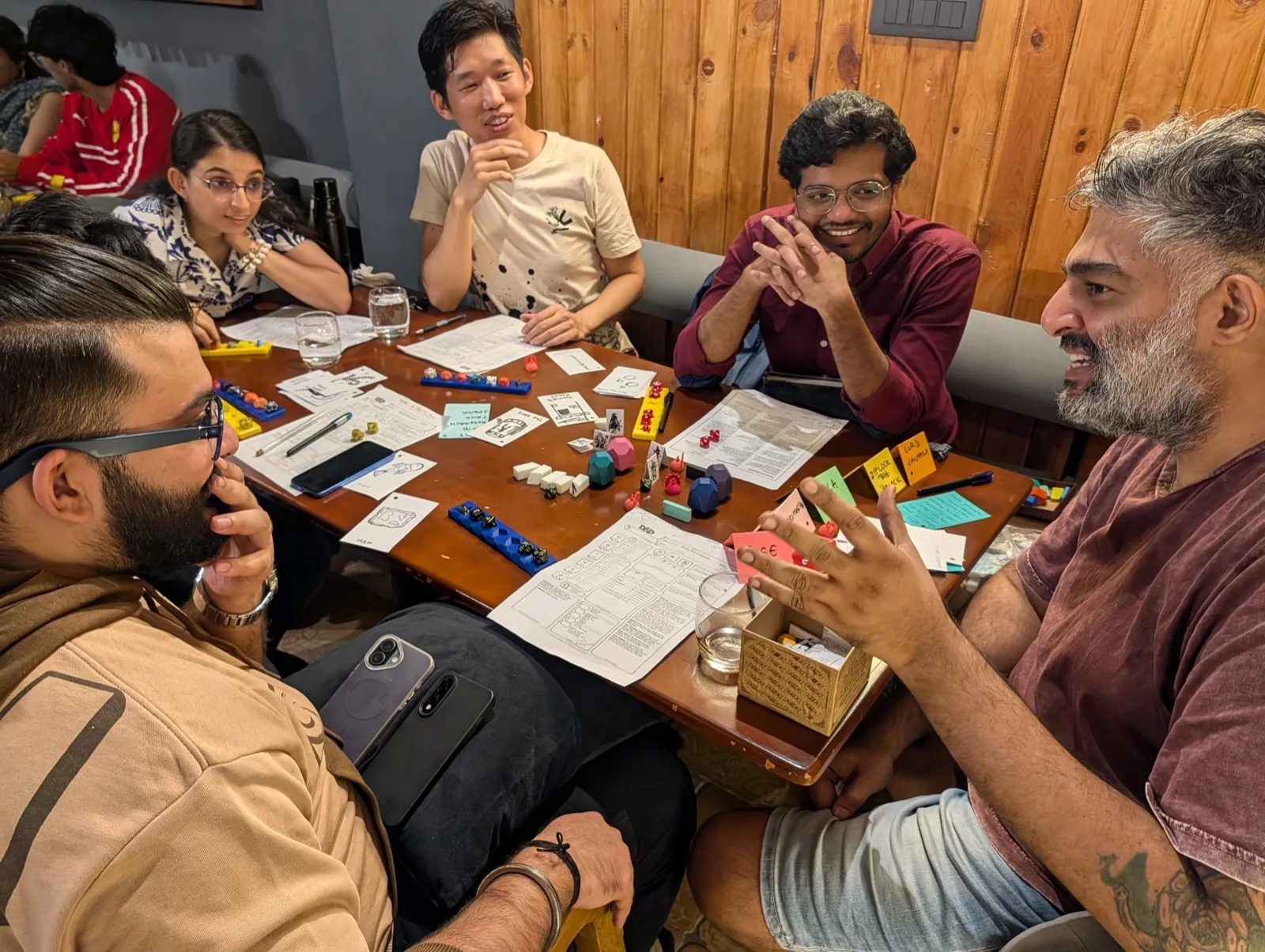
Serious games are board games, card games, or social games where learning and discovery are the primary objective, not fun. Fun usually shows up anyway - it is hard to avoid when you put adults in a room with a map, hidden information, and competing missions - but it is a byproduct of good design, not the goal. Board games are built for replayability, abstract enough to survive forty plays. Serious games are built for one afternoon that lands, where a specific behaviour comes out into the open and then gets examined, argued about, and tied to the work waiting on Monday.
The corporate training problems this handles best are skill and behaviour transfer, not knowledge transfer. If you need people to memorise a compliance framework, there are faster ways to do that. If you need someone to actually negotiate differently, or hold power without abusing it, or genuinely listen rather than wait for their turn to speak, that requires experience, not information.
 Everything in the room is there for a reason
The design starts at the end. When a brief lands, the first question is never "what game should we make" - it is "what does success look like", specifically what behaviour we want to see and what new behaviour we are trying to build. For a game about stakeholder management, I landed on gardening - players tending different plants, each with different needs and tolerances for neglect. One plant in Bloom keeps producing even when overworked, by design. In the debrief, when players realised they had been strip-mining it for output, the room went quiet. No lecture could have done that.
Everything that survives into the final game has to trace back to a debrief moment. If I cannot point at a mechanic and say exactly what it surfaces and which question I will ask about it, it comes out - however much I like it.
Serious games vs. gamified training
These get confused constantly, and conflating them costs organisations real money. Gamification takes an existing module and layers points, badges and leaderboards on top, applying external pressure to push people through content they might otherwise disengage from - the game and the learning stay two separate things sharing a screen. In a serious game the experience and the learning are fused: players interact with a designed system through its rules, and the learning emerges from what they do, how they respond to other players, what they decide under pressure. In a gamified module you are nudging people through content. In a serious game you are watching how they handle a situation, and the watching is the content.
What it looks like in the room: Welcome to Zombiepuram
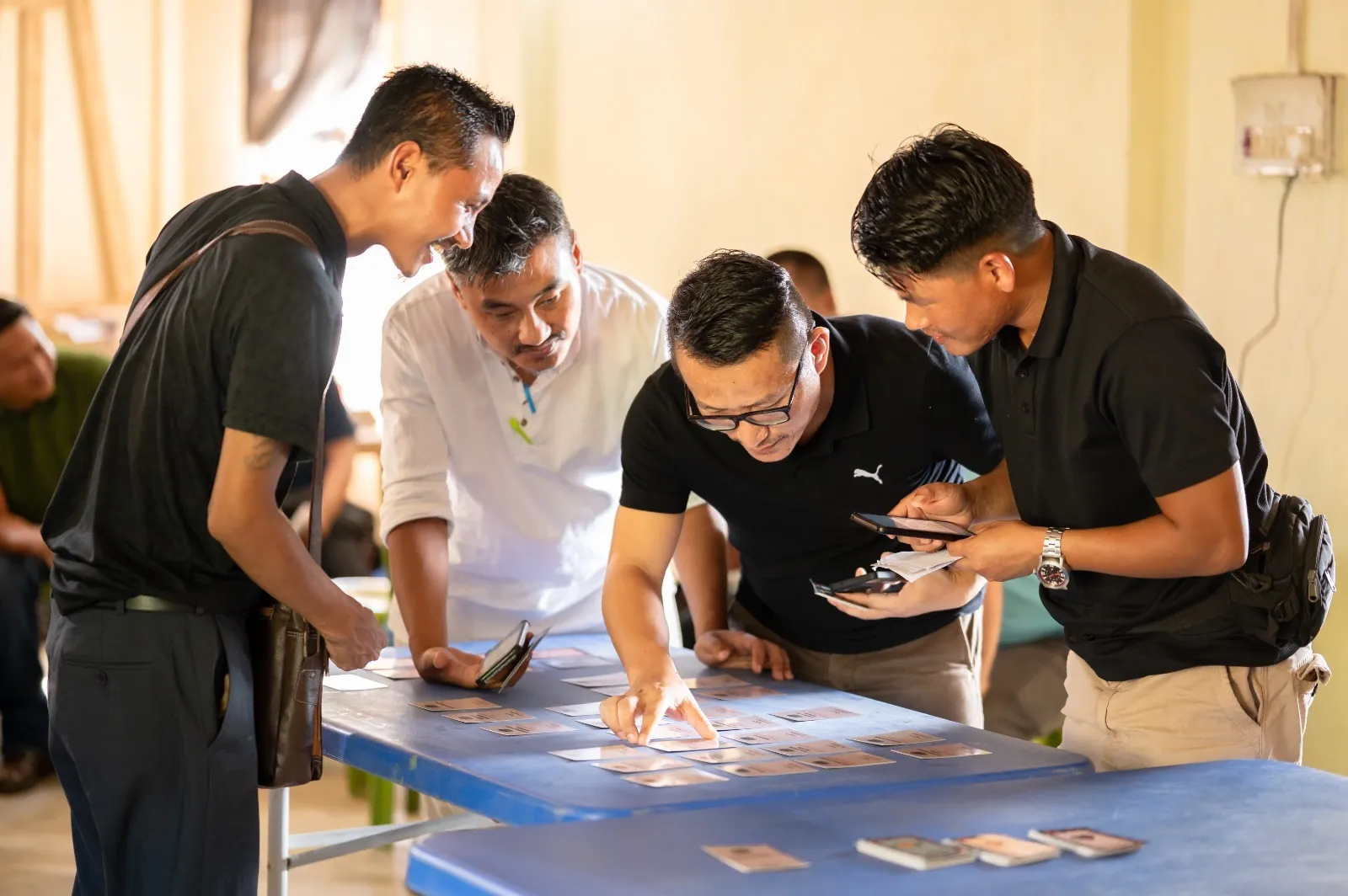
Welcome to Zombiepuram drops participants into a post-apocalyptic Bangalore. Each player belongs to a faction with its own goals, plus personal objectives and pieces of information nobody else has. The collective goal is survival; the immediate reality is that everyone needs something someone else has. What follows across multiple rounds looks chaotic from the outside - people moving around the room, making deals, sharing fragments of information, withholding others, testing who can be trusted. It is negotiation and power dynamics running in real time, unscripted, unperformed. The debrief afterward is never short of material: who gathered power through trust, who tried to accumulate it through control, what happened when someone's personal goals conflicted with the collective mission. No seminar framework produces that kind of clarity about how somebody operates when it is costing them something.
 Why I run every session myself
The physical build is iterative: notepad sketches, then Miro to lay out the full system, then low-fidelity Canva prototypes to test mechanics without getting precious about aesthetics, code to simulate game economics across thousands of playthroughs, then actual play, then revision. Polish comes only after the substance is proven - getting that order backwards is one of the most common mistakes in L&D design. And because I design and facilitate every session myself, the debrief is never a scripted lesson or a licensed hand-off. I watch how your people behave inside the simulation, then hand it back to them specifically - what they did, when, and what it cost.
What you get
- A discovery call and a written brief, tuned to your industry, your functions and the level in the room
- The game itself, half-day or full-day, run by me - the person who built it
- An EPPA debrief, designed to make behaviour visible and then say it out loud
- A written behaviour summary afterwards, ready to put straight in front of a CHRO or a leadership team
- A committed action plan from every single person in the room
And my promise: if the session does not surface at least three named leadership behaviour patterns worth changing, I redesign the next one at no cost. Nobody should pay for a session that showed them nothing.
What it costs
A day in the room runs between ₹60,000 and ₹1,00,000, plus taxes as applicable.
Half a day is half of that. So ₹30,000 to ₹50,000, plus taxes as applicable, on the same terms.
Both of those are ranges rather than a price list, and I do mean that. A short session with a lot built into it can land above a longer one with very little, so the clock is only part of it.
I put the range here because you should not have to sit through a call just to find out whether we are in the same ballpark. If that number is nowhere near your budget, you have saved yourself a fortnight and I would still rather you wrote to me and said so.
Where you land inside either of them comes down to five things, and none of them are a mystery:
- How long we are in the room. Half a day with one game and its debrief is one thing. A two-day programme is another.
- How many people are in the room, and how senior they are. Fifteen managers and sixty leaders are not the same day's work.
- How much I build from scratch. Running a game I already own costs less than designing your world, your constraints and your data into a new one.
- Whether I am leaving Bengaluru. Travel and stay are quoted separately, up front, so nothing appears on the invoice we did not talk about first.
- Whether it is one session or a series. Four batches of the same programme do not cost four times a single batch, because the design is built once.
A bespoke senior day, built from nothing, in another city, sits at the top of the band. A game I already run, one batch, here in Bengaluru, sits at the bottom. Most work lands somewhere in the middle, and I will tell you which end you are at in the first conversation rather than the third.
One honest thing about the calendar while we are being straight with each other. I take two or three engagements a month, mostly because I run every one of them myself, so dates go three or four weeks out. I would rather say that now than when you already have a date in mind.
Tell me roughly what you are trying to fix and you will have a real number, not a range, within a day of us speaking.

Frequently asked questions
What is a serious game, in the corporate training context?
A board, card or social game where learning and discovery are the primary objective, not fun. Fun usually shows up anyway - it is hard to avoid with adults in a room with hidden information and competing missions - but it is a byproduct of good design, not the goal. Every mechanic has to earn its place by doing a job in the debrief, or it does not go in the box.
How is a serious game different from gamified training?
Gamification takes an existing module and layers points, badges and leaderboards on top to push people through content they might otherwise disengage from - the game and the learning stay two separate things sharing a screen. In a serious game the experience and the learning are fused: players interact with a designed system, and the learning emerges from what they actually do under pressure, in front of colleagues, when it costs them something.
What kind of corporate training problem is a serious game actually good for?
Skill and behaviour transfer, not knowledge transfer. If people need to memorise a compliance framework, there are faster ways. But if they need to negotiate differently, hold power without abusing it, or genuinely listen instead of waiting their turn, that needs experience, not information - and a serious game is the fastest way to manufacture that experience in one room, in one afternoon.
Related
With love from Bengaluru, this is Arvindh saying over and out.